HOME DELIVERED MEALS SERVICES PROVIDER IN MISSOURI
By Fatumata Kaba · 2025-08-07 · 6 min read
ENSURING NUTRITIONAL SUPPORT FOR INDIVIDUALS WITH DISABILITIES OR CHRONIC HEALTH CONDITIONS
Home Delivered Meals Services in Missouri provide essential, nutritionally balanced food options directly to the residences of individuals who are unable to prepare meals independently due to advanced age, disability, or chronic health conditions. By operating under Missouri’s Home and Community-Based Services (HCBS) Waivers, these providers play a critical role in supporting the health, stability, and independence of vulnerable populations across the state.
Understanding the Regulatory Framework for Home Delivered Meals
The provision of home-delivered meals in Missouri is a highly regulated activity that requires coordination between several key agencies to ensure compliance with state and federal standards. The Missouri Department of Health and Senior Services (DHSS) serves as the primary entity responsible for the administration of HCBS Waiver programs. Their oversight ensures that nutritional standards are met and that services are delivered to eligible participants in accordance with their established care plans.
The Missouri Department of Social Services (DSS) manages the operational side of the provider landscape, specifically overseeing Medicaid provider enrollment and the authorization of services. Meanwhile, the federal Centers for Medicare & Medicaid Services (CMS) provides the overarching regulatory framework and federal oversight necessary to maintain the integrity of the Medicaid waiver programs. Providers must remain aligned with the directives of all three agencies to maintain their eligibility for reimbursement.
- Missouri Department of Health and Senior Services (DHSS): Administers HCBS Waiver programs and maintains quality standards for nutrition delivery.
- Missouri Department of Social Services (DSS): Oversees the Medicaid provider enrollment process and service authorization workflows.
- Centers for Medicare & Medicaid Services (CMS): Provides federal oversight to ensure state-level compliance with waiver requirements.
Operational Requirements and Service Delivery Standards
Home Delivered Meals services are highly personalized, dictated by the Individual Service Plan (ISP) or Person-Centered Plan (PCP) of each client. Because these services are designed to address specific health challenges, providers must offer more than just basic food delivery; they must offer a clinical approach to nutrition. This includes the ability to cater to medically necessary dietary requirements, such as low-sodium, diabetic-friendly, or cardiac-conscious meal preparations.
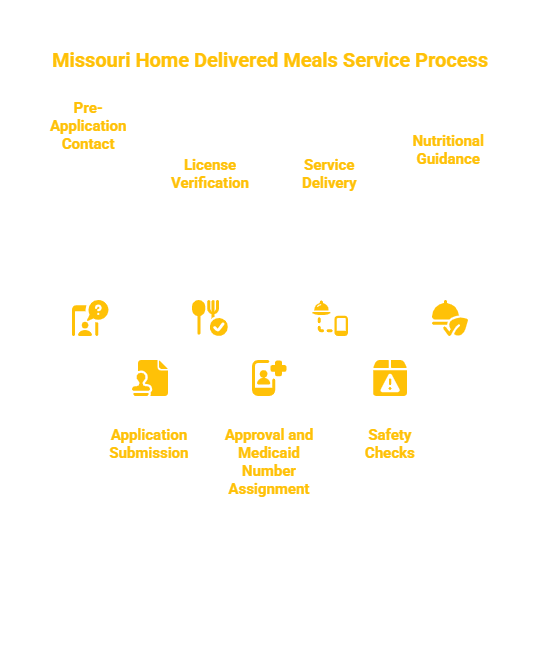
Logistics are a significant component of service delivery. Providers must be equipped to manage various distribution models, including the delivery of hot, chilled, or frozen meals depending on the client’s home setup and capability to reheat food. Furthermore, these services often serve as a vital touchpoint for the participant, involving safety checks during meal drop-offs that ensure the client is physically present and appears well, with any concerns being reported back through established communication channels.
Securing Medicaid Provider Approval and Licensing
Transitioning from a general food service business to a Medicaid-approved provider requires a structured approach to licensing and credentialing. Before beginning the application process, an agency must ensure its business structure is legally established with the Missouri Secretary of State. Obtaining a Federal Employer Identification Number (EIN) and a Type 2 National Provider Identifier (NPI) are foundational steps that precede the Medicaid enrollment application.
Regulatory compliance heavily involves the Missouri Department of Health and Senior Services regarding food safety. A valid Food Establishment Permit is mandatory for any facility preparing or handling meals for the public. Once the facility meets these health standards, the agency can proceed with the Medicaid provider enrollment process through the Missouri Department of Social Services. This process includes proving the capacity to meet both the nutritional and administrative demands of the HCBS Waiver program.
- Register the business entity with the Missouri Secretary of State.
- Secure an EIN from the IRS and a Type 2 NPI.
- Obtain the mandatory Food Establishment Permit from the Missouri Department of Health and Senior Services.
- Enroll as a participating Medicaid provider through the Missouri Department of Social Services portal.
Developing Essential Documentation and Compliance Protocols
Successful agencies maintain a robust policy and procedure manual that serves as the blueprint for daily operations. This documentation must address every facet of the meal delivery cycle, from the moment of procurement to the final delivery to the client. Regulators look for evidence that the agency has established rigorous standards for food hygiene, temperature control, and nutrient content tracking. In the event of an audit, these documents provide the necessary proof of service delivery and regulatory adherence.
The required documentation library should also include comprehensive intake and assessment forms. These records must be detailed enough to capture the client’s unique dietary needs and ensure that those needs are reflected in their service delivery logs. Furthermore, having clearly defined policies for delivery route planning, client feedback mechanisms, and infection control demonstrates to the state that the provider is fully prepared to manage the complexities of vulnerable populations.
Staffing, Credentialing, and Training Requirements
The human element of home-delivered meals is critical to both safety and compliance. A qualified Nutrition Program Manager is required to oversee the dietary aspects of the service, typically bringing professional experience in dietetics, nutrition, or food service management. This role ensures that the menus meet the specific nutritional criteria required by the Medicaid waiver programs.
Delivery personnel are the frontline representatives of the agency and must undergo rigorous vetting, including background checks and tuberculosis (TB) testing. Beyond the administrative requirements, drivers must be trained in food handling and safety regulations, infection control, and how to handle potential emergencies in a client's home. Ongoing training is a prerequisite to maintaining the high standard of care expected by the Missouri Department of Health and Senior Services.
- Nutrition Program Manager: Responsible for menu planning and dietary compliance; requires experience in nutrition or food service management.
- Meal Delivery Drivers: Must hold a valid driver’s license, possess food safety certification, and complete required background checks.
- Core Training Modules: Mandatory instruction in infection control, dietary risk management, and HIPAA-compliant client communication.
Frequently Asked Questions
What types of HCBS Waivers cover home-delivered meals in Missouri?
Home-delivered meals are generally available under the Aged and Disabled Waiver (ADW), the Independent Living Waiver, and the Medically Fragile Adult Waiver. Eligibility for these services is determined by the participant's specific care needs as identified in their Person-Centered Plan.
How long does the provider enrollment process typically take?
The timeline varies based on the agency's readiness. Business formation usually takes 1–2 weeks, followed by 30–45 days for food safety permit acquisition. The Medicaid provider enrollment process itself generally ranges from 60–90 days, provided all documentation is accurate upon submission.
What happens during a routine state audit of a meal provider?
During an audit, state representatives will review documentation of meal delivery logs, client nutritional assessments, staff training records, and food safety certifications. They verify that the services provided align with the authorizations in the client's care plan and that all safety protocols were strictly followed.
Key Takeaway: Establishing a Home Delivered Meals service in Missouri requires a rigorous adherence to both nutritional science and state administrative regulations. By aligning business operations with the guidelines provided by the Missouri Department of Health and Senior Services and the Department of Social Services, providers can ensure they are fully prepared to support the essential dietary needs of the state’s most vulnerable populations while maintaining long-term program compliance.
Last verified: September 2023. Disclaimer: This information is for educational purposes only and does not constitute legal or professional consulting advice. State regulations regarding Medicaid and HCBS waivers are subject to change. Always consult directly with the Missouri Department of Health and Senior Services or the Department of Social Services for the most current rules, forms, and guidance applicable to your agency.