HOME-DELIVERED MEALS SERVICES PROVIDER IN FLORIDA
By Fatumata Kaba · 2025-07-09 · 5 min read
Home-Delivered Meals Services are a critical component of Florida’s Medicaid Home and Community-Based Services (HCBS) framework, designed to provide nutritionally balanced, prepared meals to individuals who are unable to manage their own food preparation due to physical, cognitive, or medical limitations. By serving as an essential support for individuals aging in place or living with disabilities, this service plays a vital role in preventing malnutrition, reducing hospital readmissions, and fostering overall independence within the comfort of a participant’s own home.
Why Is Home-Delivered Meals Service Essential in the Florida HCBS Landscape?
In Florida, the demand for high-quality, reliable meal delivery services has increased alongside the growth of the state’s Long-Term Care and specialized waiver populations. These services do more than just provide sustenance; they act as a "wellness check" for vulnerable individuals. For many participants, the delivery driver is a regular point of contact, providing a crucial social connection while ensuring the participant is maintaining their nutritional intake in accordance with their physician-directed needs.
To operate effectively in this space, providers must adhere to stringent standards set by the Florida Agency for Health Care Administration (AHCA) and the Centers for Medicare & Medicaid Services (CMS). These services must align with the participant’s individualized service plan, ensuring that the meals delivered are not only nutritionally dense but also tailored to specific health requirements—such as low-sodium diets for cardiac patients or texture-modified diets for those with dysphagia.
How Are Home-Delivered Meals Regulated and Authorized?
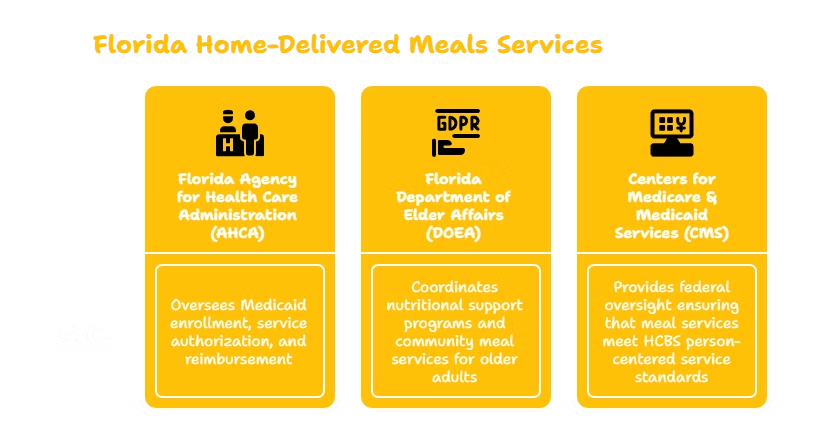
The regulatory oversight for Home-Delivered Meals is a multi-layered process involving both state and federal agencies. The AHCA serves as the primary authority, overseeing Medicaid enrollment, service authorization, and the reimbursement infrastructure. Simultaneously, the Florida Department of Elder Affairs (DOEA) provides coordination for various nutritional support programs and community meal services, ensuring that state-funded initiatives and waiver-funded services operate with a high degree of quality control.
At the federal level, the Centers for Medicare & Medicaid Services (CMS) mandates that all services meet person-centered service standards. This ensures that the individual's specific needs and preferences—including cultural, religious, or medical dietary restrictions—are honored. Providers are expected to maintain strict compliance with these mandates to ensure continuous reimbursement and to meet the high standards required for Medicaid participation.
What Are the Prerequisites for Becoming a Licensed Provider?
Establishing a Home-Delivered Meals service requires meticulous attention to business and health-safety requirements. Before initiating the AHCA enrollment process, providers must ensure their business foundation is solid. This begins with registering the entity with the Florida Division of Corporations (Sunbiz) and obtaining a federal Employer Identification Number (EIN) and a Type 2 National Provider Identifier (NPI).
Beyond standard business registration, food safety is the paramount operational concern. Providers must secure a Food Service License from the Florida Department of Business and Professional Regulation (DBPR), specifically through the Division of Hotels and Restaurants. A successful operation also requires:
- Comprehensive general liability insurance coverage.
- Validated food handler certifications for all staff members.
- Robust food safety and sanitation policies that govern preparation, storage, and transport temperatures.
- Strict adherence to USDA Dietary Guidelines and specialized nutritional requirements for medically tailored meals.
How Do You Navigate the AHCA Provider Enrollment Process?
The pathway to becoming an approved Medicaid provider is a structured, multi-phase endeavor. After ensuring your business is legally registered and properly licensed, the first step is requesting the provider application materials from AHCA. It is highly recommended that potential providers attend formal Medicaid provider orientation sessions to gain a comprehensive understanding of the billing and operational expectations.
The application phase requires submitting a suite of documentation, including articles of incorporation, proof of NPI/EIN, insurance certificates, and current food service licensure. Providers must also submit their internal policy manuals, which should clearly outline meal preparation procedures, delivery logs, and nutritional guidelines. Once documentation is submitted, the program readiness review takes place, where AHCA may inspect kitchen facilities or verify the adequacy of delivery tracking systems to ensure participants remain safe and well-nourished.
What Are the Essential Staffing and Operational Requirements?
Maintaining high service standards is dependent on a well-trained and vetted staff. Every role, from the Meal Program Manager to the delivery driver, must undergo thorough background screenings to ensure the safety of the vulnerable populations being served. Training is not a one-time event; it is an ongoing necessity to ensure consistent service delivery.
Staff must be trained in key operational areas to ensure compliance and quality:
- ServSafe food safety and sanitation protocols.
- Emergency preparedness, including contingency plans for natural disasters or equipment failures.
- HIPAA confidentiality standards and client rights awareness.
- Proper temperature control and tracking for all hot, cold, and frozen meals during the transport process.
WAIVER CONSULTING GROUP’S START-UP ASSISTANCE SERVICE — FLORIDA HOME-DELIVERED MEALS SERVICES PROVIDER
WCG supports providers and entrepreneurs in launching Medicaid-compliant Home-Delivered Meals Services under Florida’s Medicaid and HCBS waiver programs. Our scope of work includes business registration, NPI setup, food service licensing, Medicaid enrollment support, and the development of comprehensive Policy & Procedure Manuals. We also assist in building robust quality assurance programs, staff training guides, and incident tracking systems to ensure your agency is prepared for the rigorous demands of the Florida Medicaid program.
Frequently Asked Questions
What is the typical timeline for launching a Home-Delivered Meals service in Florida?
The total duration varies based on readiness, but typically ranges from 145 to 215 days. This accounts for business formation (1-2 weeks), the AHCA provider application and readiness review (60-90 days), staff hiring and training (30-45 days), and final Medicaid billing system configuration (45-60 days).
Which Medicaid waiver programs support these services?
Home-Delivered Meals are primarily authorized under the Statewide Medicaid Managed Care (SMMC) Long-Term Care (LTC) Program. Additionally, the Traumatic Brain Injury/Spinal Cord Injury (TBI/SCI) Waiver may authorize these services when nutritional support is identified as a medically necessary requirement in the participant’s service plan.
Are on-site kitchen inspections required by AHCA?
Yes, AHCA may conduct program readiness reviews that include kitchen inspections if meals are prepared on-site. This is to verify that the provider maintains compliant equipment, food preparation procedures, and the sanitation levels required to protect the health of Medicaid participants.
The successful launch of a Home-Delivered Meals provider agency requires a deep understanding of Florida’s regulatory environment and a commitment to rigorous operational standards. By prioritizing food safety, staff training, and meticulous documentation, providers can effectively meet the nutritional needs of the state's most vulnerable residents while maintaining compliance with Medicaid waiver requirements.
Last verified: 2024. The information provided in this article is for educational purposes only and does not constitute legal or professional advice. Always consult with the Florida Agency for Health Care Administration (AHCA) and relevant state departments for the most current regulatory guidance and requirements.