HOME CARE TECHNOLOGY SERVICES PROVIDER IN MISSISSIPPI
By Fatumata Kaba · 2025-08-06 · 5 min read
How Home Care Technology Services Transform Mississippi Medicaid Delivery
Home Care Technology Services in Mississippi represent a critical evolution in how the state delivers support to individuals with disabilities, chronic conditions, and age-related needs. By integrating digital tools into the Medicaid Home and Community-Based Services (HCBS) framework, providers can significantly improve care coordination, real-time health monitoring, and overall client engagement. These services act as a force multiplier for traditional care, ensuring that vulnerable populations remain safely in their homes while receiving data-driven, proactive support.
For provider agencies, entering this space requires a strategic alignment between technological capability and rigorous regulatory compliance. Mississippi’s healthcare ecosystem, overseen by the Division of Medicaid (DOM) and the Department of Health (MDH), demands that technology-assisted care is not only innovative but also deeply rooted in Person-Centered Plans (PCP) and Individual Service Plans (ISP). Success in this sector depends on a provider's ability to maintain high data security standards while effectively bridging the gap between digital solutions and clinical outcomes.
Understanding the Governance of Technology-Assisted Care
The regulatory landscape for home care technology in Mississippi is governed by three primary pillars, each serving a distinct function in ensuring participant safety and program integrity. The Mississippi Division of Medicaid (DOM) acts as the primary administrator, overseeing the HCBS Waiver programs and defining the funding parameters for technology-assisted care. Providers must strictly adhere to the policies established by the DOM to ensure that all digital services are billable and meet the specific criteria set forth in waiver guidelines.
Complementing this, the Mississippi Department of Health (MDH) holds responsibility for the regulatory oversight of healthcare technology applications, ensuring that any device or platform used in a home setting meets established health standards. At the federal level, the Centers for Medicare & Medicaid Services (CMS) provides the overarching framework for all waiver programs, ensuring that state-level delivery of services remains compliant with federal mandates. Navigating these agencies successfully requires a thorough understanding of their individual requirements for licensure, certification, and clinical reporting.
Strategic Implementation of Home Care Technology Services
Service delivery in the technology space is never a "one-size-fits-all" model. Instead, it must be tailored specifically to the Individual Service Plan (ISP) or Person-Centered Plan (PCP) of the individual participant. Providers utilize a variety of tools, ranging from telehealth consultations and remote chronic condition monitoring to the deployment of Personal Emergency Response Systems (PERS). These tools allow for a continuous flow of information, enabling care teams to identify health complications before they necessitate hospital readmission.
Beyond hardware, effective service delivery includes sophisticated digital care coordination platforms and data analytics. These systems allow providers to aggregate data to optimize care reporting and monitor client trends over time. When selecting these technologies, providers must prioritize interoperability, user-friendliness for the participant, and robust data security features to maintain compliance with federal privacy standards. Proper deployment includes not just the hardware installation, but the active management of the data generated by these systems.
- Telehealth services for remote clinical consultations.
- Remote monitoring for real-time chronic condition management.
- Personal emergency response systems (PERS) for immediate crisis intervention.
- Medication management systems, including automated dispensing technology.
- Digital care coordination platforms to streamline communication between stakeholders.
- Data analytics for longitudinal care optimization and regulatory reporting.
Navigating the Provider Enrollment and Approval Process
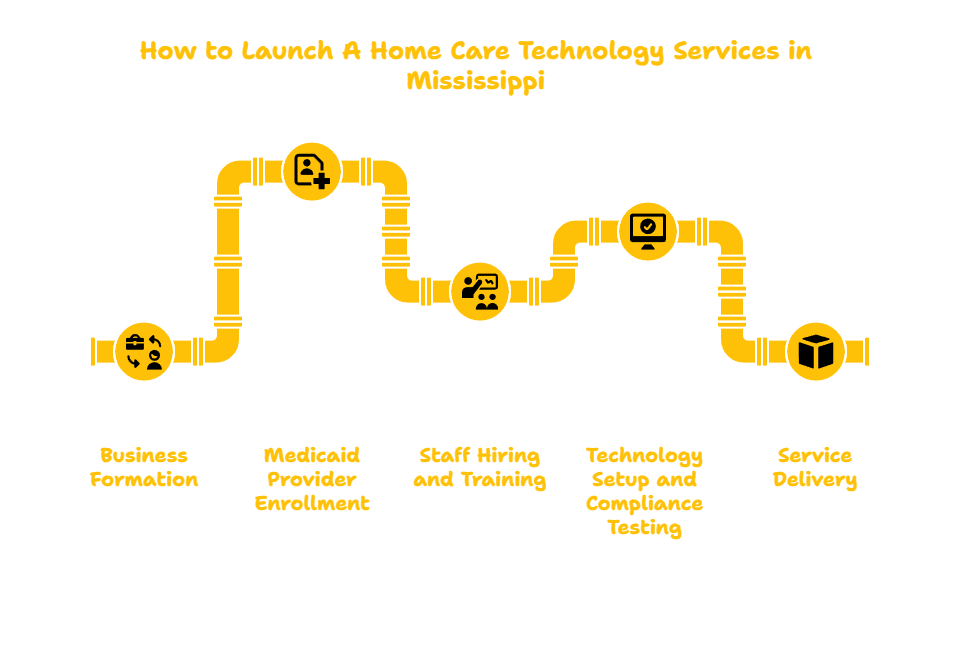
Enrolling as a Medicaid provider for technology services is a structured, multi-phase process that begins well before the submission of formal applications. Prospective agencies must first establish a formal business entity, register with the Mississippi Secretary of State, and obtain an IRS EIN and a Type 2 NPI. Because this field involves sensitive health data, providers should also be prepared to provide proof of Health IT certification where required, as this verifies that the technology infrastructure meets the security standards mandated for medical information.
The application journey involves a pre-application phase, where providers should engage with the Mississippi Division of Medicaid to clarify specific requirements for technology-assisted services. Following this, the formal submission of business credentials, insurance documentation, and service descriptions initiates the verification process. The final step involves a rigorous audit of the agency’s capacity to adhere to state and federal regulations, culminating in the assignment of a Medicaid provider number, which serves as the official authorization to begin billing for services delivered under the HCBS waivers.
Operational Requirements for Staffing and Compliance
Operational success in this field relies on maintaining a specialized workforce that understands both the clinical and technical aspects of home care. A Health Technology Coordinator is often essential to oversee the deployment of systems and ensure that digital solutions align with the broader healthcare goals of the participant. Furthermore, Remote Monitoring Technicians are required to handle the daily oversight of data streams, troubleshoot technical issues for the client, and escalate clinical alerts to appropriate personnel when necessary.
Training programs must be comprehensive, covering not only the technical operation of platforms but also the nuances of HIPAA compliance and data privacy. Because the staff often serves as the first point of contact for a client experiencing technical frustration or a health emergency, training must emphasize emergency response protocols and empathetic user support. Documenting these training efforts is a critical component of state compliance, as agencies will be audited on their ability to prove their staff is adequately prepared to handle technology-assisted care environments.
Frequently Asked Questions
Which Medicaid waiver programs cover home care technology in Mississippi?
Home Care Technology Services are currently integrated into the 1915(c) HCBS Waiver for the Elderly and Disabled, the Independent Living Waiver, and the Technology-Assisted Care Waiver. Providers must ensure their service offerings align with the specific definitions and limitations found within these waiver documents.
What documentation is critical for an initial Medicaid audit?
Agencies should maintain a comprehensive policy and procedure manual that details technology deployment, user training, data security protocols, and HIPAA compliance. Additionally, you must keep records of your business registration, NPI confirmation, liability insurance, and documented logs of client onboarding and technical troubleshooting.
What is the typical timeline to launch a technology-based agency?
While timelines vary based on individual readiness, the total launch process generally spans several months. Business formation takes 1-2 weeks, followed by a 60-90 day window for Medicaid provider enrollment, 30-45 days for hiring and training staff, and 2-4 weeks for final technology setup and compliance testing.
Key Takeaway
Successfully launching a Home Care Technology Services agency in Mississippi requires a disciplined approach to both the technical and regulatory requirements of the Medicaid HCBS program. By focusing on compliant infrastructure, specialized staffing, and seamless integration with state-approved waiver services, providers can build sustainable operations that offer significant improvements in client care quality and operational efficiency.
Last verified: October 2023. Disclaimer: This information is for educational purposes only and does not constitute legal or professional consulting advice. Requirements for Medicaid programs are subject to change by the Mississippi Division of Medicaid and the Centers for Medicare & Medicaid Services (CMS). Always verify the most current state regulations and policy manuals before making business decisions.