HOME CARE SERVICES PROVIDER IN KANSAS
By Fatumata Kaba · 2025-07-24 · 6 min read
Navigating the Landscape of Home Care Services in Kansas
Home Care Services in Kansas provide essential personal and supportive assistance to individuals who prefer to live independently at home but require support with daily activities due to aging, disability, or specific medical conditions. These services are authorized through Kansas Medicaid (KanCare) under Home and Community-Based Services (HCBS) waiver programs, which are designed to reduce institutionalization and significantly improve the quality of life for vulnerable populations across the state.
Operating a home care agency in Kansas requires a deep understanding of the regulatory framework established by the Kansas Department of Health and Environment (KDHE) and the Kansas Department for Aging and Disability Services (KDADS). Prospective providers must navigate rigorous credentialing, compliance, and enrollment processes to ensure they can deliver high-quality, person-centered care that meets federal and state standards.
Understanding the Governance and Oversight of HCBS Providers
The Kansas HCBS delivery system is structured through a collaborative framework involving both federal and state authorities. The Kansas Department of Health and Environment (KDHE) - Division of Health Care Finance serves as the primary administrator for Medicaid coverage, overseeing provider enrollment and the reimbursement mechanisms necessary for financial sustainability. Meanwhile, the Kansas Department for Aging and Disability Services (KDADS) is responsible for defining the scope of services and establishing the quality standards that all providers must uphold to maintain their status within the HCBS waiver system.
In addition to state-level oversight, providers must interface directly with Managed Care Organizations (MCOs) under the KanCare program. These organizations act as the front line for provider management; they are responsible for authorizing individualized service plans, credentialing new providers into their networks, and managing the claims processing and outcomes reporting that ensure service delivery meets the specific needs of each participant.
- Kansas Department of Health and Environment (KDHE): Manages Medicaid policy and reimbursement.
- Kansas Department for Aging and Disability Services (KDADS): Sets quality standards and defines service scopes.
- Centers for Medicare & Medicaid Services (CMS): Sets federal compliance and person-centered care mandates.
- Managed Care Organizations (MCOs): Handle credentialing, authorization, and claims management.
Defining the Scope of Authorized Home Care Services
Home care services are categorized into personal care and supportive home assistance, aimed at maintaining the health, safety, and independence of the participant within their own home. All authorized services must be explicitly listed in the participant’s Individualized Service Plan (ISP) to ensure the care provided aligns with their waiver eligibility and level of care requirements.
Providers are expected to assist with a range of activities designed to mitigate the risks of living alone. This includes help with Activities of Daily Living (ADLs) such as bathing, dressing, grooming, toileting, and mobility. Beyond personal care, providers offer essential supportive services that maintain a sanitary and functional living environment, including light housekeeping, meal preparation, medication reminders, and safety monitoring to prevent falls.
Essential Requirements for Licensing and Provider Approval
Establishing a home care agency involves a multi-step administrative process to ensure the business is legally prepared to interact with state systems. Before seeking Medicaid enrollment, owners must register their business with the Kansas Secretary of State and obtain an IRS Employer Identification Number (EIN) and a Type 2 National Provider Identifier (NPI). These foundational steps provide the legal and administrative infrastructure necessary to transact with KMAP and the regional MCOs.
Operational readiness is equally critical. A new provider must develop a comprehensive Policy & Procedure Manual that covers HIPAA compliance, emergency procedures, staff credentialing, and detailed protocols for participant safety. Agencies are also required to maintain adequate general liability and workers’ compensation insurance to protect the business and the individuals receiving care. Hiring qualified home care aides or Certified Nurse Aides (CNAs) requires robust background check systems and ongoing training to ensure staff are prepared to provide high-quality, safe care.
Streamlining the Kansas Provider Enrollment Process
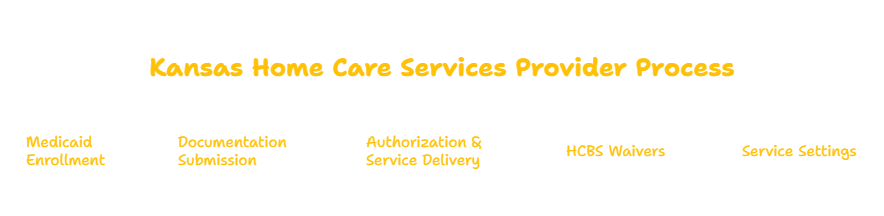
The enrollment path is structured into distinct phases, beginning with formal registration through the Kansas Medical Assistance Program (KMAP). During this initial phase, the agency must register as a Personal Care Services or Home Health Aide provider. Following state registration, the provider must undergo credentialing with each of the KanCare MCOs—Sunflower Health Plan, UnitedHealthcare Community Plan, and Aetna Better Health of Kansas—to gain access to their provider networks.
Once credentialed, the agency must focus on administrative readiness by submitting all required documentation, including internal policies, insurance verification, and staff qualification records. The final stage involves coordinating with waiver case managers to accept new participants. When a client is assigned, the agency submits the required service authorizations to the MCO; once approved, the agency can commence service delivery and begin submitting claims for reimbursement using the appropriate HCPCS codes.
- Phase 1: Register with KMAP and obtain an NPI.
- Phase 2: Credential with each of the three KanCare MCOs.
- Phase 3: Submit all organizational policies and staff documentation.
- Phase 4: Coordinate service authorizations with waiver case managers.
Maintaining Compliance Through Accurate Documentation
Maintaining a high standard of documentation is a regulatory necessity for any Kansas HCBS provider. Agencies must keep meticulous records that are "audit-ready" at all times. This includes maintaining clear care plan templates, daily service logs, ADL checklists, and records of all staff orientations and continuing education sessions. Ensuring that every interaction is recorded accurately is the foundation of successful Medicaid billing and ensures the agency remains in compliance with state and federal standards.
Furthermore, the Policy & Procedure Manual must be a living document that includes protocols for infection control, grievance procedures, participant rights, and incident reporting. Should an incident occur during the provision of care, having a pre-established reporting mechanism is vital to fulfilling regulatory requirements and maintaining the safety of the participant. HIPAA compliance must be woven into every facet of these records, ensuring that participant data remains secure and confidential throughout the billing and care coordination process.
Frequently Asked Questions
What is the typical timeline to launch a home care agency in Kansas?
The startup process generally spans several months. Business registration and policy development typically take 1–2 months, followed by 1–2 months for staff hiring and Medicaid enrollment. MCO credentialing takes approximately 60–90 days, and the final service launch and claims setup phase takes 30–45 days.
Which HCBS waivers cover home care services?
Home care services are provided under several HCBS waivers, including the Frail Elderly (FE) Waiver, Physical Disability (PD) Waiver, Brain Injury (BI) Waiver, Intellectual/Developmental Disability (IDD) Waiver, and Technology Assisted (TA) Waiver. Access to these services is strictly based on the individual’s assessed needs and their authorized Individualized Service Plan.
Are Certified Nurse Aides (CNAs) required for all home care staff?
Requirements for staff credentials depend on the specific waiver service being provided. While general home care aides are often required to have experience in caregiving and must pass rigorous background checks, certain specialized waiver services may require the staff to be a certified nurse aide. Always check the specific provider manual for the waiver program in which you are participating.
Key Takeaway
Launching a home care agency in Kansas is a complex but rewarding process that centers on rigorous administrative compliance, thorough documentation, and a deep commitment to the HCBS waiver requirements. By aligning agency policies with the standards set by KDADS, KDHE, and the KanCare MCOs, providers can successfully deliver the supportive services necessary to empower Kansans to live with dignity and independence in their own homes.
Last verified: 2024. This information is intended for educational purposes for home care providers and does not constitute legal or financial advice. Regulations for Medicaid HCBS programs are subject to change; always consult with the official Kansas Medical Assistance Program (KMAP) bulletins and the respective Managed Care Organization provider manuals for the most current requirements.