HOME AND VEHICLE MODIFICATION SERVICES PROVIDER IN MASSACHUSETTS
By Fatumata Kaba · 2025-08-07 · 5 min read
ENHANCING ACCESSIBILITY AND SAFETY THROUGH MEDICAID-FUNDED ENVIRONMENTAL ADAPTATIONS FOR INDIVIDUALS WITH DISABILITIES
Home and Vehicle Modification Services in Massachusetts are critical supports that empower individuals with disabilities to maintain independence within their homes and engage with their communities through specialized transportation adaptations. These services are provided under various MassHealth Home and Community-Based Services (HCBS) waivers and the Money Follows the Person (MFP) program, requiring providers to possess both technical construction expertise and a thorough understanding of Medicaid compliance standards.
What Are the Governing Agencies and Regulatory Frameworks?
The delivery of environmental modifications in Massachusetts is governed by a multi-tiered regulatory structure. The Executive Office of Health and Human Services (EOHHS) maintains overall responsibility for waiver and MFP environmental adaptation policy and funding, while MassHealth serves as the primary entity responsible for authorizing and reimbursing these modifications under waiver plans.
Beyond general oversight, specific state departments manage the coordination of services for distinct populations. The Department of Developmental Services (DDS) oversees waiver services for individuals with intellectual and developmental disabilities, while the Massachusetts Rehabilitation Commission (MRC) facilitates home and vehicle modification programs tailored to individuals with physical disabilities. At the federal level, the Centers for Medicare & Medicaid Services (CMS) provides the necessary oversight and funding framework that sustains these HCBS initiatives.
What Scope of Services Is Covered Under Medicaid Waivers?
Home and vehicle modifications are defined as non-medical, structural adaptations designed to mitigate physical barriers, thereby enhancing the safety, mobility, and independence of the participant. These services are pre-authorized and must be integrated into the individual’s Plan of Care (POC) or Individual Support Plan (ISP) to ensure medical necessity and cost-effectiveness.
Home modification services often involve structural changes such as the installation of ramps, stair lifts, widened doorways, roll-in showers, and accessible kitchen reconfigurations. Vehicle modification services focus on adaptive mobility, including the installation of wheelchair lifts, securement systems, transfer seating, and specialized driving controls. Providers must ensure that all work adheres to strict project planning requirements, including the submission of detailed contractor bids and cost estimates prior to project commencement.
What Are the Licensing and Provider Approval Requirements?
Establishing a service agency requires rigorous adherence to state and federal prerequisites. Providers must first register their business with the Massachusetts Secretary of the Commonwealth and obtain an IRS Employer Identification Number (EIN) and a Type 2 National Provider Identifier (NPI). Demonstrating financial responsibility through comprehensive general liability and workers’ compensation insurance is also mandatory for all entities operating within the HCBS ecosystem.
Operational compliance is equally stringent, requiring valid contractor licenses for structural home renovations and specific automotive modification certifications for vehicle projects. Furthermore, all providers must demonstrate compliance with the Americans with Disabilities Act (ADA), HUD requirements, and all relevant state building codes. Establishing formalized, written internal policies—covering project management, safety protocols, and documentation—is a critical step in achieving and maintaining provider approval.
How Do Providers Navigate the Enrollment Process?
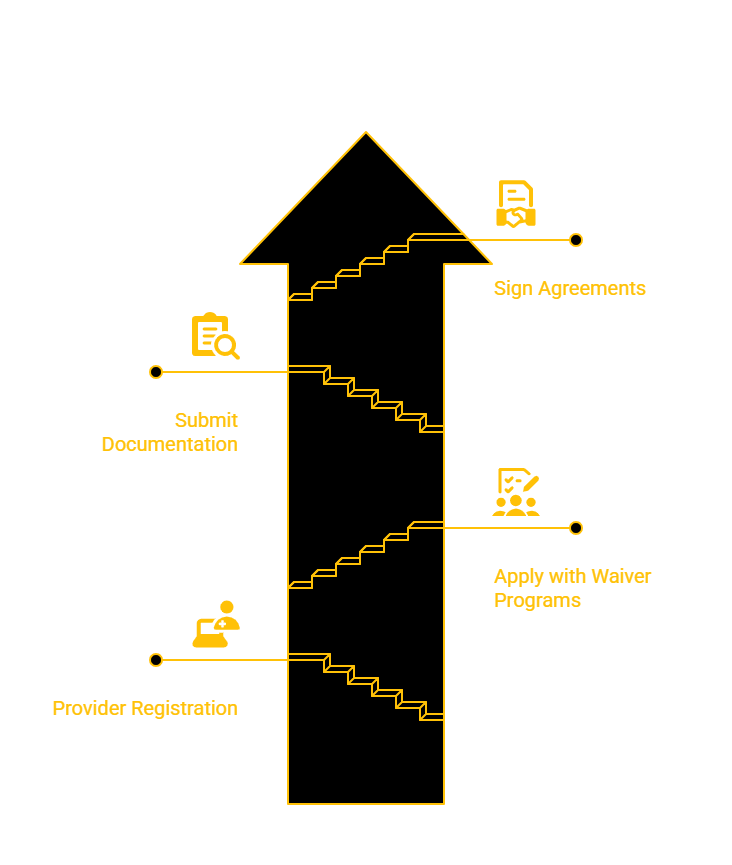
The path to becoming a Medicaid-approved provider is a structured, multi-step process. The journey begins with registration in the MassHealth Provider Online Service Center (POSC). Following initial enrollment, providers must apply specifically to the waiver programs they intend to serve, such as DDS for developmental disability waivers or the MRC for institutional transition and home access supports.
- Submit formal documentation including business filings, EIN, and Type 2 NPI.
- Provide verifiable credentials, including contractor licenses and automotive modifier certifications.
- Develop a comprehensive Environmental Modification Policy & Procedure Manual that includes bidding templates, safety assessment forms, and billing audit records.
- Execute final provider agreements with the respective state departments to begin receiving referrals through care coordination channels.
What Are the Essential Staffing and Training Mandates?
Success in this field relies on maintaining qualified staff who understand both the construction industry and the specific requirements of the Medicaid HCBS population. The Project Manager or Modification Coordinator serves as the central point of contact, requiring a background in construction or occupational therapy to oversee the alignment of project scope, budget, and clinical necessity.
For technical execution, the agency must employ licensed contractors who hold a Massachusetts Construction Supervisor License (CSL) or a Home Improvement Contractor (HIC) license. Vehicle modification work necessitates technicians with specific automotive certification, such as QAP or NMEDA credentials. Ongoing staff training is mandatory, focusing on ADA accessibility standards, structural integrity, infection control—particularly for participants transitioning from clinical settings—and strict adherence to Medicaid billing and documentation compliance.
Frequently Asked Questions
What documentation is required to ensure a project is audit-ready?
Providers must maintain exhaustive records including, but not limited to, initial safety assessment templates, approved cost proposals, project approval checklists, and photographic evidence of the work before and after completion. All service logs, warranties, client satisfaction surveys, and final contractor invoices must be archived to satisfy potential state or federal audits.
Are there restrictions on the types of modifications that can be funded?
Yes, all modifications must be medically justified, cost-effective, and directly related to the individual’s functional limitation. Medicaid will not fund modifications that are considered general home maintenance or improvements, nor will it duplicate coverage provided by other sources like HUD or Section 8 housing programs.
How does the referral process function for new providers?
Once enrolled, providers coordinate directly with support coordinators, transition teams, and case managers. These professionals conduct the initial home safety assessments and determine the individual’s waiver eligibility. Providers are then contacted to review the specific modifications needed, submit their formal bids, and coordinate the project timeline with the participant’s care plan.
Key Takeaways for Prospective Providers
Becoming an environmental modification provider in Massachusetts is a process defined by high standards of technical proficiency and administrative rigor. Agencies must balance the need for specialized construction licensing with the complexities of MassHealth and waiver program enrollment. By building a foundation based on compliant documentation, qualified staffing, and transparent communication with governing agencies like DDS and MRC, providers can effectively bridge the gap between individual functional needs and safe, accessible living environments.
Last verified: October 2023. This information is for educational purposes only and does not constitute legal or financial advice. Regulations governing MassHealth and HCBS waivers are subject to change; providers should consult directly with the relevant state departments or a professional consultant to ensure full compliance with current program requirements.