HOME AND COMMUNITY SUPPORT SERVICES PROVIDER IN NEW YORK
By Fatumata Kaba · 2025-09-04 · 6 min read
What are Home and Community Support Services in New York?
Home and Community Support Services (HCSS) in New York are critical interventions designed to assist individuals with disabilities, chronic conditions, or age-related challenges by providing highly personalized, non-clinical support. These services bridge the gap between institutional care and total independence, ensuring that participants can remain in their own homes while staying actively involved in their local communities. By focusing on skill development, social interaction, and daily living support, these services empower individuals to maintain their dignity and self-determination.
Operating under the umbrella of the New York Medicaid Home and Community-Based Services (HCBS) waiver programs, these services are governed by a robust regulatory framework. The New York State Department of Health (NYSDOH) serves as the primary administrator, coordinating with the Office for People With Developmental Disabilities (OPWDD) and the Office of Mental Health (OMH) to ensure that service delivery meets federal and state quality standards. For provider agencies, understanding these regulations is the foundational step toward building a sustainable and compliant operation.
How Do Governing Agencies Oversee Program Compliance?
The regulatory landscape for home and community support in New York is multi-layered, requiring providers to maintain strict adherence to oversight from both state and federal authorities. The New York State Department of Health (NYSDOH) is the lead agency responsible for the administration of Medicaid waiver funding. It oversees the critical functions of provider enrollment, service authorization, and the complex reimbursement processes required for successful agency operation.
Beyond the NYSDOH, specialized state offices provide necessary oversight based on the specific population being served. The Office for People With Developmental Disabilities (OPWDD) manages community-based support programs for individuals with developmental disabilities, while the New York State Office of Mental Health (OMH) maintains compliance standards for services addressing mental and behavioral health needs. At the federal level, the Centers for Medicare & Medicaid Services (CMS) sets the overarching standards for quality, safety, and person-centered care, ensuring that all Medicaid-funded services adhere to national best practices.
What Are the Core Components of Home and Community Support Services?
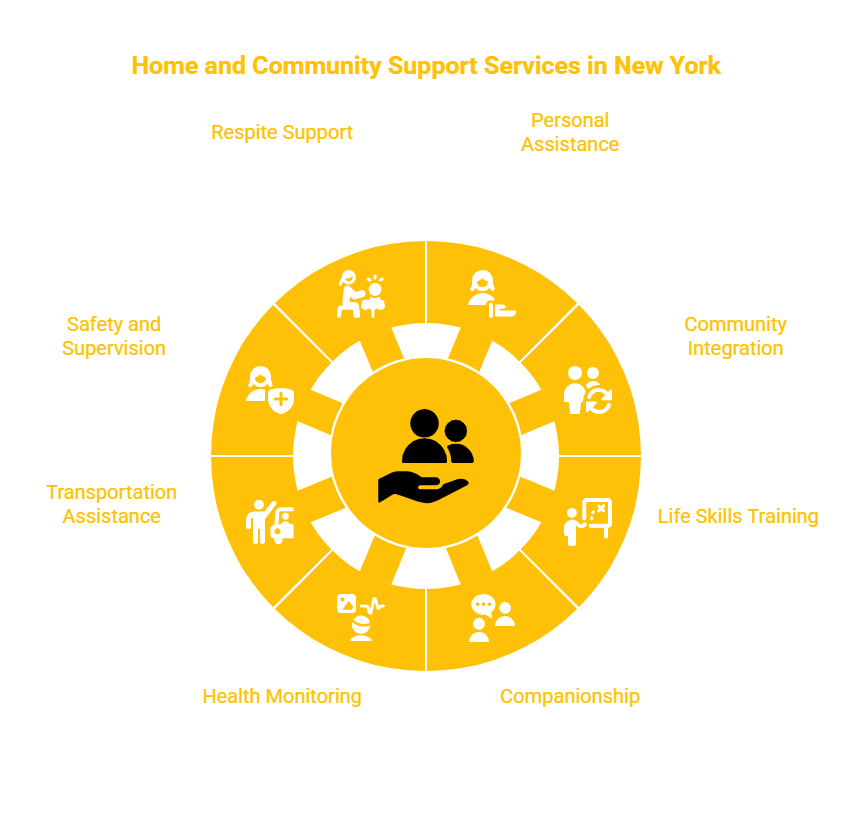
Home and Community Support Services are diverse, reflecting the unique needs of the individuals they serve. A primary objective is the promotion of independence, which is achieved through a combination of direct assistance, structured skill development, and community-based engagement. Providers must be prepared to deliver a comprehensive suite of services that cater to the evolving needs of their participants.
Approved providers generally offer services including, but not limited to, the following:
- Personal Assistance: Hands-on support with hygiene, grooming, mobility, and essential meal preparation.
- Community Integration: Facilitating active participation in social and recreational activities to prevent isolation.
- Life Skills Training: Targeted instruction in money management, interpersonal communication, and problem-solving skills.
- Companionship: Social interaction that fosters emotional well-being and reduces the risks of loneliness.
- Health Monitoring: Providing medication reminders and assistance with basic health tracking as outlined in the care plan.
- Transportation Assistance: Supporting access to community resources, medical appointments, and essential services.
- Safety and Supervision: Ensuring a secure environment during daily community and home-based activities.
- Respite Support: Providing temporary, short-term relief to primary caregivers to prevent burnout.
- Documentation: Maintaining rigorous records of care provided to ensure continuity and accurate billing.
What Are the Licensing and Enrollment Prerequisites?
Launching a service provider agency in New York requires a disciplined approach to business formation and regulatory compliance. Before engaging with the Medicaid enrollment process, an agency must formally establish itself as a legal business entity within the state. This involves registering with the New York Department of State and securing the necessary federal identification, specifically an Employer Identification Number (EIN) and a Type 2 National Provider Identifier (NPI).
Once the business structure is established, providers must focus on insurance and policy development. General liability and professional liability insurance are non-negotiable requirements for mitigating risk. Furthermore, agencies must document their operational standards, creating comprehensive manuals that cover daily support procedures, participant safety, and staff training protocols. The final step involves navigating the Medicaid Provider Enrollment Portal (eMedNY) to register specifically as a Medicaid Waiver Home and Community Support provider.
How Does the Enrollment and Readiness Process Function?
The transition from a business applicant to a Medicaid-authorized provider involves a series of structured phases overseen by the NYSDOH and relevant state offices. The process begins with the submission of an application through the eMedNY portal, which acts as the primary gateway for Medicaid reimbursement. This application must be accompanied by proof of legal incorporation, tax documentation, insurance certificates, and a detailed suite of operational policies.
Following the application, the state conducts a Program Readiness Review. During this stage, regulators evaluate the agency’s capacity to deliver quality care, examining everything from safety standards to staff qualifications. Only upon the successful completion of this review is an agency granted the authority to bill Medicaid for services. This process requires significant administrative rigor and a deep understanding of the documentation standards expected by the state.
What Are the Staffing and Training Mandates?
The quality of Home and Community Support Services is inextricably linked to the expertise and training of the staff. Agencies must hire leadership, such as a Program Director, who possesses a Bachelor’s or Master’s degree in a relevant field like social work or healthcare administration, along with direct experience in community program management. Community Support Specialists and Personal Care Aides (PCAs) also require specific qualifications, including high school diplomas or GEDs, relevant direct care experience, and mandatory background clearances.
All staff members must undergo a continuous training cycle that emphasizes the following areas:
- Community integration strategies, personal care techniques, and professional client interaction standards.
- HIPAA compliance, the protection of participant privacy, and the promotion of participant rights.
- Annual competency evaluations and ongoing professional development to stay current with care standards.
- Comprehensive safety, emergency response procedures, and modern infection control training.
- Rigorous documentation and record-keeping practices to support audit-ready compliance.
Frequently Asked Questions
Which Medicaid waiver programs cover Home and Community Support Services in New York?
These services are available under several key waivers, including the OPWDD Comprehensive Waiver, the Home and Community-Based Services (HCBS) Waiver, the Nursing Home Transition and Diversion (NHTD) Waiver, the Traumatic Brain Injury (TBI) Waiver, and the Children’s Waiver.
How long should an agency expect the entire launch process to take?
The typical timeline involves 1–2 months for business formation, 2–3 months for hiring and development, 60–90 days for the enrollment and readiness review, and an additional 30–45 days for billing setup and service launch.
What must be included in the Policy & Procedure Manual?
The manual must detail daily support procedures, personal assistance guidelines, staff credentialing and training records, documentation standards, HIPAA compliance, grievance handling, safety protocols, and quality assurance monitoring systems.
Key Takeaway
Success as a New York Home and Community Support Services provider relies on a deep commitment to regulatory compliance and person-centered care. By strictly adhering to the requirements set forth by the NYSDOH, OPWDD, OMH, and CMS, and by maintaining an audit-ready administrative environment, agencies can effectively navigate the Medicaid landscape while providing essential, life-enhancing support to the communities they serve.
Last verified: October 2023. This information is provided for educational purposes only and does not constitute legal or professional advice. Always consult with the appropriate state agencies and legal counsel to ensure your organization complies with the latest New York State Medicaid regulations and policy requirements.