HOME AND COMMUNITY NURSING SERVICES PROVIDER IN MINNESOTA
By Fatumata Kaba · 2025-07-26 · 6 min read
Home and Community Nursing Services in Minnesota provide essential medical care, health monitoring, and skilled nursing support directly within an individual’s residence. These services are vital for Minnesotans with chronic conditions, disabilities, or those recovering from illness, allowing them to manage complex health needs in a familiar environment while promoting independence through Minnesota’s Home and Community-Based Services (HCBS) Waivers.
Operating a nursing services agency in this sector requires strict adherence to state and federal regulations. By integrating skilled nursing interventions—such as wound care, medication management, and chronic disease support—providers serve as a bridge between facility-based care and independent living, ensuring that every participant receives high-quality, personalized clinical attention.
Understanding the Governing Agencies and Regulatory Oversight
The regulatory landscape for Minnesota home nursing is managed through a tiered system of oversight involving state and federal authorities. The Minnesota Department of Health (MDH) acts as the primary regulatory body for nursing care agencies, ensuring that businesses remain in compliance with state-specific health regulations, staff safety protocols, and operational standards. Their oversight is critical to maintaining the quality of care provided within private homes.
The Minnesota Department of Human Services (DHS) serves as the primary administrator for the state’s Medicaid programs and HCBS Waiver funding. This department manages the provider enrollment process, service authorization, and the financial frameworks that allow for the delivery of nursing services. Simultaneously, the federal Centers for Medicare & Medicaid Services (CMS) provides the overarching federal framework, ensuring that Minnesota’s waiver programs remain in compliance with federal law and maintain the fiscal integrity of Medicaid-funded services.
- Minnesota Department of Health (MDH): Regulates nursing care agencies and ensures compliance with state health regulations.
- Minnesota Department of Human Services (DHS): Administers Medicaid and HCBS Waiver programs, including funding for home nursing services.
- Centers for Medicare & Medicaid Services (CMS): Provides federal oversight and ensures waiver compliance.
Core Components of Home and Community Nursing Services
Services delivered under the HCBS umbrella are highly individualized, based strictly on the participant’s Individual Service Plan (ISP) or Person-Centered Plan (PCP). Providers are tasked with executing clinical interventions that mirror the complexity of hospital or clinical care, brought directly to the patient. This requires a robust clinical team capable of performing skilled nursing tasks, such as intravenous therapy, complex wound care, and ongoing health assessments.
Beyond technical medical procedures, these services emphasize proactive disease management and caregiver education. By providing consistent monitoring and coordination with a patient’s primary care provider, nursing agencies reduce the risk of hospital readmissions and stabilize health conditions. A successful provider agency must ensure that every service delivered is clearly documented and aligned with the specific medical goals outlined in the participant's care plan.
- Skilled nursing care (e.g., wound care, IV therapy)
- Chronic disease management (e.g., diabetes care)
- Medication administration and monitoring
- Health assessments and care planning
- Patient and caregiver education
- Coordination with primary care providers
Navigating Licensing and Medicaid Provider Enrollment
Establishing a legally compliant nursing agency involves a sequenced approach to registration and credentialing. Before seeking Medicaid enrollment, the agency must be properly formed as a business entity with the Minnesota Secretary of State and secure necessary federal identifiers, including an Employer Identification Number (EIN) and a Type 2 National Provider Identifier (NPI). This foundational step ensures the business is ready to handle payroll, billing, and administrative duties.
The core of the provider qualification process lies in obtaining a Comprehensive Home Care License from the Minnesota Department of Health. Once licensed, the agency can initiate the Medicaid provider enrollment process with the Minnesota Department of Human Services. This process involves submitting extensive documentation, including proofs of liability insurance and detailed service descriptions. Maintaining strict compliance throughout these steps is essential for obtaining a Medicaid provider number, which serves as the authorization to bill for services.
Staffing, Training, and Operational Compliance
The quality of a Home and Community Nursing agency is defined by its clinical leadership and nursing staff. The Nursing Care Administrator must possess documented experience in healthcare administration and home care management to oversee operations effectively. Registered Nurses (RNs) must maintain active, unencumbered licenses, and must be verified for essential certifications such as CPR and Advanced Cardiac Life Support (ACLS), alongside standard background checks and tuberculosis (TB) clearances.
Comprehensive training is not merely a policy requirement but a functional necessity for safe care delivery. Agencies are required to document rigorous staff training that covers infection control, emergency response protocols, and precise medication administration. This internal documentation is often subject to audit by the MDH and DHS, making it critical for the agency to maintain current logs, competency assessments, and clear evidence of ongoing education for every member of the nursing team.
- Nursing Care Administrator: Requires experience in healthcare administration and home care management.
- Registered Nurse (RN): Requires nursing degree, active RN license, CPR/ACLS certification, and background clearance.
- Infection Control & Safety: Mandatory staff training in patient monitoring, medication protocols, and emergency communication.
Launching Your Agency: Timelines and Program Integration
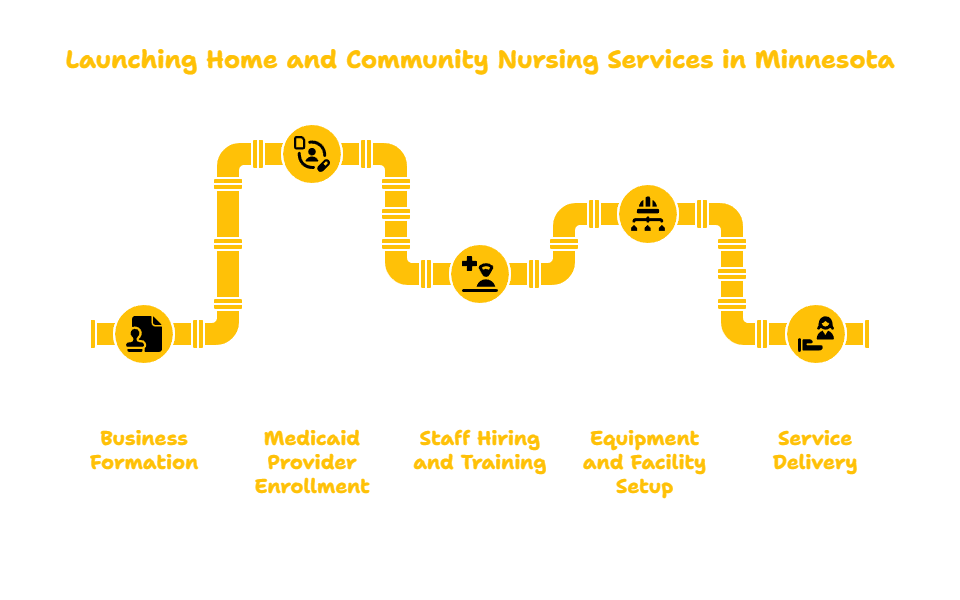
The timeline for launching a Home and Community Nursing agency varies based on administrative readiness. Business formation usually requires one to two weeks, followed by a multi-phase enrollment and setup process. The Medicaid provider enrollment phase is typically the most substantial, often taking 60 to 90 days to complete, while staff hiring and training efforts occur concurrently or in the subsequent 30 to 45 days. Equipment procurement and site readiness round out the final stages of the launch.
Providers generally operate within specific HCBS waiver programs, such as the 1915(c) HCBS Waiver for the Elderly and Disabled, the Community Access for Disability Inclusion (CADI) Waiver, and the Brain Injury (BI) Waiver. Understanding the specific medical needs addressed by these waivers allows agencies to tailor their services to the population segments most in need of home-based skilled nursing care.
Frequently Asked Questions
What documents are essential for the provider enrollment application?
Applicants must provide Articles of Incorporation or business registration, an IRS EIN letter, a Type 2 NPI confirmation, a current Comprehensive Home Care License from the MDH, and a certificate of liability insurance. Additionally, a detailed policy and procedure manual covering nursing assessments, infection control, medication administration, and record-keeping is required.
How does an agency stay compliant with state and federal regulations?
Compliance is maintained by adhering to the regulations set forth by the MDH for licensing and the DHS for Medicaid program participation. This requires ongoing documentation of patient health records, staff training logs, competency assessments, and periodic policy updates that reflect the current requirements of the 1915(c) HCBS Waiver programs.
Which waivers authorize Home and Community Nursing services?
These services are authorized under the 1915(c) HCBS Waiver for the Elderly and Disabled, the Community Access for Disability Inclusion (CADI) Waiver, and the Brain Injury (BI) Waiver. Providers should confirm specific authorization requirements with the Minnesota Department of Human Services during the enrollment process.
Key Takeaways for Provider Success
Successful entry into the Minnesota Home and Community Nursing sector requires a meticulous approach to regulatory compliance, staff competency, and administrative rigor. Founders must prioritize the attainment of the Comprehensive Home Care License and align all internal policies with the standards set by the Minnesota Department of Health and the Department of Human Services. By focusing on the clinical requirements of the HCBS waivers and maintaining robust documentation for both patients and staff, agencies can establish a stable, professional, and essential contribution to Minnesota’s healthcare landscape.
Last verified: 2024. The information provided herein is for educational purposes only and does not constitute legal, medical, or professional advice. Always consult with the Minnesota Department of Human Services, the Minnesota Department of Health, or a qualified consultant to ensure your agency meets all current, specific state and federal regulatory requirements.