HABILITATION SERVICES PROVIDER IN WYOMING
By Fatumata Kaba · 2026-04-14 · 5 min read
Promoting Skill Development, Functional Independence, and Community Engagement for Individuals with Disabilities
Habilitation services in Wyoming are essential supports designed to assist individuals with intellectual and developmental disabilities (I/DD) in acquiring, maintaining, and improving the life skills necessary for functional independence and community inclusion. These services focus on teaching new skills—ranging from self-care and communication to behavior regulation and daily living tasks—rather than restoring previously lost abilities, and they are a primary component of Wyoming’s Comprehensive and Supports Waivers administered by the Developmental Disabilities Division (DDD) of the Wyoming Department of Health.
What is the Role of Governing Agencies in Habilitation Services?
The delivery of habilitation services in Wyoming operates within a structured regulatory environment governed by several key entities. The Wyoming Department of Health’s Developmental Disabilities Division (DDD) serves as the primary oversight authority, defining service requirements, managing provider certification, and performing ongoing quality and compliance monitoring. Their role is to ensure that all services remain person-centered and adhere to the specific outcomes outlined in each participant’s Individualized Plan of Care (IPC).
Complementing the DDD’s oversight, Medicaid Provider Services—a unit within the Division of Healthcare Financing—manages the financial infrastructure of the program. This agency oversees the technical aspects of Medicaid enrollment, reimbursement, and the complex claims processing systems required for waiver services. Furthermore, Case Management Agencies act as the linchpin for the service delivery model, as they are responsible for developing the IPC, coordinating the necessary services, monitoring participant progress, and ensuring that provider activities remain aligned with the established waiver goals.
How Do Providers Define and Deliver Habilitation Services?
Habilitation services are intended to empower individuals by building the competencies required for self-sufficiency and deeper social integration. Because these services must be person-centered, they are highly customizable based on the participant’s specific needs and preferences. Whether delivered in a participant's home, a provider-owned residential setting, or directly within the community, the objective remains the acquisition of life skills that foster personal empowerment and independence.
Covered services typically encompass a broad spectrum of supportive training, including:
- Daily living skills such as personal hygiene, meal preparation, and personal budgeting.
- Social and communication skills development to facilitate interaction and expression.
- Adaptive behavior support and training to help participants navigate various environments.
- Community participation activities to encourage integration and local engagement.
- Self-advocacy and decision-making coaching to bolster personal autonomy.
- Household management training and mobility support.
- Pre-vocational and recreational support to foster community contribution and leisure.
- Skill-building focused on emotional regulation and maintaining healthy personal boundaries.
What Are the Licensing and Provider Approval Requirements?
Becoming an approved habilitation provider in Wyoming requires meticulous attention to administrative and regulatory prerequisites. Before a provider can begin service delivery, they must ensure their business is officially registered with the Wyoming Secretary of State and possesses a Federal EIN and a Type 2 NPI. This foundation allows for the subsequent application for certification through the DDD as a qualified habilitation services provider.
Administrative readiness is tested through several mandatory steps, including the completion of provider orientation, pre-service training, and the development of a comprehensive Habilitation Services Policy & Procedure Manual. Providers must also implement rigorous systems for hiring, conducting background checks, maintaining adequate insurance, and ensuring that all staff are trained in person-centered habilitation strategies. Ongoing compliance requires strict adherence to DDD standards regarding the service environment, staff supervision, and detailed documentation protocols.
What is the Standard Enrollment Process for New Providers?
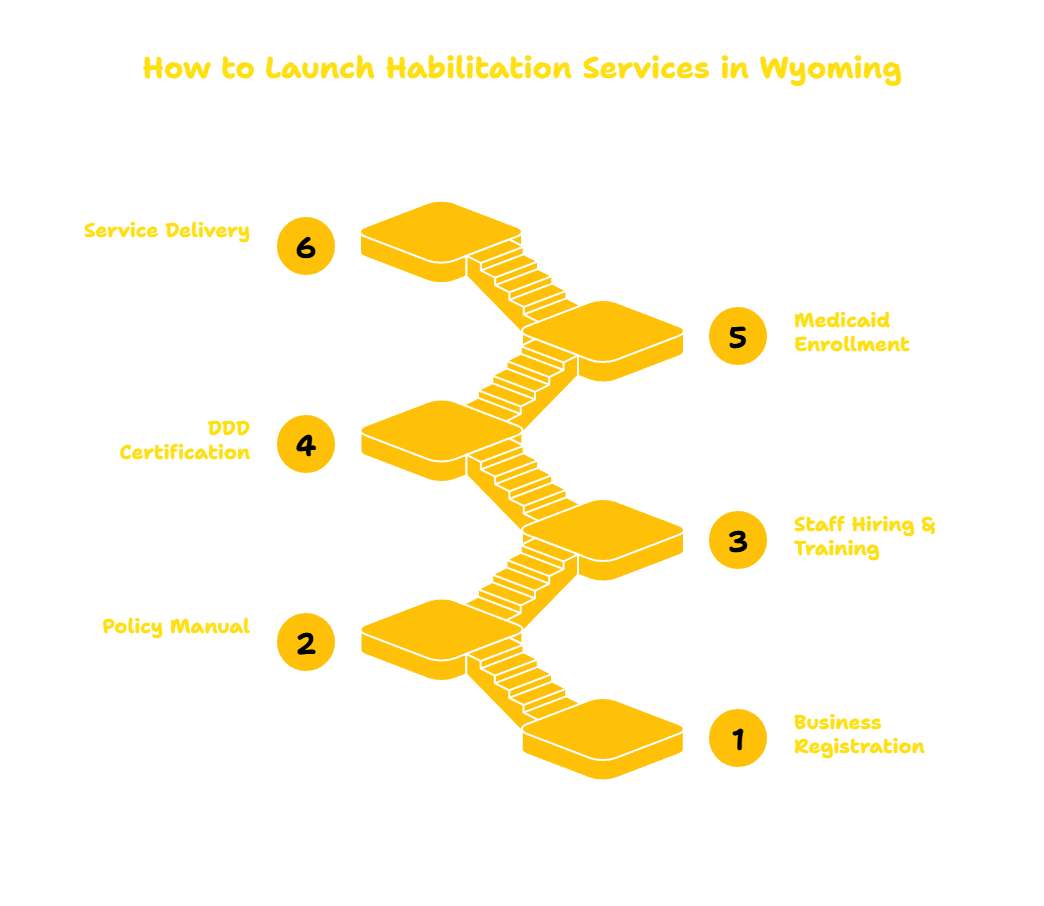
The transition from business planning to active service delivery follows a sequential process managed across multiple state portals. The journey begins with establishing the business identity and securing the necessary federal identifiers (EIN and NPI). Once the business is legal, the provider must submit an application for DDD provider certification, which includes the submission of the internal Policy & Procedure Manual and the completion of the required state-led provider orientation program.
Following the DDD certification process, the agency must enroll with Medicaid through the official Provider Portal to ensure the technical ability to submit claims. Only after these regulatory hurdles are cleared and a provider is fully authorized can they begin to receive IPC referrals from Case Management Agencies. Once a referral is received and the specific services are authorized for a participant, the provider may begin service delivery, ensuring that every session is documented according to the participant's specific IPC goals.
What Documentation and Staffing Standards Must Be Maintained?
Effective documentation is the backbone of Medicaid compliance and quality assurance. Providers must maintain a robust Habilitation Services Policy & Procedure Manual that addresses person-centered planning, daily activity logs, progress tracking, behavioral support protocols, and emergency response plans. Furthermore, agencies must maintain detailed records regarding participant rights, grievance procedures, consent forms, and proof of HIPAA and confidentiality compliance to ensure full transparency and protection for the individuals served.
Staffing requirements are equally stringent to ensure the safety and development of participants. Every Direct Support Professional (DSP) or Habilitation Specialist must be at least 18 years old, possess a high school diploma or GED, and clear a background check and abuse registry screening. Additionally, all staff must hold valid CPR/First Aid certification and complete mandatory pre-service training in areas such as abuse prevention, HIPAA, documentation techniques, and emergency safety protocols. It is highly recommended that agencies employ a Program Supervisor to oversee staff performance, conduct documentation audits, and track participant outcomes to ensure consistent service quality.
Frequently Asked Questions
Which Medicaid waivers cover habilitation services?
Habilitation services are covered under the Comprehensive Waiver (I/DD), designed for individuals with high support needs, and the Supports Waiver (I/DD), for those with moderate needs and limited budgets. Additionally, Children’s Habilitation Services may be covered for youth with developmental disabilities when medically and functionally justified.
What is the typical timeline to launch a new provider agency?
The launch process generally spans several months. Business registration and manual creation typically take 2–3 weeks, staff hiring and training take 30–45 days, and DDD certification combined with Medicaid enrollment generally requires 2–3 months before services can officially begin.
What constitutes a "person-centered" approach in documentation?
A person-centered approach means that all services, goals, and methods are specifically tailored to the unique outcomes defined in the participant's Individualized Plan of Care (IPC). Documentation must clearly reflect the progress made toward these specific, measurable goals rather than using generic activity logs.
Key Takeaway
Success as a habilitation provider in Wyoming requires a disciplined commitment to regulatory compliance, rigorous staff training, and the ability to maintain detailed, person-centered documentation that directly aligns with the participant's IPC. By adhering to the standards set forth by the Wyoming Department of Health’s Developmental Disabilities Division and maintaining active status in the Medicaid provider portal, agencies can successfully contribute to the independence and well-being of the I/DD population.
Last verified: 2024. The information provided in this article is for educational purposes only and does not constitute legal or professional consulting advice. Readers are encouraged to consult with the Wyoming Department of Health and official state portals for the most current regulatory requirements and policy updates.