HABILITATION SERVICES PROVIDER IN WISCONSIN
By Fatumata Kaba · 2026-04-14 · 5 min read
What Are Habilitation Services and Why Are They Vital in Wisconsin?
Habilitation services in Wisconsin are essential person-centered supports designed to help individuals with intellectual, developmental, and other disabilities acquire, maintain, and improve the essential skills needed for independent living and meaningful community inclusion. These services focus on personal development, adaptive behavior, and active participation in home and community environments, ensuring that individuals can exercise choice and achieve their self-defined goals.
As a core component of Wisconsin’s Home and Community-Based Services (HCBS) waiver landscape—including the IRIS (Include, Respect, I Self-Direct), Family Care, and Children’s Long-Term Support (CLTS) programs—these services are legally required to align strictly with an individual’s person-centered plan. For provider agencies, delivering these services requires a comprehensive understanding of Medicaid program guidelines, as every intervention must be documented, purposeful, and directly linked to the specific functional support needs of the participant.
Who Governs and Regulates Habilitation Providers in Wisconsin?
Navigating the regulatory hierarchy in Wisconsin is the first step for any agency founder. The Wisconsin Department of Health Services (DHS) serves as the primary regulatory body, establishing the overarching policies for waiver services, defining mandatory provider qualifications, and maintaining rigorous service standards to ensure beneficiary safety and quality of care.
Supporting the DHS, ForwardHealth acts as the administrative engine for the state’s Medicaid program. Agencies must interact with ForwardHealth to manage provider enrollment, master billing procedures, and secure waiver reimbursements. Additionally, IRIS Consultant Agencies and Managed Care Organizations (MCOs) act as the frontline for service authorization; they monitor the delivery of care against individual service plans (ISPs) to ensure that billing aligns with the authorized support needs of the participants served.
- Wisconsin Department of Health Services (DHS): Sets statewide policies and service standards.
- ForwardHealth: Manages the Medicaid enrollment and claims processing infrastructure.
- IRIS Consultant Agencies / MCOs: Authorize services and perform ongoing care monitoring.
- Wisconsin Department of Safety and Professional Services (DSPS): Governs professional licensure for specialized clinical staff.
What Are the Core Components of Habilitation Support?
Habilitation services are not "one size fits all"; they are highly individualized interventions tailored to the unique trajectory of the participant. Whether assisting with daily living skills such as meal preparation and personal hygiene, or facilitating complex social interactions, providers must ensure their interventions are documented within an ISP or Plan of Support to remain compliant with state requirements.
Beyond basic daily living, habilitation often includes specialized support for community integration, mobility, and employment readiness. For instance, staff might provide volunteer skill-building, help a participant navigate public transportation systems, or teach self-advocacy strategies. Because these services are funded through Medicaid, every interaction must be tied to a measurable outcome that demonstrates progress toward the participant’s independence.
- Daily living skills training (hygiene, money management, and nutrition)
- Socialization, communication, and self-advocacy development
- Behavior support planning and implementation
- Community inclusion, recreation, and civic engagement
- Employment readiness and vocational skill-building
How Can Your Agency Meet Licensing and Enrollment Requirements?
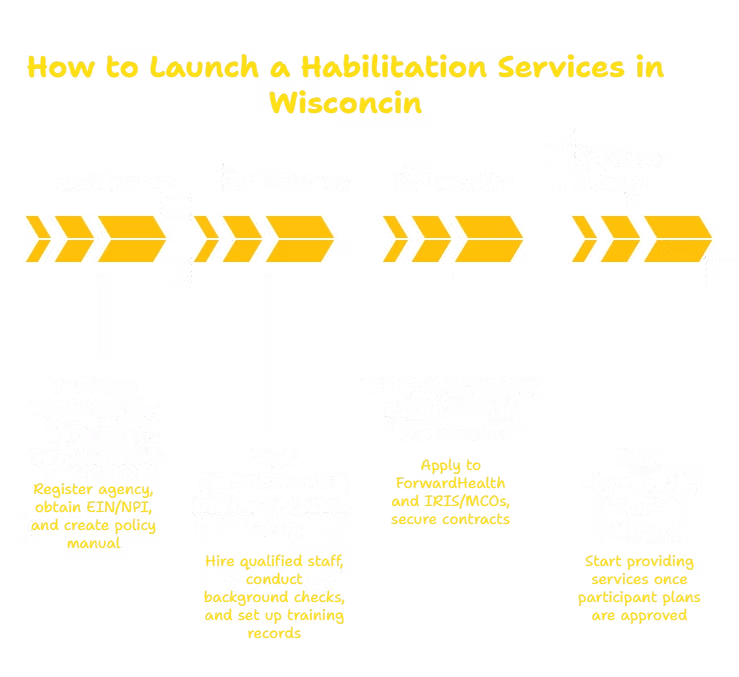
Establishing a legally compliant habilitation agency requires a methodical approach to business and healthcare registration. Initially, an agency must register with the Wisconsin Department of Financial Institutions (DFI) and secure a Federal Employer Identification Number (EIN) and a Type 2 National Provider Identifier (NPI). These structural steps form the foundation for all subsequent Medicaid-related activities.
Once the business entity is established, the agency must apply for provider status with ForwardHealth. While general habilitation services may not require specialized clinical licensure, the agency must maintain rigorous administrative documentation, including a comprehensive Policy and Procedure Manual. This manual must be audit-ready, covering everything from incident reporting protocols and HIPAA compliance to staff training logs and internal quality assurance processes.
- Register with the Wisconsin Department of Financial Institutions (DFI).
- Obtain a Federal EIN and a Type 2 NPI.
- Apply for provider enrollment status via the ForwardHealth portal.
- Develop a robust Policy & Procedure Manual for regulatory review.
- Establish contracts with IRIS Fiscal Employer Agents and regional MCOs.
What Are the Essential Staffing and Training Mandates?
The quality of habilitation services rests upon the competency of the direct support staff. Providers are responsible for ensuring that all Habilitation Specialists possess at least a high school diploma or GED, though specific waiver programs may mandate higher education or industry-specific certifications. Beyond formal education, staff must undergo comprehensive background checks and complete mandatory training before providing services independently.
Ongoing professional development is a regulatory expectation in Wisconsin. Staff must be trained in person-centered planning principles, disability rights, and crisis intervention techniques, including CPR and First Aid. To ensure the safety of participants and the integrity of the agency, managers must also maintain detailed logs of annual training covering abuse and neglect prevention, infection control, and privacy protections under HIPAA.
- Completion of initial habilitation support and person-centered planning training.
- Annual mandatory training on behavior support and communication strategies.
- Rigorous background check clearance for all employees.
- Supervised orientation and ongoing documentation skills evaluation.
Frequently Asked Questions
Is a specific license required to open a habilitation agency in Wisconsin?
In most cases, state-level professional licensure is not required to operate as a general habilitation agency; however, specific services—such as those involving behavioral therapy or counseling—may require staff to hold professional licenses from the Department of Safety and Professional Services (DSPS). Agencies must always confirm the specific credentialing requirements tied to the waiver services they intend to provide.
How long does the provider enrollment process typically take?
The timeline varies based on the completeness of your documentation, but generally, the process spans several months. Business registration and manual development typically require 2–4 weeks, while staff recruitment and credentialing take 30–45 days. The Medicaid and waiver enrollment phase often requires 1–3 months before final contract approval.
Are habilitation services the same for all Wisconsin waiver programs?
While the focus on skill development and independence is common across programs like IRIS, Family Care, and CLTS, the specific delivery model may vary. IRIS is participant-directed, allowing for more customization, while Family Care utilizes MCOs to manage service networks. Providers must ensure that their documentation reflects the specific requirements and goals stipulated in the participant’s unique Plan of Care.
Summary of Operational Support for New Agencies
Launching a habilitation service agency requires careful alignment with Wisconsin’s regulatory framework, from initial ForwardHealth enrollment to the ongoing management of participant-centered documentation. Success depends on the creation of a compliant Policy & Procedure Manual, effective staff onboarding, and rigorous attention to the audit requirements established by the Department of Health Services. By ensuring that all service delivery is tied to measurable outcomes and documented according to waiver guidelines, agencies can provide high-quality support that fosters independence for individuals with disabilities.
Last verified: June 2024. This information is intended for educational purposes only and does not constitute legal or financial advice. Regulations regarding Medicaid waivers and provider requirements are subject to change; please consult the official Wisconsin Department of Health Services and ForwardHealth portals for the most current regulatory guidance and policy updates.