HABILITATION SERVICES PROVIDER IN VIRGINIA
By Fatumata Kaba · 2026-04-08 · 5 min read
Becoming a habilitation services provider in Virginia involves navigating a rigorous regulatory framework designed to ensure that individuals with intellectual or developmental disabilities (ID/DD) receive high-quality, person-centered support. This process requires coordinated efforts between the Virginia Department of Medical Assistance Services (DMAS), the Department of Behavioral Health and Developmental Services (DBHDS), and local Community Services Boards (CSBs) to align business operations with state-mandated standards for care, safety, and documentation.
Habilitation services focus on the acquisition, retention, and improvement of foundational life skills—such as self-care, communication, and social interaction—that allow individuals to lead more autonomous lives. For prospective agency founders, success depends on a deep understanding of the Community Living (CL), Family and Individual Supports (FIS), and Building Independence (BI) Waivers, as well as the ability to maintain compliant administrative systems that support the delivery of these non-clinical, goal-oriented services.
Navigating the Regulatory Agencies and Oversight Framework
The regulatory landscape for habilitation services in Virginia is divided among three primary entities, each serving a distinct purpose in the oversight and authorization of care. The Virginia Department of Medical Assistance Services (DMAS) acts as the state Medicaid agency, establishing the reimbursement rules, defining the specific scope of services, and managing the enrollment processes necessary for providers to receive payment. Without enrollment through the DMAS Medicaid Enterprise System (MES) portal, a provider cannot bill for services rendered to waiver participants.
The Department of Behavioral Health and Developmental Services (DBHDS) serves as the primary licensing and quality assurance body. This agency is responsible for issuing the licenses required to operate, ensuring that providers meet state standards for service delivery, staff qualifications, and human rights protections. Additionally, Community Services Boards (CSBs) act as the local point of contact for individuals. CSBs are responsible for approving Individual Support Plans (ISPs), authorizing specific services, and coordinating care, making them essential partners for any provider agency seeking to receive client referrals.
Establishing the Foundational Requirements for Provider Approval
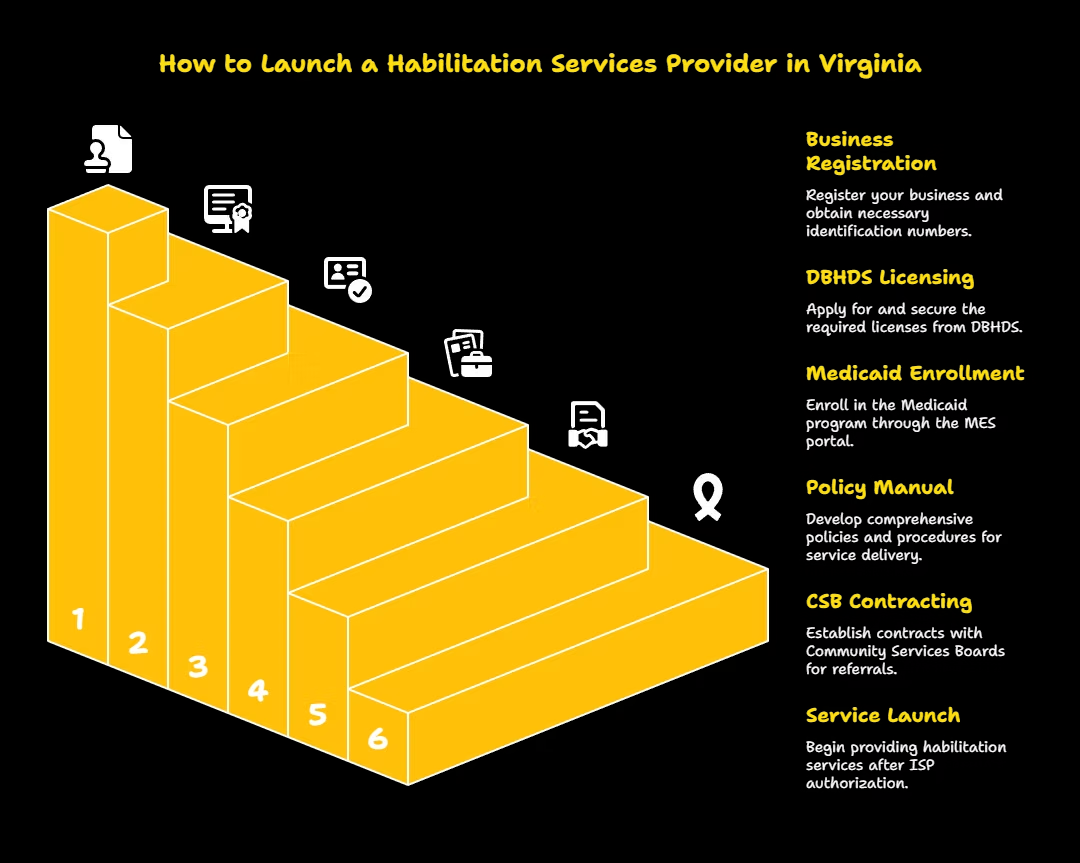
Launching a habilitation agency begins with formalizing the business entity and meeting the prerequisite criteria set by state regulators. Founders must first register their business with the Virginia State Corporation Commission (SCC) and obtain a federal Employer Identification Number (EIN) and a Type 2 National Provider Identifier (NPI). These identifiers are non-negotiable prerequisites for any subsequent licensing or Medicaid enrollment applications.
Once the business is legally established, the provider must apply for a DBHDS license, typically under the categories of In-Home Support Services or Community Engagement. This process involves proving that the organization is prepared to protect client rights and adhere to state quality standards. Key requirements during this phase include:
- Securing DBHDS Human Rights Office affiliation.
- Developing a comprehensive Habilitation Services Policy & Procedure Manual.
- Ensuring the facility and administrative systems meet all regulatory safety standards.
- Completing the Medicaid provider enrollment process via the MES portal.
Designing Person-Centered Service Delivery and Documentation
Habilitation is inherently person-centered, meaning that every activity must be directly tied to the specific goals outlined in an individual's ISP. Because these services are non-clinical, the focus remains on building autonomy, reducing dependency, and fostering community participation. Whether the service occurs in the individual's home or a broader community setting, the provider must demonstrate that the activities contribute to measurable progress in daily living skills.
Effective documentation is the backbone of a compliant habilitation program. Providers must implement systems that track progress, collect data, and verify that the services billed align with the goals in the ISP. Documentation must be meticulous, as it is subject to review during CSB monitoring visits and DMAS audits. Essential documentation protocols include:
- Individualized service delivery planning and regular progress notes.
- Standardized data collection forms for tracking skill acquisition.
- Detailed community access protocols and safety plans for off-site activities.
- HIPAA-compliant records management and informed consent documentation.
Managing Staffing and Professional Development
The success of a habilitation program rests on the quality of its Direct Support Professionals (DSPs). Providers are responsible for ensuring that all staff possess the necessary qualifications, including a high school diploma or GED, and that they have undergone thorough criminal and CPS background checks. Training is a continuous obligation, not a one-time event; staff must be proficient in person-centered practices, behavioral support, and incident reporting.
In addition to entry-level training, it is highly recommended that agencies employ a Program Supervisor or Service Coordinator. This role is crucial for maintaining the integrity of the program by overseeing ISP implementation, conducting regular reviews of progress notes, and providing direct supervision to DSPs. Ongoing professional development must include:
- Mandatory DBHDS-approved training on human rights and service delivery.
- Regular updates on HIPAA regulations and emergency response procedures.
- Annual skills assessments to verify that staff can meet the evolving needs of the individuals they support.
Understanding the Waiver Programs and Service Scope
Habilitation services are delivered within the context of three specific Virginia Medicaid waivers, each catering to individuals with different support needs. The Community Living (CL) Waiver is designed for individuals residing in staffed or independent residences who require comprehensive support. The Family and Individual Supports (FIS) Waiver is intended for individuals living with family or in their own homes, while the Building Independence (BI) Waiver supports those who require minimal paid assistance but still benefit from structured skill development.
Because each waiver has specific limitations and service definitions, providers must be diligent in verifying eligibility and ensuring that the services rendered are within the scope of the participant’s assigned waiver. Consistency between the approved service units and the outcomes documented in the ISP is required to maintain compliance with DMAS and DBHDS expectations.
Frequently Asked Questions
How long does the provider enrollment process typically take?
The timeline varies based on the completeness of documentation, but typically spans several months. Business registration takes 2–3 weeks, followed by 1–2 months for DBHDS licensing and Medicaid enrollment, and 3–5 weeks for finalizing policy manuals and contracting with CSBs.
What is the primary role of a Community Services Board (CSB)?
The CSB serves as the local coordinating entity for waiver participants. They are responsible for the approval of Individual Support Plans (ISPs), the authorization of service hours, and the management of referrals, making them the primary point of contact for service delivery coordination.
Are habilitation services considered clinical care?
No, habilitation services are non-clinical in nature. They focus on the acquisition, retention, and improvement of daily living skills—such as hygiene, money management, and community navigation—rather than the restoration of lost abilities, which is characteristic of rehabilitative care.
Key Takeaway: Successful operation as a habilitation services provider in Virginia requires meticulous attention to the distinct requirements set by DMAS, DBHDS, and local CSBs. By prioritizing person-centered documentation, maintaining rigorous staff training protocols, and ensuring strict adherence to the standards of the CL, FIS, and BI Waivers, providers can build sustainable, compliant agencies that meaningfully improve the lives of individuals with ID/DD.
Last verified: October 2023. Disclaimer: This article is for informational purposes only and does not constitute legal or professional advice. Always consult the latest guidelines published by the Virginia Department of Medical Assistance Services (DMAS) and the Department of Behavioral Health and Developmental Services (DBHDS) to ensure current compliance with state regulations.