HABILITATION SERVICES PROVIDER IN UTAH
By Fatumata Kaba · 2026-04-01 · 5 min read
Understanding Habilitation Services in Utah
Habilitation services in Utah provide essential support for individuals with intellectual or developmental disabilities (ID/DD) by focusing on the acquisition, retention, and improvement of skills necessary for independent living and community inclusion. These services are authorized under Utah’s Home and Community-Based Services (HCBS) waivers, primarily the Community Supports Waiver (CSW), and are strictly regulated by the Division of Services for People with Disabilities (DSPD) under the Utah Department of Health and Human Services (DHHS).
As a provider, your role is to facilitate person-centered outcomes that empower participants to navigate daily life with greater autonomy. By delivering structured support in home and community settings, providers help bridge the gap between clinical needs and personal independence, ensuring that each participant’s goals—as outlined in their Individual Support Plan (ISP)—are met through consistent, measurable service delivery.
How Do Habilitation Services Function Within the DSPD Framework?
Habilitation services are fundamentally goal-oriented and tailored to the unique trajectory of each participant. The primary objective is to build capacity in areas that foster self-sufficiency. This involves a collaborative approach where the provider, the support coordinator, and the individual work together to define specific, achievable milestones within the framework of the ISP.
Services are versatile and can be delivered in a variety of environments, ranging from a participant’s private residence to various community-based settings. To ensure quality, services must adhere to federal Medicaid HCBS standards, which prioritize community integration and the avoidance of institutional isolation. Providers must maintain rigorous documentation to prove that the services provided are not merely custodial, but actively building the participant's functional capacity.
- Daily Living Skills: Training in essential tasks such as hygiene, meal preparation, and personal budgeting.
- Behavioral Support: Assisting individuals with emotional regulation and healthy communication strategies.
- Community Integration: Coaching on public transportation use, social navigation, and accessing community resources.
- Safety and Self-Advocacy: Developing awareness of personal boundaries, emergency preparedness, and the ability to express personal needs.
What Are the Licensing and Enrollment Prerequisites for Providers?
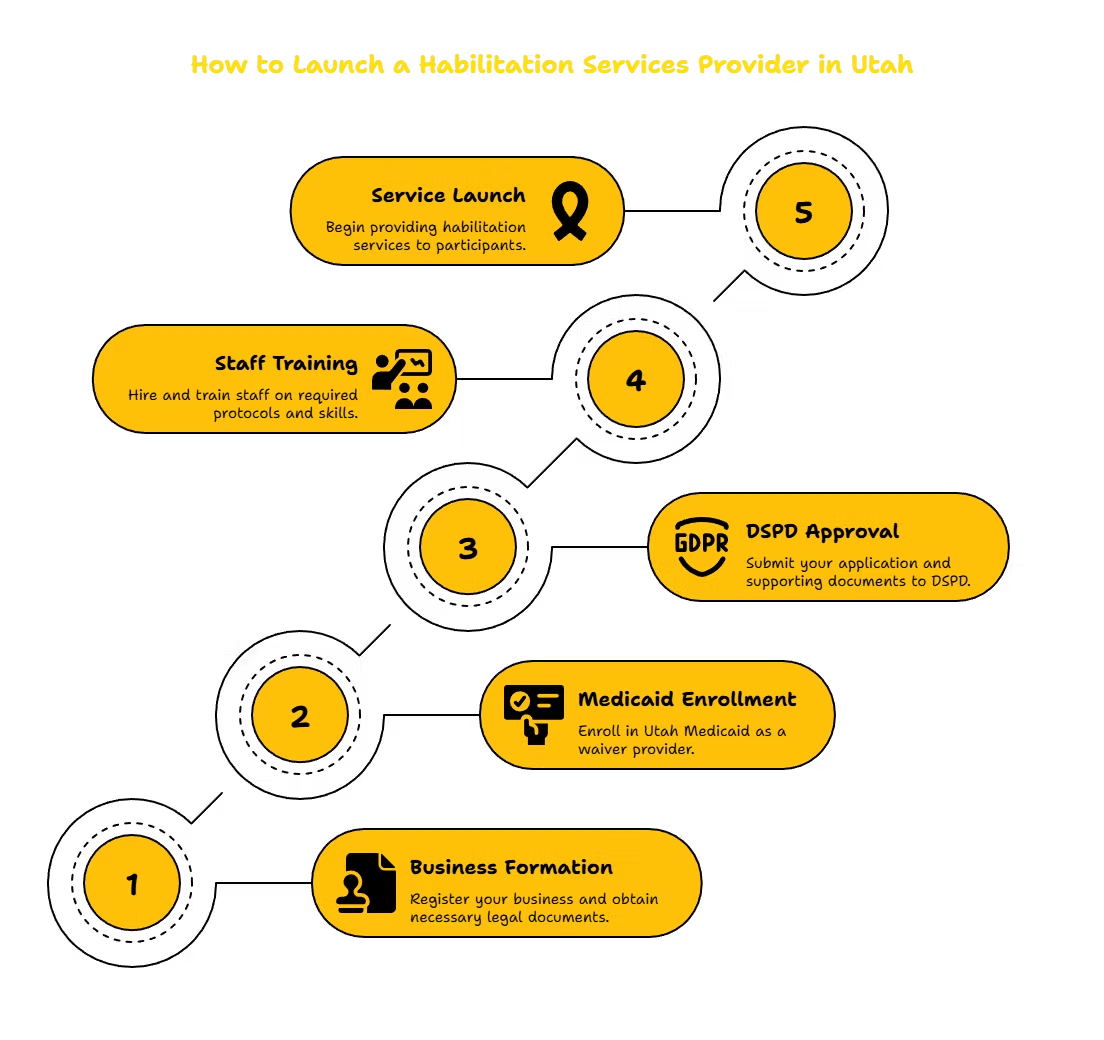
Establishing a habilitation agency in Utah requires a structured, multi-agency compliance process. Before applying for provider status, an organization must be legally formed and recognized by the Utah Division of Corporations. Once the legal entity is established, you must obtain a federal Employer Identification Number (EIN) and a Type 2 National Provider Identifier (NPI) to function within the healthcare system.
The enrollment path involves two primary levels of approval: state Medicaid provider enrollment and specific DSPD program authorization. The DSPD process is particularly focused on your agency's capacity to deliver quality habilitation. This includes demonstrating that you have comprehensive insurance coverage—specifically general liability and workers’ compensation—to protect both your staff and the participants you serve.
- Registering the legal business entity with the state.
- Securing necessary tax identification and NPI numbers.
- Submitting the formal application to the DSPD for habilitation provider status.
- Drafting a comprehensive Habilitation Services Policy & Procedure Manual that reflects current DHHS regulations.
What Documentation Is Required for Regulatory Compliance?
Successful habilitation providers maintain highly organized administrative systems to track service delivery and participant progress. Documentation serves as the primary evidence during audits and quality reviews. Your internal systems must demonstrate that every hour billed aligns with the goals identified in the participant’s ISP. Without precise record-keeping, a provider risks non-compliance and potential recoupment of Medicaid payments.
A compliant Habilitation Policy & Procedure Manual must be exhaustive. It should outline your organizational structure, your approach to person-centered planning, and your internal mechanisms for incident reporting. Because providers operate under the watchful eye of both the state and the Centers for Medicare & Medicaid Services (CMS), your documentation must reflect a commitment to participant rights and the consistent application of safety protocols.
- ISP Implementation: Evidence of how your services directly support the goals outlined in the participant’s plan.
- Data Tracking: Daily logs or digital records that quantify the acquisition or maintenance of specific skills.
- Staff Oversight: Personnel records that confirm employees are trained, supervised, and vetted.
- Incident Management: Formal procedures for reporting, documenting, and resolving health and safety incidents.
What Are the Staffing and Training Expectations?
The quality of your program is defined by the competency of your Direct Support Professionals (DSPs). In Utah, staff must be at least 18 years of age and undergo thorough background checks. Beyond basic eligibility, staff must be proficient in the specific needs of the population being served, which requires a structured onboarding process and ongoing professional development.
Staff members must complete mandatory training modules, such as those found in the MySupport system, alongside essential certifications like CPR and First Aid. Training must also cover the nuances of Abuse, Neglect, and Exploitation Prevention (ANEP) and HIPAA regulations. Supervisors are expected to maintain an oversight role, ensuring that the staff’s daily interactions with participants remain aligned with the clinical and social goals set forth in the ISP.
Frequently Asked Questions
Which Medicaid Waivers Cover Habilitation Services in Utah?
Habilitation services are primarily covered under the Community Supports Waiver (CSW) for adults with ID/DD. Additionally, these services may be accessed through the Acquired Brain Injury (ABI) Waiver, the Physical Disabilities Waiver (PDW), and on a case-by-case basis through the Medically Complex Children’s Waiver (MCCW).
How long does the provider enrollment process typically take?
The timeline is generally broken into phases: 1–2 months for business formation and manual development, 2–3 months for Medicaid and DSPD enrollment, and 30–60 days for staff hiring and specialized training. The speed of the process often depends on the accuracy and completeness of the documentation submitted to the DHHS and DSPD.
Is an Office of Licensing (OL) certification always required?
While standard home-based habilitation is governed by DSPD standards, certain group-based settings or specific service models may require additional Office of Licensing (OL) certification. Providers must verify the specific licensing requirements for their chosen service model during the application phase with the DSPD.
Key Takeaway
Becoming a successful habilitation provider in Utah requires a rigorous commitment to administrative compliance, person-centered service delivery, and ongoing staff training. By strictly following the DSPD guidelines for policy development, documentation, and enrollment, new agencies can build a sustainable program that effectively improves the independence and quality of life for individuals with disabilities. Success in this sector is built upon the foundation of accurate data collection and a clear alignment between operational practices and the specific health and skill-building goals of the waiver participants you serve.
Last verified August 2024. This information is intended for educational purposes and does not constitute legal or professional consulting advice. Requirements for Medicaid waiver providers are subject to change by the Utah Department of Health and Human Services (DHHS) and the Centers for Medicare & Medicaid Services (CMS). Always verify the current state and federal regulations through official channels.