HABILITATION SERVICES PROVIDER IN TEXAS
By Fatumata Kaba · 2026-03-30 · 5 min read
Becoming a Habilitation Services provider in Texas requires a structured approach to meeting the rigorous regulatory standards set by the Texas Health and Human Services Commission (HHSC) and the federal Centers for Medicare & Medicaid Services (CMS). This service line is essential for helping individuals with intellectual and developmental disabilities (IDD) acquire, retain, and improve the adaptive skills necessary for independence, community inclusion, and daily self-sufficiency.
For entrepreneurs and organizations entering the Texas Medicaid Home and Community-Based Services (HCBS) market, success depends on maintaining compliance across multiple waiver programs—such as HCS, CLASS, TxHmL, and DBMD. This guide outlines the operational framework, administrative requirements, and developmental milestones necessary to launch a compliant habilitation program in Texas.
Understanding the Role of Habilitation Services in Texas
Habilitation services are fundamentally goal-oriented, focusing on training rather than just assistance. Unlike traditional caregiving that emphasizes task completion, habilitation emphasizes teaching the individual how to perform activities independently or with the least amount of support possible. These services are directly tied to the individual’s Person-Directed Plan (PDP) or Individual Plan of Care (IPC), ensuring that every intervention supports specific personal outcomes.
Providers are responsible for delivering support across several functional domains. By addressing these areas systematically, providers foster an environment where individuals can safely and effectively navigate their communities and personal lives:
- In-Home Habilitation: Intensive training on activities of daily living (ADLs), including personal hygiene, bathing, dressing, and nutritional meal preparation.
- Community-Based Habilitation: Facilitating community integration by teaching navigation of public spaces, social skill-building, and appropriate community interaction.
- Health and Safety Skill Development: Coaching individuals on medication management routines, recognizing and avoiding environmental dangers, and consistent personal hygiene practices.
- Communication and Household Management: Supporting the use of assistive communication devices and teaching fundamental domestic skills such as budgeting, laundry, cleaning, and organization.
Navigating Regulatory Governance and Compliance
The operational framework for habilitation providers is defined by the oversight of the Texas Health and Human Services Commission (HHSC). HHSC is the primary state entity responsible for contracting, provider monitoring, and the reimbursement processes that sustain Medicaid waiver services. Providers must align their internal operations with HHSC standards to ensure successful audits and continued eligibility to bill for services.
At the federal level, the Centers for Medicare & Medicaid Services (CMS) establishes the overarching standards for HCBS programs. Compliance with these federal mandates ensures that the state’s waiver programs remain authorized and funded. Providers must maintain a comprehensive Habilitation Services Policy & Procedure Manual that bridges federal requirements with state-specific protocols, covering everything from daily documentation practices to incident response and reporting systems.
Establishing the Provider Entity and Enrollment Process
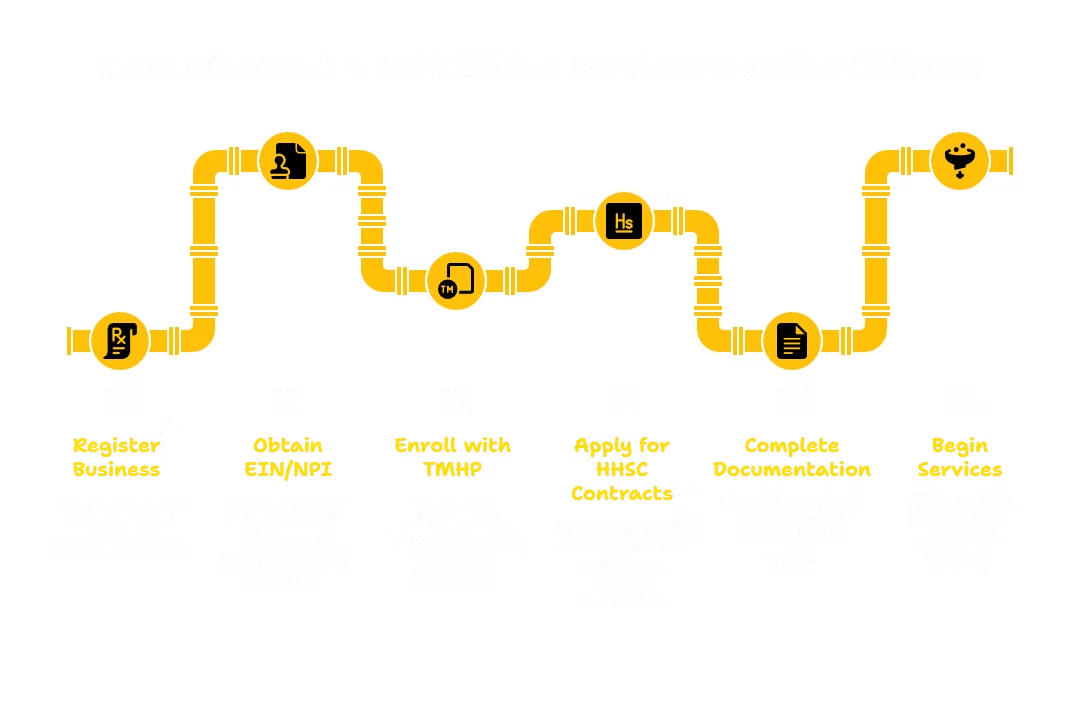
The journey to becoming a provider begins with formalizing the business entity and registering with the state. Founders must secure an Employer Identification Number (EIN) and a Type 2 National Provider Identifier (NPI) to function within the healthcare system. Once the entity is established, the provider must enroll with the Texas Medicaid & Healthcare Partnership (TMHP), which serves as the fiscal agent for Texas Medicaid.
The enrollment sequence requires meticulous attention to detail to avoid delays in authorization. The process generally follows this trajectory:
- Entity Formation: Register the business with the Texas Secretary of State and obtain all necessary tax and identification credentials.
- Medicaid Enrollment: Complete the provider enrollment application through TMHP, identifying the relevant waiver programs (HCS, CLASS, TxHmL, or DBMD).
- Contract Application: Submit formal contract applications to HHSC for the specific waiver programs intended for operation.
- Readiness Review: Prepare for and successfully undergo an HHSC readiness review, which involves demonstrating that staff are credentialed, policies are in place, and systems for documentation are operational.
Staffing Requirements and Professional Standards
The quality of habilitation services rests on the competence of the Habilitation Specialist or Direct Support Professional (DSP). These individuals are the frontline representatives of the provider agency and must meet strict qualification standards. At a minimum, staff must possess a high school diploma or GED, maintain current CPR and First Aid certifications, and pass a comprehensive criminal background check.
Beyond basic qualifications, the agency is responsible for ensuring ongoing training and supervision. A Habilitation Supervisor should be designated to oversee team performance, monitor goal progress, and ensure that documentation accurately reflects the service provided. Required training curricula for all staff include:
- Risk Management: Mandatory training on the prevention, detection, and reporting of abuse, neglect, and exploitation.
- Person-Centered Practices: Instruction on protecting participant rights and implementing individualized support strategies.
- Service-Specific Training: Practical instruction on activity-specific skills, safety protocols, and transportation safety where community engagement is involved.
Frequently Asked Questions
What documentation must a provider maintain for Medicaid audits?
Providers must maintain detailed records, including the individual's current PDP or IPC, daily service logs, progress notes toward specific goals, staff training files, incident reports, and HIPAA-compliant participant records. Billing templates must align perfectly with the services authorized in the plan of care.
How does a provider move from enrollment to receiving referrals?
After completing the enrollment with TMHP and securing the HHSC contract, the agency must pass a readiness review. Once these hurdles are cleared, the agency becomes visible in the state’s service provider database, allowing Case Managers and Service Coordinators to refer eligible participants based on the provider's capacity and specialization.
Are habilitation services the same for all waiver programs?
While the fundamental goal of habilitation—teaching independence—remains consistent, the specific service definitions, billing codes, and intensity of support can vary between HCS, CLASS, TxHmL, and DBMD. Providers must ensure their internal policy manuals reflect the specific rules governing each waiver program they are contracted to provide.
Strategic Implementation and Timeline
Launching a habilitation provider agency is a multi-phased endeavor that typically spans several months. The initial phase involves business formation and the drafting of essential policy manuals, which serves as the foundation for all future operations. Following this, the focus shifts to the administrative burden of TMHP enrollment and HHSC contract negotiations.
The final phase focuses on human capital—hiring, credentialing, and training the workforce. By following a structured timeline, founders can ensure they are fully prepared for the readiness review. Successfully navigating this process leads to the final step: accepting authorizations and beginning service delivery to participants in the community.
WCG provides specialized support for providers looking to launch or scale their operations. Services include assistance with TMHP and HHSC enrollment, the creation of custom Policy & Procedure Manuals, and the development of documentation and billing tools designed to ensure ongoing compliance with Texas Medicaid standards.
Key Takeaway: Success as a Texas Habilitation Services provider relies on a deep commitment to regulatory compliance, rigorous staff training, and the consistent documentation of goal-based, person-centered services. By adhering to the standards set by HHSC and CMS, providers ensure both the longevity of their business and the high-quality care of the individuals they serve.
Last verified: 2024. This information is provided for educational purposes and does not constitute legal or financial advice. Always consult with the Texas Health and Human Services Commission (HHSC) or a qualified consultant for the most current regulatory updates and requirements specific to your provider status.