HABILITATION SERVICES PROVIDER IN PENNSYLVANIA
By Fatumata Kaba · 2025-10-08 · 6 min read
Habilitation Services in Pennsylvania are Medicaid-funded supports designed to help individuals with intellectual or developmental disabilities (IDD) acquire, retain, and improve the self-help, social, and adaptive skills necessary for independent living and community inclusion. These services, administered through the Department of Human Services (DHS) Office of Developmental Programs (ODP), are provided under Home and Community-Based Services (HCBS) waivers to ensure participants receive person-centered care that aligns with their Individual Support Plan (ISP) goals.
Operating a habilitation provider agency in Pennsylvania requires a deep understanding of the regulatory environment, state-specific enrollment procedures, and federal compliance standards. By focusing on high-quality service delivery and administrative rigor, providers can effectively support individuals in navigating their daily lives while fulfilling the strict requirements set forth by state and federal oversight agencies.
Navigating the Regulatory Landscape for Pennsylvania Habilitation Providers
The delivery of habilitation services in Pennsylvania is governed by a multi-layered regulatory framework. At the federal level, the Centers for Medicare & Medicaid Services (CMS) sets the standards for all 1915(c) HCBS waivers, ensuring that states maintain health, safety, and quality protections for participants. Providers must demonstrate compliance with these federal mandates to participate in the Medicaid program.
At the state level, the Pennsylvania Department of Human Services (DHS) and the Office of Developmental Programs (ODP) exercise primary oversight. ODP manages the Consolidated, Community Living, and P/FDS waivers, which authorize and fund habilitation services. Administrative Entities (AEs) and County MH/ID offices act as the local operational arms of this system, responsible for reviewing provider qualifications, authorizing services, and conducting ongoing quality monitoring.
Additionally, prospective agencies must ensure legal compliance through the Pennsylvania Department of State. Proper business registration is a foundational step, as is securing the necessary insurance coverages, including liability, workers’ compensation, and commercial vehicle insurance. Maintaining rigorous adherence to these agency requirements is essential for long-term operational success.
Establishing Your Habilitation Service Model
Habilitation services are designed to be person-centered and outcomes-based, focusing on structured instruction and coaching rather than mere supervision. Providers typically offer a suite of services, including In-Home and Community Habilitation, which focuses on daily living activities, communication, and social integration. Additionally, agencies often provide Companion Services for non-skilled social support and Life Skills Coaching to assist with financial management, transportation, and cooking.
Behavioral skill development is another critical component, requiring the implementation of strategies outlined in a participant's formal behavioral support plan. For those in day programs, Community Participation Support (CPS) offers group-based learning in community settings. Success in these service areas depends on the agency's ability to maintain precise documentation, including daily logs, progress tracking against ISP goals, and accurate Medicaid billing forms.
- In-Home & Community Habilitation: Skill building in ADLs and problem-solving.
- Companion Services: Non-skilled support for community engagement.
- Behavioral Skill Development: Implementing specific behavioral support strategies.
- Life Skills Coaching: Practical training for personal and financial independence.
- Community Participation Support: Structured group-based social engagement.
The Pennsylvania Provider Enrollment Process
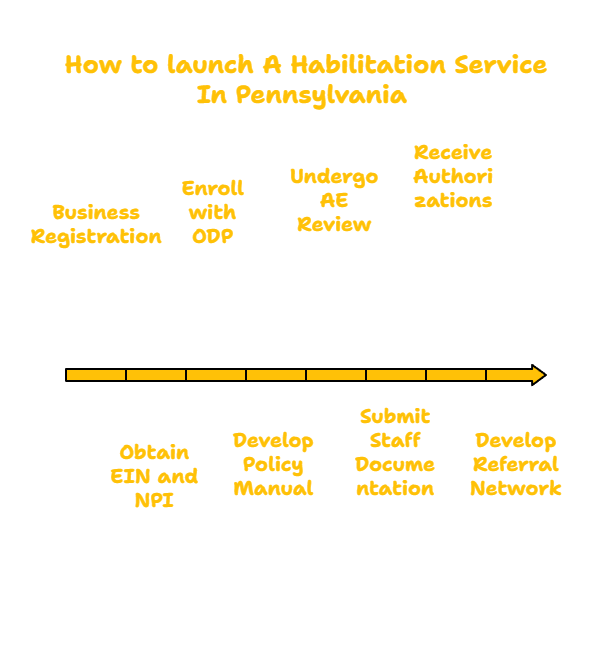
Becoming an approved provider in Pennsylvania is a structured, multi-phase undertaking that begins with establishing a formal business entity. Once the entity is registered and equipped with an EIN and a Type 2 NPI, the agency must initiate the qualification process through the ODP’s Home and Community Services Information System (HCSIS). This digital portal serves as the centralized hub for service authorizations and provider data.
After the initial registration and credentialing, the agency undergoes a review process conducted by the local Administrative Entity (AE) or County MH/ID office. This stage often involves a site visit to verify that the agency is prepared to provide services in accordance with state guidelines. Providers must be prepared to submit comprehensive documentation, including detailed professional resumes for key staff, proof of insurance, and evidence of organizational policies that meet state standards.
Upon successful review and qualification, the agency enters the active provider network. From this point forward, the focus shifts to coordinating with Supports Coordinators, who manage the ISP process for individuals, to receive service authorizations. Consistent adherence to HCSIS reporting protocols is critical to maintaining an active status and ensuring timely billing for delivered services.
Developing Essential Documentation and Compliance Protocols
A robust Policy and Procedure Manual is the cornerstone of any compliant habilitation agency. This document must clearly define how the provider will operate within the scope of ODP regulations while maintaining high standards for participant care. It must address essential topics such as service delivery models, staff supervision, and risk mitigation strategies, including formal incident reporting procedures.
Your documentation system should be designed to track not only billing data but also the qualitative impact of services. Procedures for documenting ISP goal attainment, HIPAA compliance, and participant rights must be explicitly outlined. Every staff member should be trained to utilize standardized templates for service logs and shift notes to ensure uniformity across the organization and to protect the agency during routine audits or quality reviews.
- ISP implementation protocols and goal tracking.
- Incident management and reporting procedures for participant safety.
- HIPAA compliance and confidential records management.
- Standardized templates for daily logs, progress notes, and billing.
- Protocols for communication support and participant rights.
Staffing, Training, and Quality Assurance
The quality of your program is directly proportional to the competency of your Direct Support Professionals (DSPs). All personnel must undergo rigorous vetting, including comprehensive background checks and specific training in abuse prevention, ISP implementation, and emergency protocols. Training should not be a one-time event; it must be an ongoing commitment that includes annual performance evaluations and mandatory training renewals to keep staff aligned with current ODP practices.
Supervisors and Program Coordinators play a vital role in quality assurance by monitoring staff performance and ensuring that services are delivered consistently. For staff involved in specialized areas like behavioral support, additional training or consultation with Behavior Specialist Consultants is required. By fostering a culture of professional development, agencies can ensure that every interaction between staff and participants contributes meaningfully to the individual’s personal growth and independence.
Frequently Asked Questions
How long does the provider enrollment process take?
The timeline varies based on organizational readiness, but typically involves 1–2 months for business registration and manual development, followed by 2–3 months for ODP qualification and AE review. Additional time is needed for hiring and training staff.
What are the primary funding sources for these services?
Habilitation services are primarily funded through Pennsylvania’s ODP-managed waivers: the Consolidated Waiver, the Community Living Waiver, and the Person/Family Directed Support (P/FDS) Waiver.
What is the role of the Administrative Entity (AE)?
The AE, or county MH/ID office, is responsible for reviewing provider qualifications, authorizing services for participants, and performing quality monitoring to ensure agencies remain in compliance with ODP and CMS standards.
WAIVER CONSULTING GROUP’S START-UP ASSISTANCE SERVICE — PENNSYLVANIA HABILITATION PROVIDER
WCG helps new Habilitation providers in Pennsylvania build robust, person-centered programs that empower clients and meet all compliance requirements. Our scope of work includes business registration assistance, ODP provider qualification guidance, policy manual development, staff onboarding materials, and the creation of systems for ISP implementation, incident reporting, and billing.
Key Takeaway: Successful habilitation providers in Pennsylvania must balance efficient business operations with a commitment to person-centered outcomes. By mastering the ODP qualification process, maintaining rigorous documentation standards, and investing in continuous staff training, providers can build sustainable, compliant agencies that meaningfully improve the lives of individuals with disabilities.
Last verified: May 2024. The information provided in this article is for educational purposes and does not constitute legal or financial advice. Readers should consult directly with the Pennsylvania Department of Human Services (DHS) and their local Administrative Entity for the most current regulatory guidance and to confirm specific requirements for their unique service models.