HABILITATION SERVICES PROVIDER IN OREGON
By Fatumata Kaba · 2025-10-06 · 5 min read
Becoming a habilitation services provider in Oregon involves navigating a structured regulatory landscape designed to ensure high-quality, person-centered support for individuals with intellectual and developmental disabilities (IDD). Providers must successfully integrate with the Oregon Department of Human Services (ODHS) Developmental Disabilities Services (DDS) and the Oregon Health Authority (OHA) to deliver Medicaid-funded care that fosters community integration and daily living skills.
What is the Role of a Habilitation Services Provider?
Habilitation services are distinct from rehabilitation because they focus on helping individuals with IDD acquire, maintain, or improve the essential skills needed to live more independently. While rehabilitation aims to restore a skill that has been lost, habilitation is fundamentally about growth and development. By providing these services under Oregon’s HCBS waivers and the K Plan, providers play a vital role in enabling participants to engage meaningfully with their communities.
Providers are responsible for a wide range of supports that vary based on the specific needs outlined in a participant’s Individual Support Plan (ISP). These services may range from intensive in-home training on hygiene and safety to community-based support that focuses on navigating public transit, building social skills, and accessing inclusive recreational opportunities. Success in this field requires a deep commitment to the philosophy of independence and autonomy.
How Do You Navigate the Regulatory Agencies?
The Oregon system is tiered, requiring coordination between state and federal authorities to ensure compliance and funding eligibility. The Oregon Department of Human Services (ODHS) — Developmental Disabilities Services (DDS) acts as the primary oversight body, managing the approval of services and the certification of providers through local Community Developmental Disabilities Programs (CDDPs). Understanding the relationship between these agencies is essential for any administrative lead.
In addition to state agencies, the Oregon Health Authority (OHA) administers the Oregon Health Plan (OHP) and serves as the gateway for Medicaid provider enrollment. Simultaneously, providers must ensure their operations align with the federal standards set by the Centers for Medicare & Medicaid Services (CMS). Maintaining compliance across these layers involves rigorous record-keeping, adherence to Medicaid billing requirements, and, at the foundational level, ensuring the business entity is properly registered with the Oregon Secretary of State (SOS).
What Are the Essential Steps for Provider Certification?
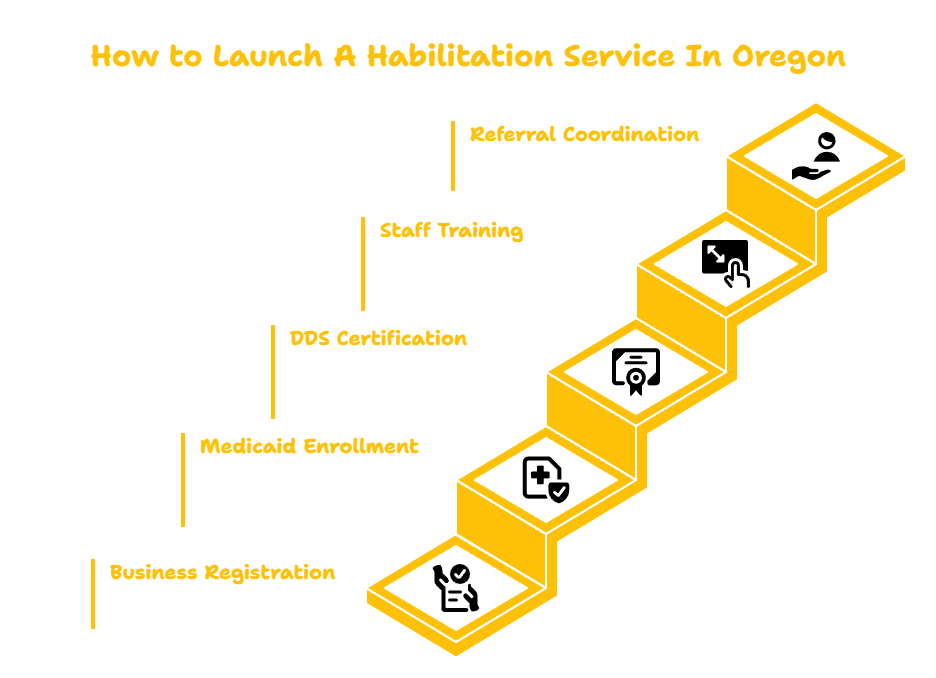
The journey to becoming a certified provider begins with formal business entity creation, such as establishing an LLC or a nonprofit organization. Once the business is established and an EIN and Type 2 NPI have been secured, the provider must navigate the OHA provider enrollment process. This is the crucial stage where a business officially enters the Medicaid ecosystem.
Following OHA enrollment, the prospective provider must work closely with their local CDDP to undergo the DD service provider certification process. This phase involves demonstrating that the organization has the necessary administrative infrastructure, insurance coverage (including general liability and workers' compensation), and operational policies to support individuals with IDD safely and effectively. The process is thorough, designed to ensure that every new provider can deliver care that meets the state's stringent quality standards.
- Register the business with the Oregon Secretary of State and obtain an EIN and Type 2 NPI.
- Enroll as a Medicaid provider through the Oregon Health Authority (OHA) Provider Portal.
- Complete the DDS certification process in coordination with the local CDDP.
- Establish comprehensive liability and workers’ compensation insurance policies.
- Develop a robust Habilitation Services Policy & Procedure Manual that meets all state-mandated requirements.
What Documentation Is Required for Operational Readiness?
Operational readiness is measured by the quality and comprehensiveness of a provider’s documentation system. Before serving the first participant, a provider must have a well-structured Habilitation Services Policy & Procedure Manual. This document serves as the backbone of the organization, outlining how the provider will handle everything from individual support planning and behavior intervention to incident reporting and staff supervision.
Internal documentation must be audit-ready at all times. This includes maintaining clear, HIPAA-compliant records of staff training, participant rights materials, and detailed service tracking forms. Data collection is not merely an administrative burden; it is a critical component of the person-centered planning process. Accurate documentation of ISP goals and progress allows the care team to adjust strategies in real-time, ensuring that services remain relevant to the participant’s evolving needs.
How Should Staffing and Training Be Managed?
The quality of habilitation services relies heavily on the expertise and compassion of the staff. The Direct Support Professional (DSP) or Habilitation Specialist is typically the individual providing daily care, meaning they must be trained in person-centered planning, ADL/IADL skill-building, and safety protocols. Beyond the DSP, an organization needs a Program Coordinator or Supervisor to oversee client schedules and ensure that the delivery of care aligns with the ISP and Medicaid regulations.
Training requirements are extensive and mandatory for all personnel. Staff must complete ODHS core competency training, which covers essential topics such as abuse reporting, First Aid/CPR, HIPAA compliance, and the intricacies of documenting ISP goals. Because these roles directly impact the health and safety of participants, annual recertification and performance evaluations are strictly enforced to maintain a high standard of care throughout the organization.
Frequently Asked Questions
What types of Medicaid waivers fund these services?
Habilitation services are primarily funded through the Comprehensive Waiver, the Support Services Waiver, the Children’s DD Waiver, and the 1915(k) Community First Choice option. Each waiver has specific eligibility criteria and service scopes tailored to the participant's living situation and level of need.
What is the typical timeline to launch a new agency?
Launching a habilitation agency is a multi-phase process. Business registration and manual development typically take 1–2 months, followed by 2–3 months for Medicaid enrollment and DDS certification. Staff recruitment and training follow, usually requiring 30–60 days before service activation can commence in coordination with the local CDDP.
Where can I find the official resources for provider enrollment?
Key information is available through the Oregon Department of Human Services (DDS) website, the Oregon Health Authority (OHA) portal, and the official CMS website for federal guidelines. Local CDDPs are the primary point of contact for specific regional certification guidance.
Key Takeaway
Establishing a habilitation services agency in Oregon requires a meticulous approach to administrative compliance, staff training, and collaborative partnership with the CDDP network. By prioritizing person-centered care and maintaining rigid adherence to Medicaid, DDS, and OHA guidelines, providers can build sustainable, high-impact programs that significantly enhance the lives of Oregonians with developmental disabilities.
Last verified by Waiver Consulting Group. Disclaimer: This information is for educational purposes only and does not constitute legal or professional advice. Always verify current state requirements through the Oregon Department of Human Services and the Oregon Health Authority websites.