HABILITATION SERVICES PROVIDER IN NORTH DAKOTA
By Fatumata Kaba · 2025-09-18 · 5 min read
Becoming a Habilitation Services provider in North Dakota allows agencies to play a critical role in supporting individuals with disabilities to achieve greater independence through structured skill development. By participating in North Dakota’s Medicaid Home and Community-Based Services (HCBS) waiver programs, providers deliver person-centered interventions that foster autonomy, community inclusion, and improved quality of life for vulnerable populations.
What is the Scope of Habilitation Services in North Dakota?
Habilitation services are designed to assist individuals in acquiring, maintaining, and improving the essential skills required for daily living and meaningful community involvement. Unlike rehabilitative services that focus on restoring lost functions, habilitation is centered on helping participants develop new abilities that they may have never acquired due to developmental or chronic conditions. These services are highly individualized, reflecting the unique goals and personal preferences of each participant.
Providers are expected to implement comprehensive service plans that cover a wide range of developmental domains. By focusing on both functional and social outcomes, habilitation services act as a bridge between clinical support and independent living. Successful service delivery hinges on the provider's ability to maintain high-quality documentation that tracks participant progress against specific, measurable goals established in their individualized service plan.
- Personal Skill Development: Training in hygiene, grooming, and daily self-care routines.
- Social Interaction Skills: Teaching communication, relationship-building, and conflict resolution.
- Community Living Skills: Budgeting, meal planning, and using public transportation.
- Vocational and Educational Support: Preparing for employment through skills workshops and assisting with lifelong learning activities.
- Behavioral and Adaptive Training: Addressing behavioral challenges and developing coping mechanisms.
Which Regulatory Agencies Govern Habilitation Services?
The delivery of habilitation services in North Dakota is subject to strict oversight by both state and federal authorities to ensure compliance with Medicaid standards. At the state level, the North Dakota Department of Human Services (NDDHS) serves as the primary governing body. NDDHS is responsible for administering the Medicaid waiver funding, overseeing the provider enrollment process, and ensuring that all services authorized are delivered in alignment with state policy.
In addition to NDDHS, the Medical Services Division (MSD) plays a key role in managing waiver services and overseeing Medicaid provider participation. For services targeting the elderly or adults with specific disabilities, the North Dakota Division of Aging Services provides additional oversight. Federally, the Centers for Medicare & Medicaid Services (CMS) sets the overarching standards for quality, safety, and person-centered care that all North Dakota waiver programs must satisfy to maintain federal financial participation.
How Do Providers Secure Medicaid Enrollment and Authorization?
The path to becoming an approved provider begins with establishing a formal business entity and ensuring all administrative prerequisites are in place. Agencies must register with the North Dakota Secretary of State and obtain both an Employer Identification Number (EIN) from the IRS and a Type 2 National Provider Identifier (NPI). These are the foundational requirements for interacting with the state’s healthcare billing infrastructure.
Once the business is legally formed, the provider must enroll via the North Dakota Medicaid Management Information System (MMIS). This process involves submitting detailed documentation, including insurance certificates and a comprehensive Habilitation Services Policy & Procedure Manual. Following the initial application, NDDHS and MSD perform a program readiness review. This evaluation focuses on whether the provider has the infrastructure in place to handle staff training, safety protocols, and billing in accordance with Medicaid requirements.
What Are the Essential Staffing and Credentialing Requirements?
Effective habilitation services require a qualified, well-trained, and vetted workforce. Agencies must designate a Habilitation Program Director who holds a Bachelor’s or Master’s degree in social work, human services, or healthcare administration. This individual is responsible for ensuring the program adheres to all state regulations and maintains high standards of service delivery.
Direct Support Professionals (DSPs) serve as the backbone of the agency, providing the day-to-day assistance that facilitates skill growth. These individuals must have proven experience in personal care and community engagement. Furthermore, agencies often employ Behavioral Specialists—who should hold certifications in applied behavior analysis (ABA) or similar qualifications—and Skill Development Coordinators to manage specialized training. Regardless of role, every staff member must undergo background clearances and complete rigorous initial and ongoing training in person-centered planning, HIPAA compliance, participant rights, and emergency response.
What Documentation Is Required for Long-Term Compliance?
Maintaining regulatory compliance requires a robust documentation system. Providers must create and adhere to a detailed Habilitation Services Policy & Procedure Manual. This document serves as the agency's primary operational guide, detailing how the provider will manage participant care, staff supervision, and billing. It must include clear protocols for skill development, social integration, and vocational support, as well as specific procedures for handling grievances and protecting participant rights.
Beyond internal manuals, providers must maintain meticulous clinical records for every participant. This includes evidence of the Habilitation Plan, progress notes, and documentation of all care provided for billing purposes. Quality assurance systems should be integrated into the workflow to ensure that documentation standards are consistently met, protecting the agency during potential audits or state inspections.
Frequently Asked Questions
Which Medicaid waivers currently support Habilitation Services in North Dakota?
Habilitation services are authorized under several key North Dakota Medicaid waivers, including the Aged and Disabled Waiver, the Technology Dependent Waiver, the Developmental Disabilities Waiver, and the broader Home and Community-Based Services (HCBS) Waiver.
How long should an agency expect the enrollment process to take?
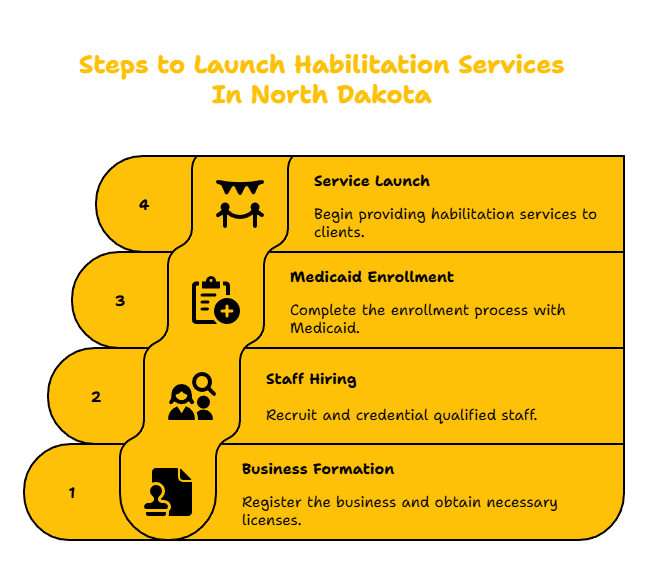
The total timeline from business formation to active billing generally spans several months. Business formation takes 1-2 months, followed by 2-3 months for staff hiring and credentialing. The North Dakota Medicaid provider enrollment and readiness review typically requires 60-90 days, with an additional 30-45 days for final billing setup.
What are the primary responsibilities of the Habilitation Program Director?
The Director is responsible for overseeing the entire habilitation program, ensuring compliance with NDDHS standards, managing the professional development of staff, ensuring that documentation for Medicaid billing is accurate, and upholding the quality of care for all program participants.
Strategic Support for New Agencies
WCG provides specialized support for agencies aiming to launch Medicaid-compliant Habilitation Services in North Dakota. Our assistance covers the entire lifecycle of program development, from initial business registration and Medicaid enrollment to the drafting of comprehensive policy manuals. We assist in establishing staff credentialing systems, developing training programs, and configuring Medicaid billing protocols to ensure agencies remain audit-ready from day one. By providing structured templates and quality assurance strategies, we help providers navigate the complexities of North Dakota’s regulatory environment, allowing administrators to focus on the core mission of client skill development and community integration.
Key Takeaway: Establishing a successful Habilitation Services agency in North Dakota requires a strategic approach to regulatory compliance, meticulous documentation, and a commitment to person-centered care. Providers who prioritize strong administrative infrastructure and rigorous staff training are best positioned to meet the standards of the NDDHS and deliver impactful outcomes for participants.
Last verified: May 2024. This information is for educational purposes only and does not constitute legal or professional advice. Always refer to the official North Dakota Department of Human Services (NDDHS) and CMS guidelines for the most current regulatory updates.