HABILITATION SERVICES PROVIDER IN MAINE
By Fatumata Kaba · 2025-08-12 · 5 min read
Becoming a Habilitation Services provider in Maine requires a thorough understanding of the state’s intellectual and developmental disability (IDD) support infrastructure and its strict regulatory environment. By aligning business operations with the Maine Department of Health and Human Services (DHHS) and the Office of Aging and Disability Services (OADS), providers can deliver essential supports that foster independence and community integration under the state’s robust Medicaid waiver programs.
How Do Habilitation Services Support Individuals with IDD in Maine?
Habilitation Services are foundational to the MaineCare (Medicaid) model, designed to help individuals with intellectual and developmental disabilities (IDD) acquire, retain, and improve the life skills necessary for self-determination. These services shift the focus from traditional care-taking to active skill-building, enabling participants to engage more fully in their homes and communities. By focusing on developmental milestones and functional independence, these services help participants bridge the gap between their current capabilities and their personal goals.
The scope of these services is highly individualized, dictated by a participant’s unique Individualized Service Plan (ISP). Through a person-centered planning process—involving the participant, their family, and their assigned case manager—services are tailored to specific growth areas. Whether the goal is improving daily hygiene routines, mastering public transportation, or building vocational readiness, the provider acts as a facilitator for personal growth and social inclusion.
What Are the Governing Agencies and Regulatory Frameworks?
Success as a MaineCare provider depends on navigating a multi-layered regulatory environment. The Maine Department of Health and Human Services (DHHS), specifically the Office of Aging and Disability Services (OADS), serves as the primary authority for overseeing waiver programs and establishing the standards for habilitative support. Their role is to ensure that service delivery remains consistent with state goals for community-based care.
Beyond state-level oversight, several other entities play critical roles in compliance:
- Office of MaineCare Services (OMS): Manages the financial side of operations, including provider enrollment and Medicaid reimbursement protocols.
- Centers for Medicare & Medicaid Services (CMS): Sets the federal standards for 1915(c) waivers, ensuring that state-level services meet strict person-centered planning and HCBS settings requirements.
- Division of Licensing and Certification: Holds responsibility for regulating licensed agencies that provide facility-based or residential habilitative care, ensuring safety and quality standards are maintained.
How Do You Meet Licensing and Provider Approval Requirements?
The path to becoming a recognized provider starts with rigorous administrative groundwork. Before an agency can begin billing for services, it must establish legal standing by registering the business with the Maine Secretary of State and obtaining an IRS EIN and a Type 2 NPI. These documents form the core of the provider’s legal identity in the MaineCare ecosystem. Following registration, agencies must develop a comprehensive Habilitation Services Policy & Procedure Manual, which serves as the operational roadmap for staff and surveyors alike.
Once the legal foundation is set, the provider must engage in the specific enrollment process for Section 21 (Comprehensive Waiver) or Section 29 (Support Waiver). This involves submitting detailed staffing plans, safety protocols, and service delivery models to OADS for review. Additionally, providers must ensure they maintain comprehensive liability insurance and a HIPAA-compliant documentation system, as these are non-negotiable requirements for auditing and ongoing compliance.
What Does the Provider Enrollment and Launch Process Look Like?
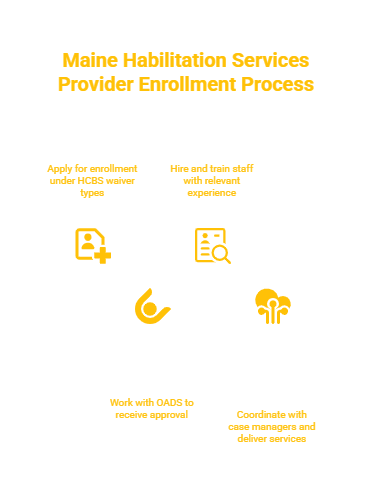
The enrollment process is sequenced to ensure that quality standards are met before the first unit of service is delivered. Initially, providers must navigate the MaineCare Provider Enrollment Portal to select the correct waiver provider types. Once the application is submitted, coordination with OADS is essential to receive authorization for service delivery. This phase requires patience, as the state must verify the provider’s readiness to support vulnerable populations.
Following approval, the final steps involve operational readiness. This includes:
- Hiring Direct Support Professionals (DSPs) who possess the necessary background and training in IDD support.
- Establishing formal relationships with case managers to facilitate the referral process.
- Finalizing the internal systems for tracking ISP-driven goals and daily activity logs.
- Implementing staff orientation programs that emphasize participant rights, abuse prevention, and positive behavioral support.
What Are the Essential Documentation and Staffing Requirements?
Maintaining high-quality documentation is the most critical task for any Habilitation Services provider. Every interaction that supports a participant's ISP goals must be recorded, tracked, and ready for audit. This includes daily activity documentation, incident reports, behavioral support protocols, and detailed Medicaid billing records. Without these records, an agency cannot demonstrate the efficacy of their service or justify their reimbursement claims to MaineCare.
Staffing also plays a pivotal role in maintaining compliance. DSPs are required to hold at least a high school diploma or GED and must undergo state-mandated training and background checks. Program supervisors or coordinators are tasked with the oversight of these professionals, ensuring that the documentation produced by the staff is accurate and reflects the person-centered goals established in the ISP. All personnel must remain current in their training regarding HIPAA, mandatory reporting, and community integration strategies.
Frequently Asked Questions
Which MaineCare waivers cover Habilitation Services?
Habilitation services are primarily funded through the Section 21 (Comprehensive Waiver) and the Section 29 (Support Waiver). Additionally, children may receive habilitation-like supports through Section 28 under Children’s Behavioral Health Services (CBHS).
How long does the provider enrollment process typically take?
Business registration and licensing usually take 1–2 months, followed by a 60–90 day period for MaineCare enrollment and OADS approval. Hiring and onboarding staff adds another 3–4 weeks to the launch timeline.
What should be included in my Policy & Procedure Manual?
Your manual should include intake and assessment templates, ISP alignment tools, daily activity logs, incident reporting protocols, HIPAA and participant rights agreements, and comprehensive staff training and credentialing logs.
Key Takeaway for New Providers
Launching a Habilitation Services agency in Maine is a commitment to regulatory excellence and person-centered support. By prioritizing accurate documentation, rigorous staff training, and close coordination with OADS and case management entities, new providers can successfully build a sustainable program that empowers individuals with IDD to achieve their highest level of independence and community integration.
Waiver Consulting Group provides expert assistance to human services agencies and IDD professionals looking to navigate the complexities of launching compliant Habilitation Services in Maine. Our services cover Section 21/29 MaineCare enrollment, Policy & Procedure manual development, DSP supervision frameworks, and audit-ready quality assurance systems to ensure your agency is prepared for success. Last verified: 2024. The information provided is for educational purposes only and does not constitute legal or financial advice; providers should consult directly with the Maine Department of Health and Human Services (DHHS) and the Office of MaineCare Services (OMS) for official guidance and current state regulations.