HABILITATION SERVICES PROVIDER IN HAWAII
By Fatumata Kaba · 2025-07-16 · 5 min read
Habilitation Services in Hawaii empower individuals with intellectual and developmental disabilities to achieve greater independence by fostering essential life skills, facilitating community integration, and supporting vocational potential. These services are vital components of Hawaii’s Medicaid Home and Community-Based Services (HCBS) waiver programs, requiring providers to adhere to rigorous standards set by state and federal agencies to ensure person-centered, high-quality care.
Understanding the Role of Habilitation Services in Hawaii’s HCBS Waivers
Habilitation Services serve as a foundational pillar within Hawaii’s Medicaid framework, specifically targeting the acquisition, retention, and improvement of skills necessary for individuals to thrive in their homes and communities. By focusing on person-centered outcomes, these services help participants navigate daily life with increased autonomy. Whether through in-home instruction or community-based engagement, the primary objective is to move beyond mere supervision and toward tangible skill development.
Under the oversight of the Hawaii Department of Health (DOH) Developmental Disabilities Division (DDD) and the Department of Human Services (DHS) Med-QUEST Division, these services are designed to be dynamic. Providers are expected to move away from custodial care models and instead implement strategies that actively build a participant’s capacity for self-advocacy, communication, and functional independence. Each service must be meticulously aligned with the participant’s Individualized Service Plan (ISP) to ensure that every interaction contributes to the individual’s long-term personal goals.
What Are the Core Service Offerings and Provider Responsibilities?
Providers authorized to deliver Habilitation Services must be prepared to support a diverse range of developmental needs. This includes direct assistance with Activities of Daily Living (ADLs)—such as grooming, bathing, and eating—as well as Instrumental Activities of Daily Living (IADLs), which include financial literacy, cooking, household maintenance, and shopping. The breadth of these services requires a provider to be multifaceted, balancing physical care with educational coaching.
In addition to foundational daily living skills, providers are responsible for facilitating social and community integration. This involves teaching communication techniques, assisting with mobility and orientation in public spaces, and offering support for pre-employment skill-building. By acting as coaches rather than just caregivers, Habilitation Specialists help participants break down barriers to participation, ensuring that each individual has the tools to make informed decisions about their daily life and future aspirations.
- Training and assistance with Activities of Daily Living (ADLs) such as bathing, dressing, grooming, and eating
- Support with Instrumental Activities of Daily Living (IADLs) such as cooking, money management, shopping, and household tasks
- Communication skills development and social skills training
- Mobility and orientation assistance
- Self-advocacy and decision-making support
- Pre-employment skill-building and support
What Are the Regulatory and Licensing Requirements for New Providers?
Establishing a Habilitation Services agency in Hawaii requires navigating a multi-layered regulatory environment. Before seeking Medicaid enrollment, an organization must formalize its business entity through the Hawaii Department of Commerce and Consumer Affairs (DCCA) and obtain the necessary federal identifiers, specifically an IRS Employer Identification Number (EIN) and a Type 2 National Provider Identifier (NPI). These foundational steps provide the legal and administrative structure necessary to operate as a healthcare entity within the state.
Beyond basic business registration, prospective providers must demonstrate operational readiness. This involves obtaining appropriate general and professional liability insurance and developing a comprehensive Policy & Procedure Manual. This manual acts as the backbone of the organization, detailing how the provider will maintain participant rights, ensure safety, respond to emergencies, and track individual progress. For those targeting the DD/ID Waiver specifically, DDD Provider Standards Certification is a critical milestone that must be reached before the agency can begin billing for services.
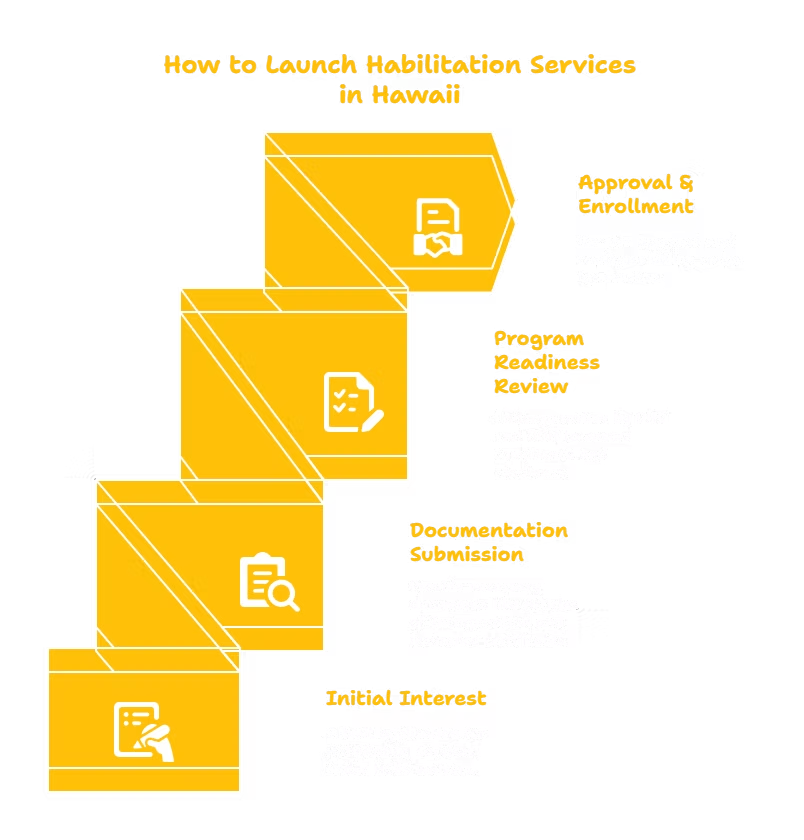
Navigating the Med-QUEST and DDD Provider Enrollment Process
The enrollment process is a structured sequence designed to verify a provider's capacity to deliver safe, effective, and compliant care. It begins with the initial application to the Med-QUEST Division, where the applicant must clearly delineate the intended scope of services, such as Community-Based Habilitation or In-Home Habilitation. During this phase, applicants must submit a portfolio of documentation including their Articles of Incorporation, staffing plans, and standardized templates for participant intake and habilitation planning.
Once the application is submitted, the program undergoes a rigorous readiness review by DHS and DOH. During this phase, agencies assess the provider’s protocols for service delivery, staff training, and incident reporting. The review ensures that the provider is fully integrated into the state’s quality assurance framework. Upon successful completion of this review and final approval, the provider can then configure their systems for Medicaid billing, enabling them to begin delivering services under the specific HCBS waiver authorizations.
Staffing, Training, and Clinical Supervision Standards
The quality of habilitation services is inherently tied to the competence and preparedness of the staff. Agencies must employ a Habilitation Program Manager or Supervisor who possesses a strong background in human services or a related field, ensuring that they can provide adequate oversight of the skill-building strategies used by the team. Direct Support Professionals (DSPs) serve as the frontline staff, and they must hold at least a high school diploma or GED along with mandatory CPR and First Aid certifications.
Training mandates are extensive and ongoing. All staff, regardless of their specific role, must undergo training in HIPAA compliance, participant rights, and the core tenets of person-centered planning. Furthermore, providers must ensure their team is proficient in emergency preparedness, abuse prevention, and incident reporting. Because these services are meant to evolve with the participant, annual refresher courses are required to ensure that the entire staff remains updated on the latest Medicaid compliance standards and habilitation techniques.
Frequently Asked Questions
What is the difference between Community-Based and In-Home Habilitation?
In-Home Habilitation focuses on skill development within the participant’s private residence, whereas Community-Based Habilitation is focused on teaching those same essential skills in integrated, public settings to promote broader social and community inclusion.
How long does the provider enrollment process typically take?
While timelines vary based on the completeness of the application, the initial setup phase takes 1–2 weeks, the Med-QUEST/DDD review takes 60–90 days, staffing takes 30–45 days, and the final billing system setup takes 45–60 days.
Are providers required to maintain specific documentation for billing audits?
Yes. Providers must maintain detailed daily service documentation that tracks specific skill-building outcomes. These records must be auditable and reflect direct alignment with the participant’s Individualized Service Plan (ISP) to remain compliant with Medicaid reimbursement requirements.
Key Takeaway
Launching a Habilitation Services agency in Hawaii requires a strategic approach to regulatory compliance, staff training, and administrative infrastructure. By prioritizing person-centered care and maintaining rigid adherence to the standards set by the Hawaii Med-QUEST Division and the Developmental Disabilities Division, providers can ensure both operational success and the meaningful improvement of the lives of the individuals they support.
Last verified: 2024. Disclaimer: This information is for educational purposes and does not constitute legal or professional advice. Always refer to the official Hawaii Department of Human Services (DHS) Med-QUEST Division and Department of Health (DOH) Developmental Disabilities Division (DDD) websites for the most current regulations and policy updates.