HABILITATION SERVICES PROVIDER IN GEORGIA
By Fatumata Kaba · 2025-07-14 · 5 min read
Becoming a Habilitation Services provider in Georgia is a high-impact way to support individuals with developmental disabilities by fostering essential skills for daily living, community integration, and long-term self-sufficiency. These services, authorized under Georgia’s Medicaid Home and Community-Based Services (HCBS) waivers, require a rigorous commitment to person-centered care, regulatory compliance, and administrative excellence.
To operate successfully, prospective providers must navigate a multi-agency regulatory landscape involving the Georgia Department of Behavioral Health and Developmental Disabilities (DBHDD), the Georgia Department of Community Health (DCH), and the federal Centers for Medicare & Medicaid Services (CMS). This guide outlines the essential steps and requirements for establishing a compliant, high-quality habilitation program in Georgia.
What Are the Governing Agencies for Habilitation Services?
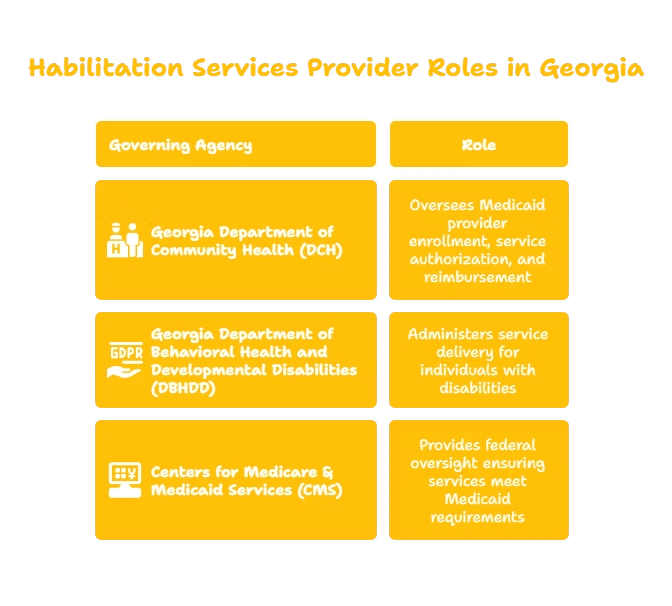
The regulatory framework for Habilitation Services in Georgia is distributed across three primary levels of oversight. Understanding the distinct roles of these agencies is critical for maintaining compliance and ensuring the seamless delivery of services to participants. Each agency plays a specific part in the funding, regulation, and quality assurance of the HCBS programs.
The Georgia Department of Community Health (DCH) serves as the single state Medicaid agency, responsible for provider enrollment, service authorization, and the reimbursement process. Simultaneously, the Georgia Department of Behavioral Health and Developmental Disabilities (DBHDD) acts as the operational authority, administering service delivery for individuals with intellectual and developmental disabilities through the state's waiver programs. Finally, the Centers for Medicare & Medicaid Services (CMS) provides federal oversight to ensure all services adhere to strict, person-centered planning requirements that prioritize the participant's choice and independence.
How Do Providers Define and Deliver Habilitation Services?
Habilitation Services are designed to provide individualized instruction that directly targets the unique needs of the participant. The core objective is to move beyond mere supervision, focusing instead on active skill acquisition, retention, and improvement. Providers are expected to implement strategies that empower individuals to navigate their environments with greater autonomy.
Approved providers deliver a wide array of support services, which must be explicitly tied to the participant’s Individual Service Plan (ISP). These services are intended to produce measurable outcomes that enhance the individual's quality of life. Common service categories include:
- Daily living skills training, including cooking, grooming, and financial management.
- Social and communication skills development.
- Mobility and transportation training for community navigation.
- Self-advocacy coaching and community integration activities.
- Support for recreational and educational pursuits.
- Behavior shaping and adaptive skill-building interventions.
What Are the Licensing and Provider Approval Prerequisites?
Launching a habilitation agency is a formal process that begins with establishing the business as a legal entity and meeting state-specific operational requirements. Before a provider can bill for Medicaid services, they must demonstrate that they have the infrastructure to manage clinical, fiscal, and administrative responsibilities safely and effectively.
Prospective providers must complete several foundational tasks, including registering the business with the Georgia Secretary of State, obtaining an Employer Identification Number (EIN) from the IRS, and securing a Type 2 National Provider Identifier (NPI). Following these steps, providers must enroll in the Georgia Medicaid Management Information System (GAMMIS) and pursue certification through the DBHDD, which may involve obtaining specific Behavioral Health/Developmental Disabilities (BHDD) certifications depending on the scope of care offered.
- Register business and obtain all federal tax identification.
- Enroll in GAMMIS to become a recognized Medicaid provider.
- Obtain necessary BHDD Provider Certification from DBHDD.
- Secure comprehensive general liability and professional insurance policies.
- Develop a robust, written policy and procedure manual that aligns with all Medicaid and DBHDD standards.
What Is the Step-by-Step DBHDD/DCH Enrollment Process?
The enrollment timeline is structured into distinct phases, beginning with the expression of intent and concluding with final Medicaid activation. The initial stage requires submitting a Letter of Intent to the DBHDD Provider Enrollment office, accompanied by a pre-qualification checklist that covers business registration, insurance coverage, and readiness to provide services.
Once the initial phase is cleared, the applicant enters the documentation and review phase. This involves the submission of Articles of Incorporation, staff credentials, and detailed operational protocols regarding intake, service delivery, and incident management. The DBHDD will then conduct a program readiness review, which may include site visits and inspections—particularly for those providing residential habilitation—to verify that staffing levels, safety plans, and emergency procedures meet the state’s high standards for participant well-being.
What Are the Essential Staffing and Training Requirements?
The quality of a habilitation program relies heavily on the qualifications and training of its workforce. Leadership roles, such as the Habilitation Services Supervisor or Program Manager, typically require a bachelor’s degree in a human services field and demonstrated experience in developmental disability services. Direct Support Professionals (DSPs) are required to hold at least a high school diploma or GED and must clear thorough background screenings.
All staff members, regardless of their role, are required to undergo comprehensive training to ensure they can provide safe and effective care. This includes mandatory instruction on person-centered planning, HIPAA confidentiality, participant rights, and emergency response procedures. Ongoing, annual continuing education is also required to ensure that staff remain current on best practices for supporting individuals with intellectual and developmental disabilities.
Frequently Asked Questions
Which specific Medicaid waivers authorize Habilitation Services in Georgia?
Habilitation Services are currently authorized under the Comprehensive Supports Waiver Program (COMP) and the New Options Waiver Program (NOW).
What documentation is needed for the policy and procedure manual?
The manual must contain procedures for participant intake and assessment, service planning and goal tracking, service delivery documentation, incident management, participant rights, and HIPAA confidentiality.
How long should a new provider expect the launch process to take?
The entire process typically takes several months, broken down into phases: 2–3 weeks for business formation, 90–120 days for DBHDD pre-qualification, 30–45 days for hiring and training, and 45–60 days for Medicaid billing configuration.
Key Takeaway
Successfully launching a Habilitation Services agency in Georgia demands strict adherence to the standards set by the DBHDD and DCH, focusing on rigorous documentation, staff competency, and person-centered service design. By carefully navigating the enrollment timeline and maintaining comprehensive, compliant operational procedures, new providers can ensure they meet the needs of individuals with disabilities while operating successfully within the Georgia Medicaid HCBS waiver system.
WAIVER CONSULTING GROUP’S START-UP ASSISTANCE SERVICE — GEORGIA HABILITATION SERVICES PROVIDER
WCG supports habilitation agencies, direct support organizations, and entrepreneurs in launching Medicaid-compliant Habilitation Services under Georgia’s Medicaid HCBS waiver programs. Our services include assistance with business registration, DBHDD provider pre-qualification, the development of comprehensive policy and procedure manuals, staff credentialing templates, and guidance on Medicaid billing systems.
Last verified: October 2023. This content is for informational purposes only and does not constitute legal or professional consulting advice. Always refer to the latest updates from the Georgia Department of Behavioral Health and Developmental Disabilities (DBHDD) and the Georgia Department of Community Health (DCH) for the most current regulatory requirements.