GROUP HOME SERVICES PROVIDER IN ALASKA
By Fatumata Kaba · 2025-07-03 · 6 min read
Understanding Group Home Services in Alaska
Group Home Services in Alaska provide structured, 24-hour residential care in a licensed setting for individuals with intellectual and developmental disabilities (IDD) who require ongoing support. These services are delivered under Alaska’s Home and Community-Based Services (HCBS) Medicaid Waiver programs, ensuring that residents receive high-quality, person-centered support in a community-based environment that fosters independence and social inclusion.
Operating a group home in Alaska requires a rigorous commitment to state licensing standards and federal oversight. Providers serve as essential partners in the healthcare ecosystem, delivering 24/7 supervision, assistance with activities of daily living (ADLs), and health monitoring. By adhering to the regulations set forth by the Alaska Department of Health’s Division of Senior and Disabilities Services (SDS) and the Centers for Medicare & Medicaid Services (CMS), providers ensure that individuals with disabilities can thrive safely within their own communities.
Who Regulates and Oversees Group Home Providers?
The regulatory framework for group homes in Alaska is bifurcated between licensing for the physical facility and enrollment for the Medicaid waiver service. The Alaska Department of Health’s Division of Senior and Disabilities Services (SDS) acts as the primary agency for oversight, ensuring that all providers comply with HCBS regulations, quality-of-care standards, and person-centered planning requirements. SDS monitors these homes to verify that the environment remains safe, therapeutic, and integrated into the local community.
Complementing the SDS role are state licensing authorities for Residential Assisted Living, which enforce environmental, fire, and health safety codes. Additionally, the Centers for Medicare & Medicaid Services (CMS) provides federal oversight to maintain the integrity of the HCBS program. Medicaid provider enrollment and reimbursement are administered through the Alaska Medicaid system, which ensures that services rendered under the IDD, APDD, and CCMC waivers are properly documented and billed in accordance with federal and state regulations.
- Alaska Department of Health – Division of Senior and Disabilities Services (SDS): Licenses and monitors group homes, ensures service quality, and enforces HCBS compliance.
- Alaska Medicaid (under the Department of Health): Administers provider enrollment, MMIS access, and reimbursement for waiver services.
- Centers for Medicare & Medicaid Services (CMS): Sets federal standards for person-centered, community-based care delivery.
What Are the Core Service Requirements and Operational Standards?
Group Home Services are designed to support individuals who require consistent supervision and assistance with daily tasks. Approved providers are expected to deliver a holistic range of support services that address both the clinical and social needs of the residents. This includes meticulous health monitoring, medication administration, and behavioral management, all while promoting the participant's individual goals as outlined in their person-centered service plan.
Beyond clinical care, the group home must function as a true community-based residence. This involves facilitating social and recreational activities, ensuring nutritious meal preparation, and maintaining a clean, accessible living space. Providers must maintain robust documentation systems to track daily progress, incidents, and health changes, as this data is essential for both regulatory auditing and the ongoing refinement of the individual's care plan.
- 24/7 supervision and comprehensive assistance with ADLs, such as bathing, dressing, and grooming.
- Medication administration and health-related clinical support.
- Individualized behavior management and skill-building programming.
- Social, recreational, and meaningful community engagement activities.
- Strict adherence to environmental, safety, and staffing standards as mandated by state and federal authorities.
What Are the Prerequisites for Licensure and Enrollment?
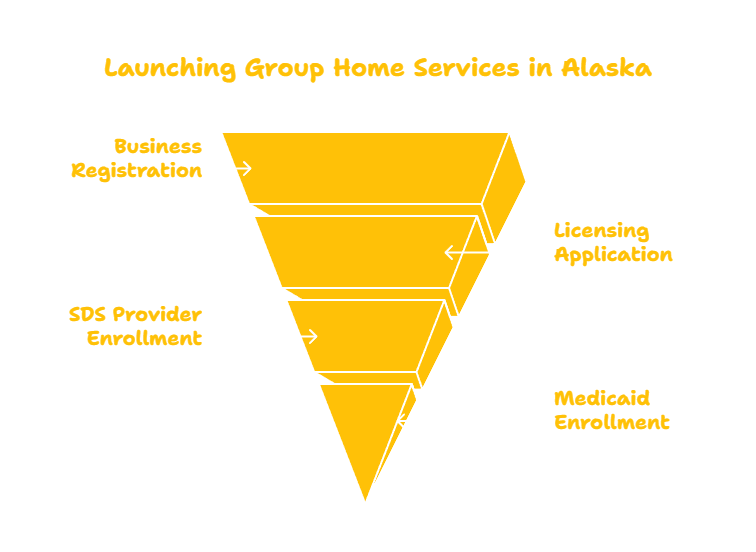
The path to becoming an approved provider begins with establishing a formal business entity and securing the necessary state-issued licenses. Before applying for Medicaid participation, an organization must be registered with the Alaska Division of Corporations, Business and Professional Licensing. A Type 2 NPI and an EIN are mandatory to initiate the process, alongside securing comprehensive insurance policies, including general liability and workers' compensation.
Once the business foundation is set, the applicant must obtain a Residential Assisted Living License through the Division of Health Care Services. This process involves a rigorous inspection of the facility to ensure it meets all local fire, health, and safety codes. Only after the facility is physically cleared and the business operations are fully documented can the provider proceed to the SDS provider enrollment phase, which aligns the home with specific HCBS waiver programs.
How Does the SDS Provider Enrollment Process Function?
The enrollment process is a structured, multi-phase undertaking. Initial steps involve contacting SDS to request the provider application packet and participating in recommended residential services training. During the application review, prospective providers must submit a detailed program plan that outlines house operations, staffing ratios, emergency protocols, and behavioral support models. The inclusion of floor plans and proof of zoning compliance is critical at this stage.
Following document review, the provider undergoes a readiness inspection conducted by SDS and state licensing officials. This inspection confirms that the facility is physically prepared to serve residents and that all staffing documentation, such as background checks and credentialing, is in full compliance. Once these hurdles are cleared, the final step involves enrollment through the Alaska MMIS, where the provider is officially registered to bill for Medicaid Group Home Services.
- Phase 1: Business formation and securing the Residential Assisted Living License.
- Phase 2: Submission of the program plan and facility readiness documentation to SDS.
- Phase 3: On-site physical inspection and staff credentialing verification.
- Phase 4: Medicaid enrollment via Alaska MMIS and finalization of the provider agreement.
How Are Staffing and Training Requirements Met?
The quality of a group home is fundamentally defined by its staff. Each home requires a qualified House Manager or Program Supervisor who possesses deep knowledge of HCBS standards and extensive experience in managing residential programs. Direct Support Professionals (DSPs) are the primary caregivers, and they must hold at least a high school diploma or GED, alongside current certifications in CPR and First Aid.
Ongoing education is a mandatory component of compliance. All staff must participate in initial and continuing training covering medication administration, ADL support, crisis intervention, and documentation ethics. Because group homes operate 24/7, providers must implement a robust staffing model that guarantees consistent supervision, emergency readiness, and adherence to individualized behavior support plans for every resident.
Frequently Asked Questions
What waivers authorize Group Home Services in Alaska?
Group Home Services are authorized under the Individuals with Intellectual and Developmental Disabilities (IDD) Waiver, the Adults with Physical and Developmental Disabilities (APDD) Waiver, and the Children with Complex Medical Conditions (CCMC) Waiver for minors.
What is the typical timeline for launching a group home?
The process is intensive, generally spanning 4 to 8 months. Business formation and licensing take roughly 2–4 weeks, followed by a 60–120 day period for application review, 30–60 days for staff readiness and training, and finally 45–60 days for Medicaid enrollment.
What core documents must a provider maintain?
Providers must maintain comprehensive records including, but not limited to, articles of incorporation, an NPI, a Residential Assisted Living License, fire safety inspection reports, and a full policy and procedure manual covering emergency plans, privacy rights, and daily progress documentation.
Key Takeaway
Establishing and operating a Group Home Service provider in Alaska requires a disciplined approach to regulatory compliance, facility management, and staff training. By strictly adhering to the standards set by the Division of Senior and Disabilities Services and the Alaska Medicaid program, providers can ensure the delivery of high-quality, person-centered care that meets the vital needs of individuals with intellectual and developmental disabilities while building a sustainable and professional service organization.
Last verified: October 2023. Disclaimer: This information is provided for educational purposes only and does not constitute legal or professional advice. Always consult directly with the Alaska Department of Health and the relevant licensing authorities for the most current regulations and program requirements.