From Subcontractor to Direct: Bill Medicaid in Your Own Name
By Fatumata Kaba · 2026-06-27 · 5 min read
Transitioning from a subcontracted entity to a directly enrolled Medicaid and managed care provider is a strategic move that grants an agency full control over its revenue cycle and brand identity. By billing Medicaid in your own name, you eliminate the administrative overhead of working through an intermediary and position your organization for long-term scalability within the Home and Community-Based Services (HCBS) landscape.
The shift from subcontractor to direct provider is a precise sequence of credentialing and administrative actions. Because state Medicaid agencies and Managed Care Organizations (MCOs) prioritize compliance, the order of these operations is as critical as the accuracy of the data submitted. Failure to align your provider profile across various national and state databases often results in application denials or significant processing delays.
Why Shift from Subcontractor to Direct Provider?
Working as a subcontractor for a larger agency often means sacrificing a portion of your reimbursement rates for the convenience of using the lead agency’s administrative umbrella. While this model is effective for startups, it limits your agency's ability to negotiate directly with payers and restricts your capacity to build your own institutional reputation with state oversight agencies.
By moving to a direct billing model, your organization gains:
- Direct Payment: Elimination of delays caused by waiting for a lead agency to process sub-payments.
- Contractual Autonomy: The ability to negotiate rates and service areas directly with MCOs.
- Independent Compliance: Full control over your quality assurance processes and direct communication channels with state surveyors.
Fix Your Taxonomy First
Everything in the provider enrollment ecosystem downstream depends on your National Provider Identifier (NPI) and the taxonomy codes associated with your record in the National Plan and Provider Enumeration System (NPPES). A taxonomy code acts as a descriptor of your specific service niche, and if it is missing or misaligned with the services you intend to deliver, your applications will stall at the portal level.
Before initiating any state-level paperwork, audit your NPPES record to ensure your taxonomy accurately reflects your HCBS service offerings. If your taxonomy is outdated or inconsistent with the scope of care you provide, state enrollment systems may automatically flag your file as non-compliant. Correcting this at the start prevents the common issue of downstream rejection where an application is denied due to an "unmatched service category."
Enroll with Medicaid and CAQH
Once your NPPES data is verified, the next step is completing your state Medicaid provider enrollment. This process officially recognizes your agency as a provider eligible to participate in the state’s HCBS waiver programs. This is not merely a registration but a rigorous vetting process that confirms your agency’s adherence to state standards for service delivery.
Simultaneously, establish or update your profile in the Council for Affordable Quality Healthcare (CAQH) portal. Many MCOs utilize CAQH as the primary source of truth for their credentialing teams. Maintaining a complete, current CAQH profile is a prerequisite for rapid MCO contracting. By centralizing your information, you avoid the redundant "back-and-forth" of repeatedly submitting the same credentialing documentation to multiple health plans.
Register and Contract with Each Managed Care Plan
Most states have shifted their HCBS delivery models to a managed care environment, requiring providers to hold specific contracts with individual MCOs. Direct payment requires a separate, legally binding contract with each plan you wish to participate in. This stage requires significant attention to state-specific timelines and operational requirements.
It is vital to monitor MCO enrollment windows carefully. Some states only allow providers to apply for network participation during specific months or in response to "Request for Proposals" (RFP) cycles. If you miss these windows, you may be forced to wait until the next enrollment period to gain access to that specific plan’s member base. Ensure your agency is prepared for the following:
- Reviewing the provider manual for each MCO to understand specific billing guidelines.
- Submitting credentialing packets that mirror the data verified in your CAQH profile.
- Tracking the effective date of each contract to ensure billing for services begins only after the contract is fully executed.
Managing the Operational Transition
The transition period between ending subcontracting work and beginning direct billing requires a carefully orchestrated timeline. You must balance the finalization of your existing subcontracted obligations with the activation of your new direct provider status. Sudden shifts without proper planning can disrupt cash flow and service continuity for your clients.
Communicate with your existing lead agency according to your contractual obligations, and ensure that your transition plan accounts for the time required for MCO credentialing. Being a direct provider brings the benefit of ownership, but it also mandates a higher level of internal administrative rigor regarding claim submissions, billing accuracy, and audit preparedness.
Frequently Asked Questions
Can I hold an MCO contract before I am enrolled with the state Medicaid agency?
In most jurisdictions, state Medicaid enrollment serves as the foundational requirement. MCOs generally verify your state Medicaid status as the first step in their credentialing process, so it is rarely possible to contract with a plan until you are recognized by the state Medicaid agency.
How often should I update my CAQH profile?
You should review your CAQH profile at least quarterly and update it immediately whenever there is a change to your legal name, business address, ownership structure, or clinical service taxonomy. Keeping this profile current ensures that your credentialing with MCOs remains seamless.
If my state’s MCO enrollment window is closed, what are my options?
If you miss a formal enrollment window, you may need to wait for the next open period or contact the MCO’s provider relations department to inquire about "out-of-network" billing agreements or exception requests based on member need. However, the most sustainable path is to align your internal administrative calendar with the state's established enrollment windows.
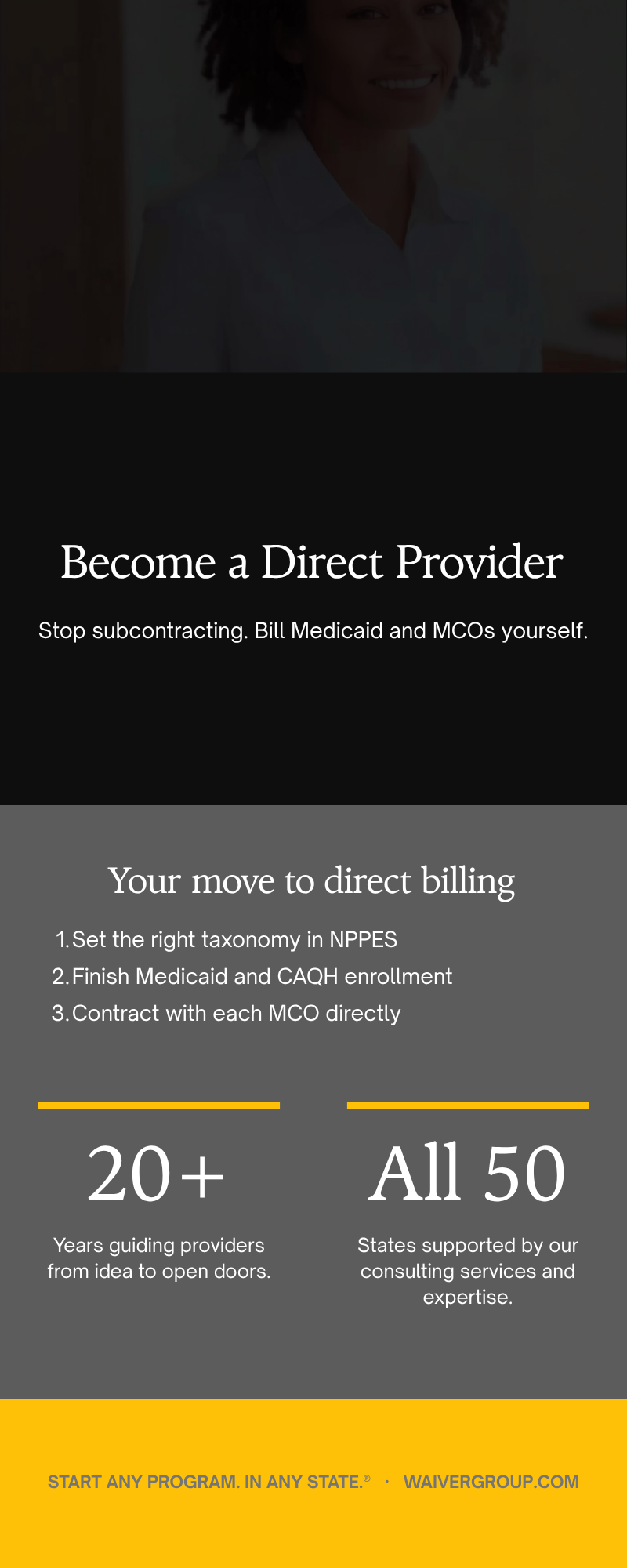
Key takeaway: Going direct is a sequence — correct taxonomy, then Medicaid and CAQH enrollment, then state registration, then a contract with each MCO. Start early and keep your current referrals flowing.
Start Any Program. In Any State.® Ready to move? Book a video consultation at waivergroup.com/videoappointment, call 302.888.9172, or email [email protected].
Last verified: May 2024. This information is intended for educational purposes only and does not constitute legal or financial advice. Consult with state-specific Medicaid regulations and professional counsel before making changes to your provider status.