FINANCIAL MANAGEMENT SERVICES PROVIDER IN UTAH
By Fatumata Kaba · 2026-03-31 · 5 min read
Financial Management Services (FMS) in Utah represent the essential fiscal and administrative infrastructure that enables participant-directed Medicaid waiver programs to function effectively. By providing the oversight necessary for individuals and families to manage their own budgets and hire support staff, FMS providers serve as the vital link between state-mandated compliance and the autonomy of HCBS waiver participants.
Empowering self-direction requires a deep commitment to transparency, accuracy, and rigorous adherence to federal and state guidelines. Whether you are an aspiring provider or an established organization looking to enter the Utah market, understanding the specific requirements set forth by the Division of Services for People with Disabilities (DSPD) is the first step toward building a sustainable and compliant FMS operation.
What Are the Core Functions of an FMS Provider?
FMS providers act as fiscal intermediaries, performing critical administrative tasks that allow waiver participants to assume the role of an employer. This model shifts the responsibility of service coordination to the individual, while the FMS provider handles the complex regulatory and tax-related requirements that accompany hiring and managing support staff.
The primary objective of an FMS provider is to ensure that every dollar spent aligns perfectly with the participant’s Individual Support Plan (ISP). By centralizing payroll, tax filings, and background checks, these providers shield participants from administrative burdens while ensuring the program remains audit-ready at all times. Key operational functions include:
- Issuing timely payments to workers, vendors, and service providers.
- Handling employer-related tax withholdings and filings at both the federal and state levels.
- Assisting participants with budget monitoring and real-time expenditure tracking.
- Conducting comprehensive new hire paperwork and eligibility verifications.
- Performing mandated background checks on all potential employees to ensure participant safety.
- Generating detailed reports for participants, families, and state case managers.
How Do Governing Agencies Influence FMS Operations?
Operating an FMS agency in Utah requires seamless coordination with several oversight bodies. The Utah Department of Health and Human Services (DHHS), specifically the Division of Services for People with Disabilities (DSPD), serves as the primary authority for contracting and monitoring providers. They ensure that all entities operating within the self-directed service model are maintaining the quality standards required by state law.
Beyond the DSPD, the Utah Division of Integrated Healthcare (DIH) manages the Medicaid claims process, verifying that reimbursements match the approved services documented in the participant's ISP. Additionally, because the FMS provider frequently acts as an agent of the employer, the Internal Revenue Service (IRS) plays a significant role in governing tax compliance. Providers must facilitate the issuance of Employer Identification Numbers (EINs) and maintain rigorous systems for managing payroll taxes.
What Are the Prerequisites for Provider Approval?
Becoming an approved FMS provider is a structured process that demands meticulous preparation. Before engaging with the state, an organization must be legally established, registered with the Utah Division of Corporations, and equipped with a Type 2 NPI. Because this role involves the management of public funds and sensitive personal data, the state requires proof of financial stability and operational readiness.
A central pillar of the approval process is the development of a comprehensive Policy & Procedure Manual. This document serves as the blueprint for how the agency will handle every aspect of the FMS lifecycle, from initial onboarding to fraud prevention. Successful applicants must demonstrate their ability to maintain general liability and fidelity bond insurance, alongside robust data privacy protocols that adhere to HIPAA standards.
What Does the Utah Enrollment Process Entail?
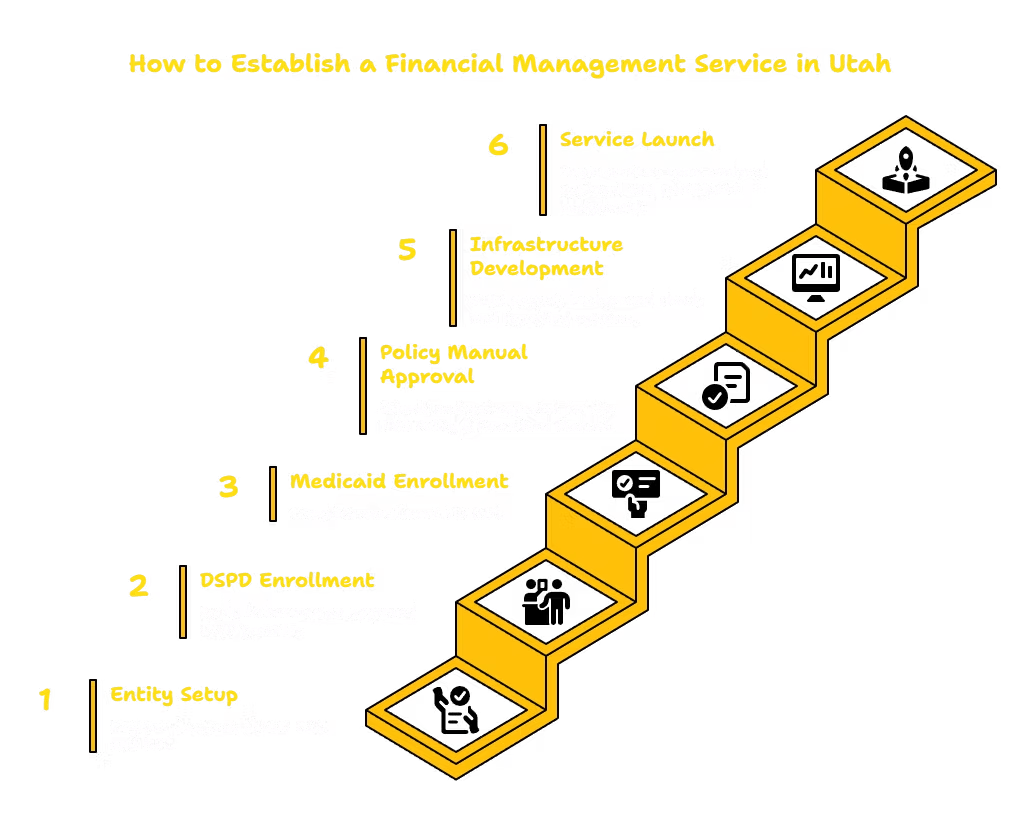
The enrollment timeline can be extensive, typically spanning several months of rigorous review. The process begins with the registration of the legal entity and moves into the formal application for DSPD approval. Once the provider entity is recognized by the state, the next phase involves enrolling with the Utah Medicaid system via the official Provider Enrollment Portal.
Infrastructure is the defining factor during the enrollment phase. Applicants must prove that they possess the technical capacity to process payroll, verify employee backgrounds, and generate reports. After the administrative infrastructure is built and the Policy & Procedure Manual is approved by the relevant state departments, the agency can begin the final stages of contracting. Once a contract is finalized, the agency may be assigned participants according to their ISP needs.
What Staffing and Compliance Standards Must Be Met?
Operational success in the FMS space relies on a multidisciplinary team. A typical FMS provider requires a Payroll/Finance Manager with expertise in tax law and accounting software, an FMS Program Coordinator familiar with the nuances of participant-directed models, and a Compliance Officer dedicated to monitoring the changing regulatory landscape of Medicaid and HIPAA.
Training is an ongoing requirement for all staff members. Beyond initial onboarding, employees must participate in regular competency evaluations. This includes mandatory training in Medicaid and DSPD program rules, IRS tax compliance, and financial data security. Maintaining this level of expertise is not just a regulatory hurdle but a necessary measure to ensure the protection of both the program and the participants it serves.
Frequently Asked Questions
Which Medicaid waiver programs require FMS support?
FMS support is a mandatory component for self-directed services within the Community Supports Waiver (CSW), the Acquired Brain Injury (ABI) Waiver, the Physical Disabilities Waiver (PDW), and the Medically Complex Children’s Waiver (MCCW). Authorization for these services is specified in the participant’s Individual Support Plan.
How long should a new agency anticipate for the launch timeline?
The journey from initial entity setup to full operational status generally takes 4–6 months. This includes 2–4 weeks for business registration, 2–3 months for DSPD and Medicaid enrollment, and 4–6 weeks for final system configuration and policy manual approval.
What is the role of the FMS provider in tax compliance?
The FMS provider acts as a fiscal intermediary that assists the participant—as the employer—with federal and state tax responsibilities. This includes obtaining necessary IRS authorizations, withholding required payroll taxes, and filing periodic forms such as W-2s and 941s to ensure full tax compliance.
Key Takeaway: Successfully operating as a Financial Management Services provider in Utah requires a strategic balance of financial expertise, regulatory compliance, and a deep understanding of the self-directed model. By focusing on robust internal policy development and maintaining strict alignment with DSPD and Medicaid requirements, providers can ensure the long-term sustainability of the supports they offer to individuals and families across the state.
Last verified: October 2023. Disclaimer: This information is for educational purposes and does not constitute legal or financial advice. Regulations governing Medicaid HCBS programs and FMS providers are subject to change; always refer to the official Utah Division of Services for People with Disabilities (DSPD) and Utah Medicaid websites for the most current program requirements and administrative statutes.