FAMILY SUPPORT SERVICES PROVIDER IN MARYLAND
By Fatumata Kaba · 2025-09-02 · 6 min read
How to Become a Certified Family Support Services Provider in Maryland
Family Support Services in Maryland represent a vital component of the state’s long-term care infrastructure, specifically designed to empower families caring for individuals with developmental disabilities or autism. By providing respite care, caregiver training, advocacy, and in-home support, these services help maintain family stability and prevent unnecessary institutional placement, allowing participants to thrive within their own communities.
Operating as a provider in this space requires navigating the regulatory framework established by the Maryland Developmental Disabilities Administration (DDA). Successful agencies must demonstrate a commitment to person-centered care, maintain rigorous documentation standards, and ensure that all staff members are trained to meet the unique, evolving needs of the families they serve.
Understanding the Governance and Regulatory Landscape
The provision of Family Support Services in Maryland is governed by a multi-layered regulatory structure that ensures quality, compliance, and fiscal responsibility. At the top of this hierarchy is the Maryland Department of Health (MDH), which provides overall oversight for Medicaid and waiver-funded services. Within the MDH, the Developmental Disabilities Administration (DDA) serves as the primary regulatory body, administering the Family Supports Waiver and establishing the specific eligibility and quality standards that providers must meet to operate legally within the state.
Financial and operational management is handled through the Office of Long-Term Services and Supports (LTSS Maryland), which serves as the central hub for billing, data management, and service documentation. Furthermore, because these programs are largely funded through Medicaid, the federal Centers for Medicare & Medicaid Services (CMS) maintains oversight to ensure that all state programs remain compliant with federal Home and Community-Based Services (HCBS) guidelines and maintain a focus on family-centered approaches.
- Maryland Department of Health (MDH): Oversees statewide Medicaid and waiver-funded family services.
- Developmental Disabilities Administration (DDA): Administers the Family Supports Waiver and regulates provider eligibility and quality.
- Office of Long-Term Services and Supports (LTSS Maryland): Manages waiver billing and service documentation.
- Centers for Medicare & Medicaid Services (CMS): Approves waiver programs and ensures HCBS compliance and family-centered approaches.
Core Components of Family Support Service Programming
Effective Family Support Services are highly individualized, moving beyond one-size-fits-all models to address the specific dynamics of the family unit. These services are officially authorized under a participant’s Person-Centered Plan (PCP), which acts as the roadmap for the care and support provided. Providers are expected to enhance the natural support system of the individual, ensuring that the services provided are meaningful, relevant, and directly contribute to the individual’s ability to remain in their home.
The scope of these services is broad, covering both the direct needs of the individual with a disability and the practical, educational, and emotional needs of the caregivers. By integrating these supports, providers play a critical role in reducing caregiver burnout and fostering a healthier, more sustainable home environment.
- In-home respite care to provide temporary relief for primary caregivers.
- Comprehensive caregiver training, consultation, and behavioral coaching.
- Family navigation services to help households understand and access community resources.
- Support during significant life transitions, such as moving from school to adult services.
- Sibling support programs and recreational opportunities to foster peer connections.
Navigating Licensing and Provider Enrollment Requirements
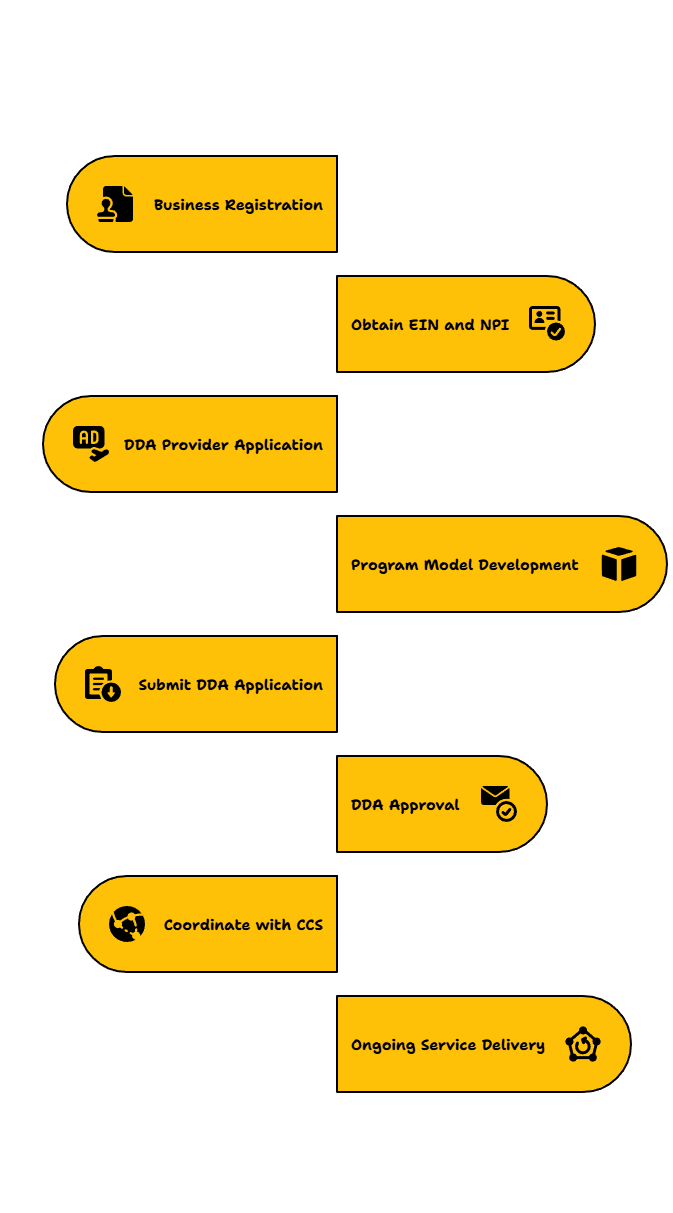
Before an agency can begin billing for services, it must establish its legal and professional credentials. The process begins with the Maryland Department of Assessments and Taxation (SDAT), where the business must be registered. Following this, the entity must secure an Employer Identification Number (EIN) and a Type 2 NPI. The agency must then apply specifically as a DDA-approved provider, a process that requires the submission of detailed program models, staff qualifications, and comprehensive emergency protocols.
While most Family Support Services do not require separate facility licensure, agencies providing respite in a structured, out-of-home environment must adhere to specific state safety and physical plant standards. All providers must maintain valid general liability insurance and implement robust HIPAA-compliant record-keeping systems. Furthermore, for agencies offering advocacy or navigation, it is essential to adhere strictly to conflict-free case management rules to ensure that the interests of the individual and family remain the top priority.
Operationalizing Your Provider Application and Approval
The path to becoming an active provider involves a systematic progression from business formation to the activation of referrals. Initially, an agency must define its specific service offerings—such as respite or caregiver training—and develop intake forms that reflect the person-centered mission of the DDA. Once the program model is finalized, the provider submits the application to the DDA, selecting the appropriate service designations under the Family Supports Waiver.
Upon receiving DDA approval, the agency enters the referral phase. This involves coordinating closely with Coordination of Community Services (CCS) providers, who act as the bridge between families and service providers. Once a provider is linked with a family, all service delivery and data tracking must be accurately recorded in LTSS Maryland to ensure proper billing and compliance. Maintaining accurate documentation at every stage is critical for successful audits and continued eligibility.
Staffing, Training, and Documentation Standards
The quality of a Family Support agency is defined by its personnel. Staff members—whether they are Family Support Specialists, Peer Support Workers, or Respite Workers—must possess a unique combination of technical skill and emotional intelligence. All staff must undergo thorough background checks and be trained in DDA core competencies, which include mandatory reporting, HIPAA privacy standards, and trauma-informed care.
Beyond standard certifications like CPR and First Aid, staff must be proficient in person-centered communication and behavioral de-escalation techniques. Documentation is equally essential; providers must maintain meticulous records, including caregiver logs, training consent forms, and incident reports. A comprehensive policy and procedure manual, which outlines these standards and ensures consistent service delivery, is a non-negotiable component of any successful DDA-approved agency.
- DDA Core Competencies and Orientation.
- HIPAA and mandated reporting requirements.
- Trauma-informed care and behavioral de-escalation.
- Cultural sensitivity and understanding of complex family dynamics.
Frequently Asked Questions
What types of waivers cover family support services?
Family Support Services are primarily covered under the Family Supports Waiver for children under age 21 with intellectual or developmental disabilities. Adults with varying levels of need may receive services through the Community Supports Waiver or the Community Pathways Waiver, depending on the intensity of support required.
Is a physical facility required to become a provider?
No separate facility licensure is required for standard in-home Family Support Services. However, if your agency intends to provide respite services in a structured, out-of-home setting, you must meet specific state facility regulations and safety standards.
How long does the provider enrollment process typically take?
The entire startup process is phased. Business formation and federal registration typically take 1–2 weeks, followed by 2–3 weeks for policy development. The formal DDA provider application and approval process generally ranges from 6–10 weeks before the agency can begin accepting referrals and onboarding families.
Key Takeaway
Establishing a Family Support Services agency in Maryland is a significant endeavor that requires strict adherence to DDA regulations and a deep commitment to the families being served. By focusing on compliant documentation, comprehensive staff training, and the integration of person-centered care models, providers can successfully build sustainable programs that provide essential relief and empowerment to households throughout the state.
Last verified: October 2023. This information is for educational purposes only and does not constitute legal or professional advice. Always consult the official Maryland DDA website and state regulatory agencies for the most current guidance, statutes, and application requirements applicable to your specific business model.