FAMILY STABILITY ASSISTANCE PROVIDER IN OHIO
By Fatumata Kaba · 2025-09-17 · 5 min read
Family Stability Assistance in Ohio is a specialized Medicaid Home and Community-Based Services (HCBS) support framework designed to equip primary caregivers with the clinical and practical resources necessary to maintain a safe, sustainable home environment for individuals with complex disabilities. By providing targeted training, crisis mitigation strategies, and ongoing behavioral coaching, these services empower families to prevent burnout and avoid the necessity of out-of-home placement.
What is the Role of Governing Agencies in Ohio?
The administration of Family Stability Assistance involves a multi-agency hierarchy that ensures services remain person-centered and compliant with federal mandates. The Ohio Department of Medicaid (ODM) functions as the primary regulatory body, overseeing the overarching Medicaid reimbursement structures, establishing service guidance, and setting the rigorous eligibility standards that all participating providers must meet.
Complementing the ODM, the Ohio Department of Developmental Disabilities (DODD) serves as the primary operational partner for DD-specific waivers, managing provider certification and the coordination of family-centered support plans. Furthermore, the Ohio Department of Aging (ODA) plays a critical role in bridging gaps for older adults and their caregivers by providing access to education and resource linkages. All state-level operations are ultimately guided by the Centers for Medicare & Medicaid Services (CMS), which ensures that Ohio’s HCBS programs align with national standards for community integration and family-driven care.
How Do Family Stability Assistance Services Function?
These services are structured to be highly flexible, acknowledging that every family’s needs are unique. Rather than a one-size-fits-all approach, the model focuses on professional intervention to bolster the caregiver’s capacity to manage daily routines, behavioral challenges, and unexpected emergencies. By addressing these factors, providers directly contribute to the long-term viability of the home-based care arrangement.
Approved providers deliver a comprehensive suite of interventions, including:
- Caregiver Training and Education: Instruction on medical care, behavior management, and emergency preparedness.
- Family Counseling and Mediation: Facilitating improved family communication and effective stress management.
- Crisis Support Planning: Developing actionable tools to navigate emergencies without resorting to institutionalization.
- In-Home Consultation: Professional guidance on daily routines, home safety strategies, and navigating community resources.
- Behavioral Coaching: Evidence-based strategies for managing challenging behaviors in the home.
- Community Resource Linkage: Connecting families with peer support, housing assistance, and external aid.
- Family Respite Coordination: Referral to and integration of respite options to mitigate caregiver fatigue.
- Supportive Technology Access: Identifying and implementing tools to monitor or assist loved ones at home.
What Are the Licensing and Provider Approval Requirements?
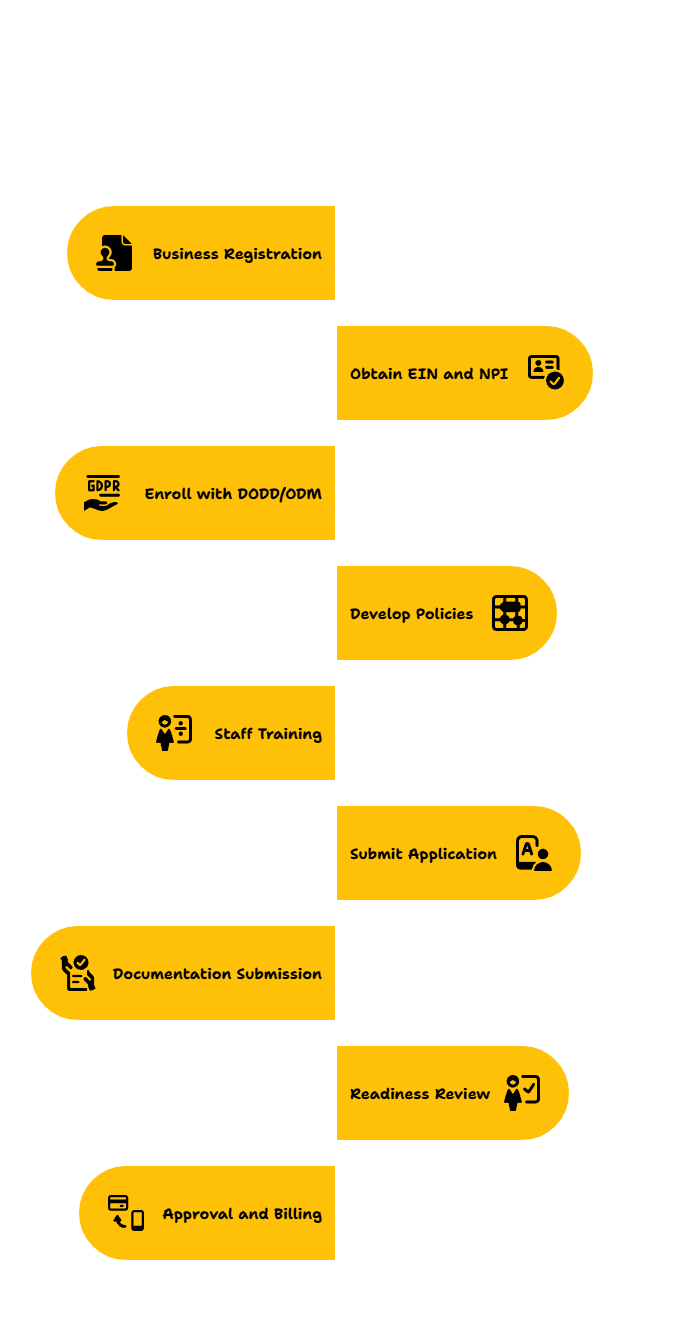
Launching a Family Stability Assistance program requires a structured approach to business administration and compliance. Before a provider can deliver services, they must establish a formal business entity registered with the Ohio Secretary of State and secure a federal EIN. Additionally, obtaining a Type 2 NPI is a mandatory step for the enrollment process within the Medicaid Provider Portal or the DODD Provider Certification Wizard.
Beyond basic business registration, prospective providers must demonstrate operational readiness. This involves maintaining professional liability insurance and developing a robust Policy and Procedure Manual. This manual must explicitly cover family engagement protocols, service planning, emergency response strategies, and strict documentation standards. Organizations must also verify that all staff members have cleared comprehensive background checks and have completed the necessary caregiver support training modules prior to interacting with participants.
How Does the Provider Enrollment Process Work?
The enrollment path is a sequential process that ensures only qualified agencies are granted access to Medicaid billing. The initial application is submitted to either the DODD or the ODM, depending on the specific waiver program alignment. This submission must include all organizational formation documents, staff training logs, and proof of insurance, along with detailed service protocols and compliance documentation.
Following the submission, the state conducts a readiness review. During this phase, officials assess the provider’s capacity for effective family engagement, the viability of their crisis planning models, and their overall understanding of waiver coordination. Once the application successfully clears this review, the provider is issued a Medicaid billing number. This milestone allows the agency to officially begin providing services and submitting claims for reimbursement under the relevant waiver programs.
What Documentation Is Necessary for Compliance?
Maintaining accurate and thorough documentation is the foundation of a successful Medicaid-compliant operation. Providers are expected to maintain an up-to-date Policy and Procedure Manual that serves as the organization’s roadmap for both clinical and administrative excellence. This manual must be readily available for audit purposes and should cover all critical aspects of service delivery.
- Articles of Incorporation or official Business License documentation.
- IRS EIN confirmation and NPI registration details.
- Proof of current general and professional liability insurance.
- Detailed Service Intake and Needs Assessment protocols.
- Crisis planning and behavioral coaching models.
- Caregiver education outlines and progress-tracking mechanisms.
- HIPAA and participant/family rights documentation.
- Emergency response and protective oversight policy statements.
- Service logs, billing standards, and internal quality assurance forms.
Frequently Asked Questions
What staff roles are required to operate a Family Stability Assistance program?
The program requires a Family Stability Services Director, typically possessing a Bachelor’s or Master’s degree in social work, psychology, or counseling with home-based experience. Supporting this director are Family Support Coaches, who should have a background in human services or waiver coordination, and, where needed, clinical consultants for trauma-informed or specialized behavioral interventions.
Which Ohio Medicaid waivers cover these services?
These services are embedded or available under the Individual Options (IO) Waiver, the SELF Waiver, and the Level One Waiver (limited to consultation/training). Additionally, elements of family support are found within the Ohio Home Care Waiver, the PASSPORT Waiver, and MyCare Ohio managed care programs.
How long should a new provider expect the launch process to take?
The timeline generally spans 6 to 9 months. Business formation and compliance setup take 1–2 months, followed by 2–3 months for hiring and policy development. The Medicaid enrollment and certification phase typically takes 60–90 days, with an additional 30–45 days required to finalize billing systems and launch actual service delivery.
Support for New Providers
Waiver Consulting Group (WCG) assists new providers in launching Medicaid-compliant Family Stability Assistance programs across Ohio. The scope of work includes business formation, waiver enrollment, credentialing, and the creation of specialized policy manuals tailored to caregiver support. WCG also provides guidance on staff training, Medicaid billing setup, audit-readiness protocols, and the development of quality assurance systems to ensure long-term program sustainability.
Key takeaway: Achieving success as a Family Stability Assistance provider in Ohio requires a disciplined focus on regulatory compliance, robust staff training, and a clear, documented commitment to the principles of person-centered, family-driven care as defined by the ODM and DODD.
Last verified: October 2023. Disclaimer: This article is for informational purposes only and does not constitute legal or professional medical advice. Always consult with the Ohio Department of Medicaid and the Ohio Department of Developmental Disabilities regarding current regulations, as specific waiver requirements may change. Waiver Consulting Group is not a government agency and cannot guarantee approval of provider applications.