FAMILY MODEL RESIDENTIAL SERVICES PROVIDER IN TENNESSEE
By Fatumata Kaba · 2025-10-22 · 5 min read
CREATING STABLE, SUPPORTIVE HOME ENVIRONMENTS FOR INDIVIDUALS WITH INTELLECTUAL AND DEVELOPMENTAL DISABILITIES THROUGH FAMILY-BASED CARE
Family Model Residential Services—often referred to as Host Home or Companion Care—provide adults with intellectual and developmental disabilities (I/DD) the opportunity to reside in a private, community-based home with a trained caregiver. By operating under the umbrella of TennCare’s Employment and Community First (ECF) CHOICES program and select 1915(c) waivers, these services ensure participants receive personalized, high-quality support in the least restrictive setting possible, prioritizing long-term stability and social integration.
What Are the Governing Bodies Overseeing Tennessee Family Model Services?
The successful operation of a Family Model Residential program requires strict adherence to oversight from both state and federal entities. In Tennessee, the Department of Intellectual and Developmental Disabilities (DIDD) acts as the primary regulatory body responsible for certifying providers, conducting mandatory home inspections, and ensuring that host families maintain compliance with Individual Support Plan (ISP) requirements.
TennCare, as the state’s Medicaid agency, manages the broader waiver landscape, overseeing provider reimbursement and establishing the parameters for allowable services. Finally, the Centers for Medicare & Medicaid Services (CMS) provides the federal framework, ensuring that all Medicaid-funded home and community-based services (HCBS) meet specific criteria for community integration, participant autonomy, and health and safety protections.
How Do You Structure and Deliver Family-Based Residential Support?
Unlike institutional group homes, Family Model Residential Services emphasize an intimate, person-centered environment. A host family is not merely a caregiver but an integral part of the participant's support team, providing 24/7 supervision and companionship. This model requires a carefully curated approach to daily life that balances autonomy with the specific medical or behavioral needs of the individual served.
Providers are responsible for ensuring that the residential environment supports the participant's goals as outlined in their ISP. Core duties for host families and supporting agencies include:
- Providing 24/7 supervision, companionship, and emotional support.
- Managing personal care needs, including hygiene, bathing, and dressing assistance.
- Executing medication administration and health monitoring protocols.
- Facilitating community involvement, social outings, and recreational activities.
- Assisting with daily living skills, meal preparation, and nutritional oversight.
- Coordinating with professional teams to integrate behavioral support and safety monitoring.
What Are the Essential Requirements for Provider Certification?
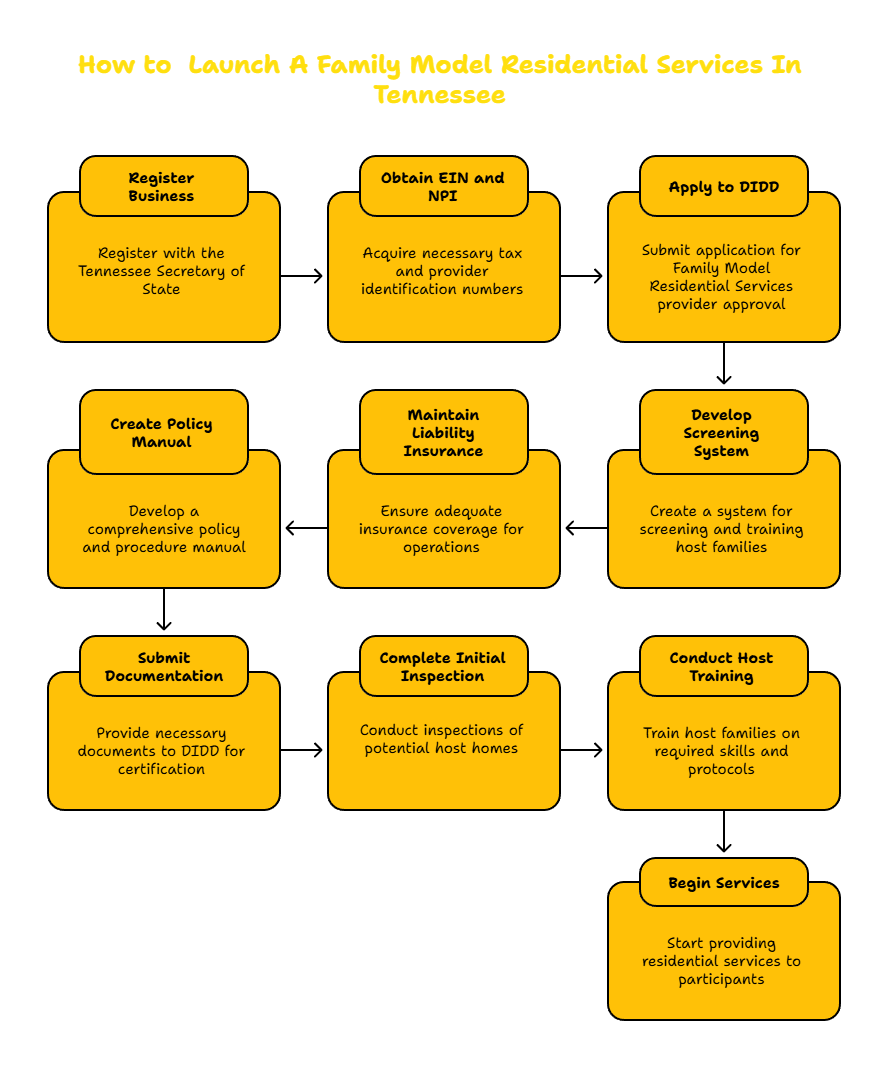
Becoming a certified provider in Tennessee begins with establishing a formal business entity and ensuring that all organizational structures meet state standards. Before applying for provider approval through the DIDD, an agency must secure a federal Employer Identification Number (EIN) and a Type 2 National Provider Identifier (NPI). This foundational step allows the agency to interface properly with Medicaid billing systems.
Beyond the legal registration, the agency must develop a comprehensive administrative infrastructure. This includes creating a detailed Family Model Services Policy & Procedure Manual that covers emergency response, incident reporting, and quality assurance. Furthermore, agencies must maintain adequate liability insurance and establish a robust internal system for the screening, training, and ongoing monitoring of host families to ensure constant compliance with DIDD standards.
What Is the Step-by-Step Provider Enrollment Process?
The enrollment timeline follows a logical progression of administrative preparation and regulatory vetting. Initial focus must be placed on the development of high-quality documentation, including home study procedures and standardized training curricula, as these will be scrutinized during the certification phase. Agencies should prepare for a thorough review process that emphasizes both the safety of the residence and the qualifications of the host caregivers.
- Phase 1: Foundation: Register the business with the Tennessee Secretary of State and obtain the necessary NPI and EIN.
- Phase 2: Certification: Submit a formal application to the DIDD for Family Model Residential Services, including all procedural manuals and policies.
- Phase 3: Operational Setup: Develop and document the host family recruitment and screening processes, including home inspection checklists.
- Phase 4: Inspection & Approval: Facilitate DIDD site visits and home inspections for potential host locations and verify the completion of mandatory host training.
- Phase 5: Implementation: Upon receipt of ISP team approval, begin the participant matching process and initiate service delivery.
How Are Staffing and Host Family Training Managed?
Effective management of host families is the cornerstone of a sustainable Family Model agency. Because the care is provided in a private home, the agency must act as a bridge between the state’s regulatory requirements and the day-to-day realities of home life. Every host family must undergo a comprehensive background check and complete mandatory DIDD-approved training, which includes CPR/First Aid, HIPAA compliance, abuse prevention, and emergency preparedness.
If the provider operates as an agency, the Program Coordinator role is essential. This individual is responsible for overseeing the ISP coordination, ensuring that daily documentation is accurate, and monitoring the home environment for health and safety compliance. For participants with high acuity, agencies may also need to integrate behavioral specialists or nurses to provide specialized clinical oversight, ensuring that the residential setting remains appropriate for the individual's evolving needs.
Frequently Asked Questions
What is the typical timeline to launch a Family Model Residential program?
The launch process generally spans 4 to 7 months. Business formation and initial policy development typically take 1–2 months, while the DIDD enrollment and home study setup require 2–3 months. Subsequent recruitment and matching efforts for host families can add another 30–60 days before service launch.
Which Medicaid programs cover Family Model Residential Services?
These services are authorized under ECF CHOICES, which targets adults with I/DD, as well as specific 1915(c) waivers such as the Comprehensive or Self-Determination (SD) waivers. In limited, high-oversight scenarios, the Katie Beckett program may also authorize these settings for youth.
What must be included in the Family Model Services Policy Manual?
The manual must detail participant safety and emergency response protocols, ISP integration and activity documentation, behavioral intervention plans, transportation guidelines, incident reporting procedures, and established grievance resolution mechanisms.
Key Takeaway: Successful Family Model Residential providers prioritize the intersection of compassionate, home-based care and rigid administrative compliance. By investing in thorough documentation, standardized host family training, and consistent monitoring, providers can effectively support individuals with I/DD while meeting the rigorous expectations of the Tennessee Medicaid waiver program.
Last verified: October 2023. Disclaimer: This guide is for informational purposes and does not constitute legal or professional advice. Always consult the latest bulletins and policy updates from TennCare, the DIDD, and CMS to ensure full compliance with current Tennessee state regulations and federal waiver requirements.