FAMILY LIVING SERVICES PROVIDER IN NEW MEXICO
By Fatumata Kaba · 2025-09-05 · 6 min read
Understanding Family Living Services: A Framework for Community-Based Care
Family Living Services in New Mexico represent a vital component of the state’s Home and Community-Based Services (HCBS) waiver programs, designed to provide individuals with intellectual or developmental disabilities a nurturing, family-like environment. By embedding professional support directly into a residential setting, these services promote independence, personal growth, and deep community integration for participants who might otherwise require more restrictive institutional care.
As a provider, operating within this model requires a meticulous approach to compliance, person-centered planning, and clinical oversight. Programs must be structured to align with the stringent standards set by the New Mexico Human Services Department (HSD) and the Developmental Disabilities Supports Division (DDSD) to ensure that the health, safety, and rights of every participant are protected under the federal guidance of the Centers for Medicare & Medicaid Services (CMS).
What Are the Governing Agencies and Their Regulatory Roles?
The regulatory landscape for Family Living Services in New Mexico is hierarchical, involving both state-level oversight and federal guidance. The New Mexico Human Services Department (HSD) acts as the primary administrator for Medicaid waiver funding. Their role encompasses the management of provider enrollment, the authorization of specific services, and the administration of the reimbursement processes necessary to sustain agency operations.
Complementing HSD, the Developmental Disabilities Supports Division (DDSD) serves as the primary quality assurance body. They are responsible for establishing service delivery standards and monitoring ongoing compliance to ensure that providers are adhering to the specific requirements outlined in the state’s HCBS waiver programs. At the national level, the Centers for Medicare & Medicaid Services (CMS) provide the overarching federal framework, ensuring that all New Mexico programs meet consistent, high-level standards regarding participant rights, person-centered care planning, and the integrity of Medicaid-funded services.
What Scope of Care Do Approved Providers Deliver?
Approved providers of Family Living Services are tasked with delivering comprehensive, 24/7 support that is tailored to the individual’s unique goals as defined in their Individualized Service Plan (ISP). This model extends beyond simple residential oversight; it is an integrated approach that combines daily living assistance with active skill building. Providers must balance the delivery of medical and behavioral support with the social objective of community inclusion.
- 24/7 Supervision and Support: Constant availability of assistance within a stable home environment.
- Personal Care Assistance: Direct support with Activities of Daily Living (ADLs) such as bathing, grooming, dressing, and mobility.
- Skill Building and Training: Structured instruction in essential life skills, including cooking, money management, and personal hygiene.
- Community Integration: Facilitated participation in social, recreational, and educational opportunities to foster community membership.
- Health Monitoring: Systematic tracking of health conditions, medication management, and proactive wellness oversight.
- Behavioral Support: Specialized assistance for behavioral challenges to promote positive social interactions and emotional stability.
- Emergency and Safety Planning: Establishing rigorous safety protocols and ensuring the residence is prepared for any emergency.
- Caregiver Support: Ongoing training, guidance, and professional development for family caregivers to maintain high standards of care.
How Do Agencies Navigate Licensing and Provider Enrollment?
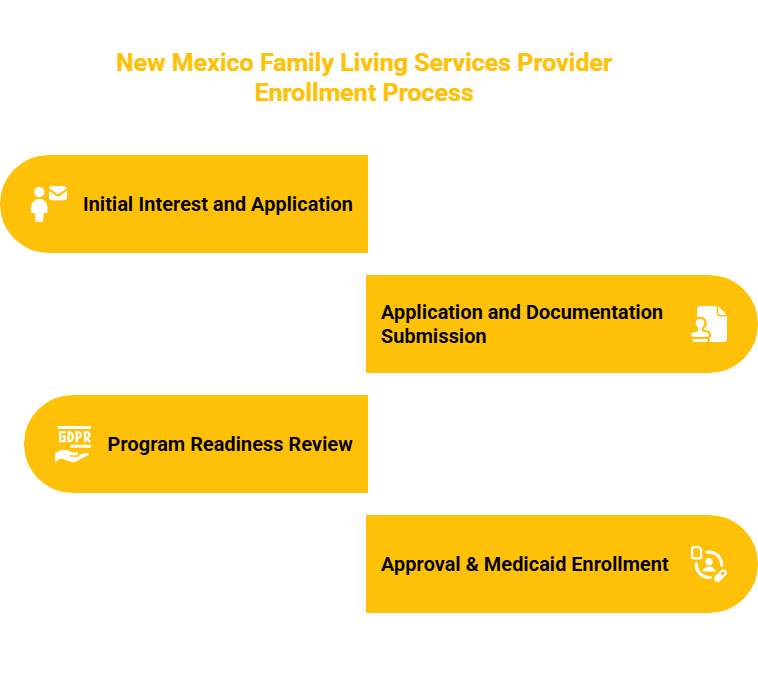
Launching a Family Living Services agency requires a systematic approach to business formation and regulatory vetting. Initially, an entity must be properly registered with the New Mexico Secretary of State. Following the creation of the business entity, the provider must secure an Employer Identification Number (EIN) from the IRS and a Type 2 National Provider Identifier (NPI). These foundational credentials are required to initiate the enrollment process through the New Mexico Medicaid Provider Enrollment Portal.
Beyond basic business registration, prospective providers must demonstrate operational readiness. This involves developing robust internal policies that address safety protocols, care standards, and staff training modules. If the service is provided in a specialized group home setting, specific facility licensure is mandatory. Providers must also secure comprehensive general and professional liability insurance to protect both the agency and the individuals served. The enrollment process concludes with a program readiness review conducted by HSD and DDSD, which validates that the agency is prepared to uphold the quality standards required to bill Medicaid for services.
What Are the Mandatory Staffing and Training Requirements?
The success of a Family Living Services program hinges on the competence and qualification of its personnel. At the administrative level, the Family Living Program Director must possess a Bachelor’s degree in a relevant field such as human services, social work, or healthcare administration, complemented by documented experience in residential or family-based care. This individual acts as the primary conduit for quality control and regulatory compliance.
Direct care roles—including family caregivers, Direct Support Professionals (DSPs), and Behavioral Support Specialists—require a strict adherence to vetting and credentialing. All staff must undergo thorough background clearances and hold valid certifications for CPR and First Aid. Training is a continuous process that covers:
- Family-centered care philosophies and daily living support techniques.
- Strict adherence to HIPAA compliance and the protection of participant rights.
- Annual competency evaluations and ongoing professional development sessions.
- Comprehensive emergency preparedness and safety protocol training.
- Standardized education in infection control and proactive health monitoring.
Which Medicaid Waivers Cover These Services?
Family Living Services are a key component of several New Mexico Medicaid waiver programs, each designed to meet the needs of specific populations. These services are authorized under the Developmental Disabilities (DD) Waiver, the Mi Via Waiver, the Medically Fragile Waiver, and the Supports Waiver. Collectively, these programs operate under the Home and Community-Based Services (HCBS) framework to ensure individuals with complex needs can thrive outside of institutional settings.
Regardless of the specific waiver under which a participant is enrolled, the services provided remain focused on family-based care, supervision, and skill acquisition. Providers must ensure that their billing practices are mapped accurately to the specific codes associated with the participant's assigned waiver program, ensuring that all documentation supports the level of care delivered to the participant.
Frequently Asked Questions
How long does the provider enrollment process typically take?
The timeline for launching as a Family Living Services provider varies based on preparedness. Typically, business formation and compliance take 1–2 months, caregiver recruitment and training take 2–3 months, the Medicaid enrollment and readiness review process spans 60–90 days, and the final billing setup takes 30–45 days.
What documentation is essential for an agency's policy manual?
A comprehensive manual must include participant intake and assessment procedures, safety and emergency preparedness protocols, detailed staff credentialing and training records, HIPAA compliance policies, participant rights and grievance handling, and quality assurance frameworks.
What is the primary role of the DDSD in this process?
The Developmental Disabilities Supports Division (DDSD) is the primary regulatory body responsible for ensuring that all services delivered by providers meet state quality standards, remain in compliance with HCBS waiver rules, and follow the individualized service plans of the participants.
Key Takeaway: Establishing a Family Living Services agency in New Mexico requires a structured commitment to regulatory compliance, from initial business formation to the rigorous standards mandated by the DDSD and HSD. Success as a provider is defined by the ability to consistently deliver high-quality, person-centered care while maintaining the documentation and operational transparency necessary for Medicaid program participation.
Last verified: October 2023. This information is for educational purposes only and does not constitute legal or professional medical advice. Requirements for New Mexico Medicaid providers may change; always refer to official HSD and DDSD documentation for current regulations.