FACILITY-BASED DAY SUPPORT SERVICES PROVIDER IN TENNESSEE
By Fatumata Kaba · 2025-10-22 · 5 min read
Facility-Based Day Support Services in Tennessee provide essential, structured environments for adults with intellectual and developmental disabilities (I/DD) to build life skills, foster social connections, and prepare for greater community inclusion. These programs are governed by strict regulatory standards set by the Tennessee Department of Intellectual and Developmental Disabilities (DIDD) and TennCare to ensure that every participant receives high-quality, person-centered support in a safe, licensed setting.
How Do Governing Agencies Regulate Day Support Programs?
The delivery of facility-based services in Tennessee is a multi-layered regulatory process. TennCare, as the state’s Medicaid agency, is the primary authority responsible for managing reimbursement and establishing service authorization protocols under the state’s various waiver programs. Their oversight ensures that services remain fiscally responsible and align with federal Medicaid expectations for Home and Community-Based Services (HCBS).
The Tennessee Department of Intellectual and Developmental Disabilities (DIDD) acts as the operational lead, responsible for licensing and certifying providers. This agency conducts rigorous facility inspections, reviews program curricula, and monitors ongoing compliance with safety and staffing requirements. Furthermore, all providers must adhere to the Centers for Medicare & Medicaid Services (CMS) HCBS Final Settings Rule, which mandates that facilities must be integrated into the greater community, protect individual rights, and promote personal autonomy.
What Are the Core Components of Facility-Based Day Services?
Facility-based day services are designed for individuals who require a structured environment before transitioning to fully integrated employment or community-based activities. The primary goal is to foster independence through individualized, goal-oriented programming that is explicitly documented within the participant’s Individual Support Plan (ISP). By focusing on these developmental areas, providers help participants bridge the gap between their current skill sets and their long-term personal goals.
- Skill Development: Concentrating on daily living skills, effective communication, personal care, and critical problem-solving abilities.
- Social Engagement: Facilitating peer interactions through teamwork, group games, and structured role-playing activities.
- Pre-Vocational Readiness: Introducing tasks such as sorting, assembly, and maintaining adherence to schedules or simple work routines.
- Health & Wellness: Promoting physical health through light exercise, nutritional education, and consistent hygiene reminders.
- Community Preparation: Providing simulated training for real-world scenarios, including bus navigation, budgeting, and personal safety.
What Are the Prerequisites for Licensure and Provider Enrollment?
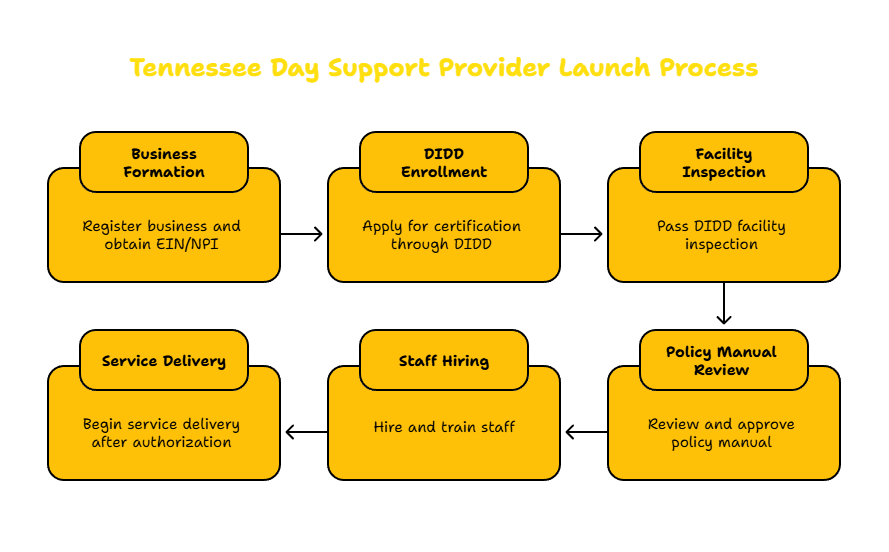
Launching a facility-based day program requires significant administrative preparation and a thorough understanding of state-level prerequisites. Before initiating the formal application, prospective providers must establish their legal business entity with the Tennessee Secretary of State and secure necessary federal identifiers, including an Employer Identification Number (EIN) and a Type 2 National Provider Identifier (NPI). These foundational steps allow the agency to enter into the regulatory pipeline managed by DIDD.
Beyond administrative setup, the physical facility must meet rigorous health, fire, safety, and accessibility standards. This includes obtaining local zoning approval and ensuring a certificate of occupancy is in place. Because these facilities house vulnerable populations, documentation—including a comprehensive Policy & Procedure Manual—is critical. This manual must outline everything from daily activity curricula to emergency evacuation protocols, serving as the blueprint for both staff training and state certification inspections.
How Is the Tennessee Provider Enrollment Process Sequenced?
The enrollment process follows a logical sequence designed to verify that the provider is fully prepared to deliver care. Once the business entity is established and the physical location is prepared, the provider must apply for certification through the DIDD Provider Enrollment Unit. This involves submitting detailed documentation, including the proposed facility layout, comprehensive staff credentials, and the program’s instructional curriculum.
Following the document review, the agency must pass an on-site DIDD facility inspection. During this phase, regulators assess the environment against safety standards and review the provider’s policy manual to ensure it aligns with state and federal regulations. Once certification is granted and the facility is deemed ready, the provider can begin accepting referrals through ISP teams. At this point, service delivery can commence for authorized participants, with all actions carefully logged against the participant’s individualized care objectives.
What Are the Essential Staffing and Documentation Requirements?
Staffing a facility-based day program requires a blend of administrative oversight and direct support expertise. Direct Support Professionals (DSPs) represent the core of the workforce and are required to undergo comprehensive background checks, training in ISP implementation, and certification in CPR/First Aid. Furthermore, specialized roles such as Day Services Managers or Behavior Specialists may be required to oversee administrative compliance and manage positive behavior support strategies, respectively.
- HCBS Compliance Training: All staff must complete training on person-centered care and the HCBS Final Settings Rule.
- Documentation Mastery: Staff must be proficient in tracking participant progress, documenting attendance, and recording incident reports accurately.
- Safety and De-escalation: Mandatory training in behavior management and de-escalation techniques is required to ensure a safe environment for all participants.
- Emergency Preparedness: Regular drills and in-service training sessions are necessary to maintain readiness for medical or environmental emergencies.
Frequently Asked Questions
What funding sources support facility-based day services in Tennessee?
Services are primarily authorized under the 1915(c) Statewide and Self-Determination Waivers, as well as the Employment and Community First (ECF) CHOICES program. In instances where waiver capacity is limited or pending, state-funded services through DIDD may be available, or in specific circumstances, EPSDT/Katie Beckett funding may apply.
How long does the provider setup process typically take?
The timeline varies based on organizational readiness, but generally, business formation and facility preparation require 1–2 months. Subsequent DIDD enrollment and licensing take approximately 2–3 months, followed by 30–60 days for final staff onboarding and manual development before service delivery can begin.
What does a Policy & Procedure Manual need to include?
The manual is a comprehensive requirement that must cover daily curriculum design, participant supervision, behavior support plan implementation, staff-to-participant ratios, incident reporting, infection control, and transportation policies if the agency provides transit services.
Key Takeaway
Establishing a Facility-Based Day Support program in Tennessee requires a rigorous commitment to DIDD and TennCare regulatory standards. By prioritizing compliant policy development, robust staff training, and a clear, person-centered curriculum, providers can build a sustainable organization that meaningfully enhances the quality of life for individuals with I/DD while meeting all necessary state and federal requirements for HCBS participation.
Last verified: 2024. This information is provided for educational purposes only and does not constitute legal or professional advice. Providers should consult directly with the Tennessee Department of Intellectual and Developmental Disabilities (DIDD) and official TennCare documentation for the most current regulatory updates and specific enrollment requirements.