ENVIRONMENTAL MODIFICATION SERVICES PROVIDER IN VIRGINIA
By Fatumata Kaba · 2026-04-07 · 5 min read
Environmental Modification Services in Virginia are specialized home adaptations designed to increase the accessibility, safety, and independence of Medicaid waiver participants within their primary residences. By providing structural changes that address functional limitations, these services act as a critical preventative measure against institutionalization, allowing individuals to remain in their communities with dignity and support.
What Are Environmental Modification Services and Who Do They Support?
Environmental modification services involve permanent or semi-permanent physical changes to a participant's home environment. These modifications are specifically tailored to mitigate the risks associated with an individual’s disability, such as mobility impairments, sensory deficits, or behavioral health needs. By adjusting the physical space, providers enable participants to perform daily living activities with greater autonomy and reduced physical strain on their caregivers.
These services are an integral component of Virginia’s long-term care infrastructure, falling under the purview of the Department of Medical Assistance Services (DMAS). To be eligible for coverage, the modifications must be deemed medically necessary and directly linked to the individual’s functional requirements as documented in their Individual Support Plan (ISP). Whether for physical access or behavioral safety, the goal is to optimize the home environment to accommodate the specific needs of the waiver participant.
- Wheelchair ramps, porch lifts, and widened doorways for mobility access.
- Roll-in showers, accessible tubs, and strategically placed grab bars.
- Lowered countertops, kitchen sinks, and modified cabinet heights for accessibility.
- Specialized flooring materials that reduce trip-and-fall hazards.
- Reinforced walls, specialized locks, or safety glass for behavioral safety.
Which Regulatory Agencies Govern Home Modification Providers?
Operating as a Medicaid-enrolled environmental modification provider in Virginia requires navigating a multi-layered regulatory environment. The Department of Medical Assistance Services (DMAS) functions as the primary state authority, establishing the rules for provider enrollment, defining the scope of allowable services, and overseeing the allocation of federal and state Medicaid funding.
At the local level, coordination is managed by either Community Services Boards (CSBs) or Managed Care Organizations (MCOs), depending on the specific waiver program. CSBs generally oversee the Community Living (CL) and Family and Individual Supports (FIS) waivers, ensuring that all proposed home adaptations align with the participant's ISP. For individuals enrolled in the CCC Plus waiver, MCOs serve as the point of contact for service authorizations and reimbursement management. Providers must maintain professional relationships with these entities to ensure a smooth transition from project approval to final billing.
What Are the Prerequisites for Provider Enrollment and Licensing?
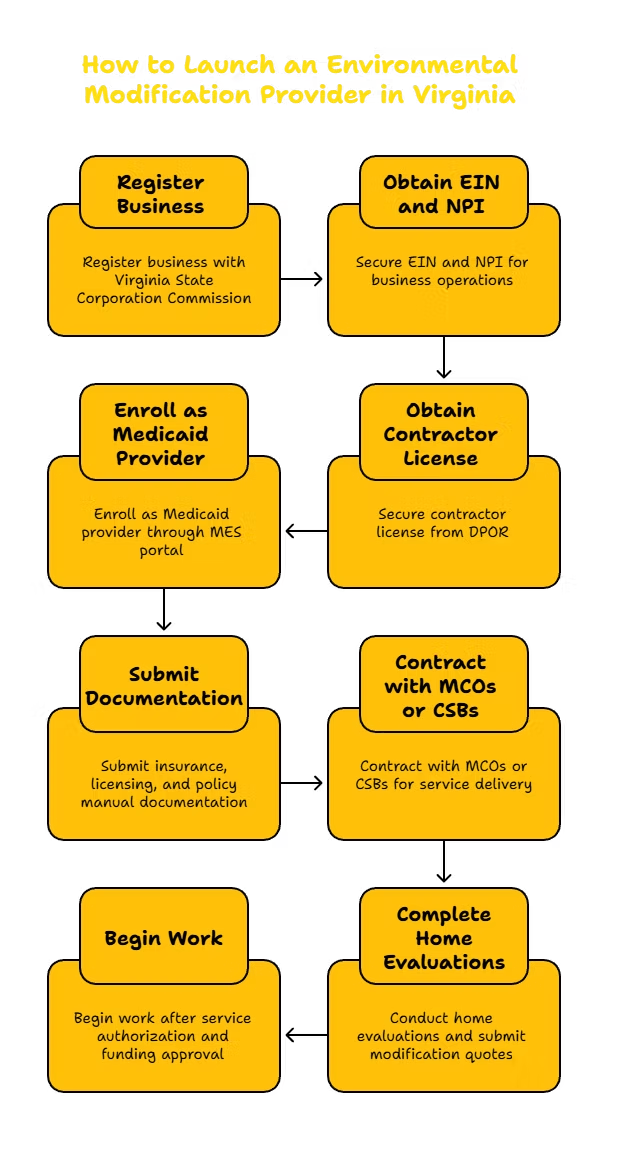
Establishing an agency to provide these services begins with formal business and professional registration. Before an entity can enroll as a Medicaid provider, it must be legally recognized in the Commonwealth of Virginia. This includes registering with the Virginia State Corporation Commission (SCC) and obtaining a federal Employer Identification Number (EIN) and a Type 2 National Provider Identifier (NPI).
Beyond standard business registration, environmental modification work requires specific construction-related credentials. Prospective providers must secure a valid contractor’s license through the Virginia Department of Professional and Occupational Regulation (DPOR). Furthermore, to protect the agency and the participant, the provider must maintain current commercial liability and workers’ compensation insurance policies. These documents serve as the foundation for the enrollment application submitted through the Medicaid Enterprise System (MES) portal.
- Business registration with the Virginia SCC and acquisition of a Type 2 NPI.
- Securing a DPOR contractor license appropriate for the specific scope of building trades.
- Maintaining adequate commercial liability and workers' compensation coverage.
- Developing a comprehensive internal Policy & Procedure Manual for regulatory review.
How Is the Enrollment and Service Delivery Process Managed?
The path to becoming an active provider involves a sequential process, beginning with the Medicaid enrollment via the MES portal. Once the administrative documentation is submitted and approved by DMAS, the provider must then contract with individual MCOs or align with local CSBs to begin receiving referrals. This readiness phase is critical, as funding for modifications is tied to specific service authorizations for each participant.
Following successful enrollment, the service delivery cycle typically begins with a professional home evaluation. The provider assesses the residence to determine the necessary modifications, prepares a detailed cost estimate, and submits this proposal for approval to the CSB or MCO. No work should commence until the official service authorization is issued, as this represents the formal commitment of Medicaid funding for the project. Maintaining a clear, transparent communication workflow with the participant's care coordinator is essential for timely approvals and successful outcomes.
What Standards Must Internal Policies and Procedures Meet?
A robust Policy & Procedure Manual is the cornerstone of a compliant environmental modification agency. This manual serves as a roadmap for daily operations, ensuring that every project meets the rigorous standards of Medicaid oversight. It must clearly outline the agency’s approach to bidding, project management, and quality control, while also addressing client rights and safety protocols.
The documentation must explicitly detail how the agency handles the intake of requests, from the initial site visit to the final inspection. It should include standardized forms for quotes, evidence of compliance with safety standards, and protocols for incident reporting. Additionally, the manual must outline the agency's commitment to documentation, such as the requirement for before-and-after photographs of the modified space. Establishing these written procedures early ensures consistency across every project and prepares the agency for potential audits by DMAS or the MCOs.
- Defined protocols for bidding, project estimation, and quote submission.
- Standards for worksite cleanliness, safety, and client communication.
- Clear procedures for documenting project progress and completion.
- Protocols for handling incident reports and ensuring HIPAA compliance.
- Procedures for managing warranty and maintenance logs for installed equipment.
Frequently Asked Questions
What items are excluded from Medicaid coverage for home modifications?
Medicaid does not cover general home repairs, routine maintenance, luxury upgrades, or home appliances and furniture that are not directly tied to the individual’s disability-related functional needs.
What is the typical timeline for launching a provider agency?
The timeline varies but generally spans several months. Business registration takes approximately 2–4 weeks, Medicaid enrollment via MES takes 4–6 weeks, and final contracting with MCOs or CSBs requires an additional 3–4 weeks of readiness review.
Are specific staff certifications required beyond the contractor’s license?
While the lead technician must hold a valid DPOR contractor license, all staff involved in the service should complete training in HIPAA compliance, client confidentiality, and disability sensitivity to ensure a respectful and safe service environment.
WAIVER CONSULTING GROUP’S START-UP ASSISTANCE SERVICE — VIRGINIA ENVIRONMENTAL MODIFICATION PROVIDER
WCG assists contractors and disability-access professionals in launching compliant Medicaid Environmental Modification programs across Virginia. Our services include MES Medicaid enrollment support, contractor licensing and credentialing guidance, and the development of Policy & Procedure Manuals tailored to Medicaid requirements. We also provide sample quote forms, pre/post evaluation tools, and guidance on HIPAA compliance and project documentation.
Key takeaway: Success as a Medicaid environmental modification provider in Virginia relies on the precise intersection of valid DPOR construction licensing, rigorous adherence to DMAS enrollment standards, and proactive collaboration with local CSBs and MCOs to ensure all home adaptations are medically necessary and fully documented.
Last verified: October 2023. Disclaimer: This article is for informational purposes only and does not constitute legal or professional advice. Always verify current state regulations and DMAS policies through official government channels before finalizing business operations or submitting provider applications.