ENVIRONMENTAL MODIFICATION SERVICES PROVIDER IN TEXAS
By Fatumata Kaba · 2026-03-30 · 6 min read
Creating Safe, Accessible, and Supportive Living Spaces to Promote Independence for Individuals with Disabilities
Environmental Modification Services are essential home or residential adaptations that ensure health, safety, and accessibility for individuals receiving Medicaid waiver services in Texas. These services, overseen by the Texas Health and Human Services Commission (HHSC), provide the physical infrastructure necessary for individuals with functional limitations to remain in their homes and communities rather than in institutional settings.
What Are Environmental Modification Services in the Texas Medicaid Context?
Environmental modifications represent physical adaptations to a primary residence designed to increase an individual's independence and decrease the need for external assistance. By removing architectural barriers, these modifications promote safety and allow individuals to perform daily activities with greater autonomy. These services are authorized under specific 1915(c) Home and Community-Based Services (HCBS) waiver programs in Texas, including the Community Living Assistance and Support Services (CLASS), Deaf Blind with Multiple Disabilities (DBMD), and Medically Dependent Children Program (MDCP).
For a project to be considered for reimbursement, it must be directly related to the individual’s functional limitation as identified in their professional assessment. All modifications must be explicitly included in the participant’s Individual Plan of Care (IPC) or Person-Directed Plan (PDP). Compliance with state building codes and safety standards is mandatory, and all work must be performed or overseen by qualified professionals to ensure the integrity of the living environment.
- Wheelchair ramps, widened doorways, and accessible entrances to facilitate entry and exit.
- Roll-in showers, grab bars, raised toilets, and bathroom handrails to ensure hygienic safety.
- Specialized, non-slip flooring to reduce fall risks and accommodate mobility devices.
- Lowered countertops, accessible appliances, and voice-activated systems for adaptive independence.
- Emergency alert systems or structural reinforcements that ensure environmental safety.
How Do Governing Agencies Regulate Environmental Modifications?
The administration of Environmental Modification services is a collaborative effort between state and federal agencies. The Texas Health and Human Services Commission (HHSC) serves as the primary governing body, responsible for administering waiver programs, managing provider enrollment, authorizing specific modification requests, and overseeing the quality of service delivery across the state. HHSC ensures that providers adhere to state-specific guidelines regarding construction, billing, and participant safety.
At the federal level, the Centers for Medicare & Medicaid Services (CMS) sets the overarching policy framework. CMS ensures that Texas Medicaid programs remain in compliance with federal HCBS regulations, which prioritize the integration and independence of individuals with disabilities. Providers must ensure that their operational practices align with both the specific waiver requirements defined by HHSC and the broader standards mandated by CMS to maintain their provider status and authorization for payment.
What Are the Prerequisites for Provider Enrollment and Licensing?
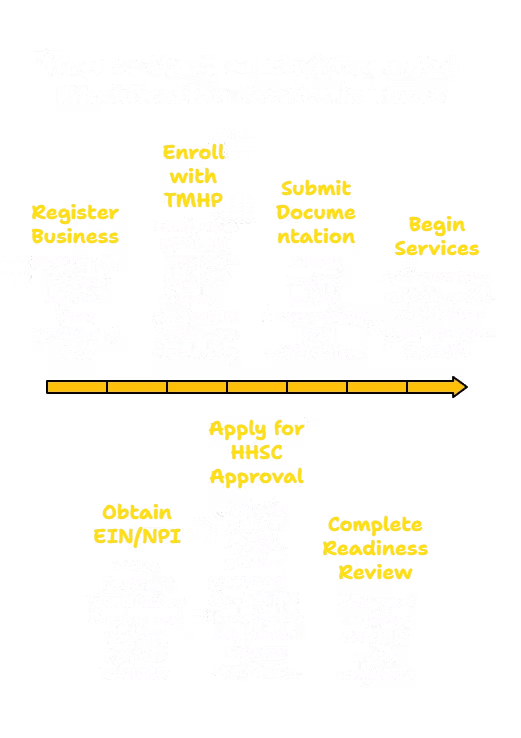
Establishing an Environmental Modification agency requires a systematic approach to business and healthcare regulatory compliance. Before engaging in service delivery, an organization must register with the Texas Secretary of State, secure an Employer Identification Number (EIN), and obtain a Type 2 National Provider Identifier (NPI). This foundational step is followed by enrollment with the Texas Medicaid & Healthcare Partnership (TMHP), which functions as the gateway for Medicaid billing and payment processing.
Beyond initial business registration, providers must undergo a rigorous approval process with HHSC. This involves demonstrating the capability to deliver services in compliance with waiver-specific regulations. Providers should be prepared to maintain comprehensive general liability and workers' compensation insurance, as these are critical for mitigating risks associated with construction activities in private homes. Developing a robust Environmental Modification Policy & Procedure Manual is a mandatory requirement to document the provider’s internal controls for assessment, bidding, construction, and inspection.
- Register the legal business entity and obtain the required tax and identification numbers.
- Enroll as a Medicaid provider through the TMHP portal.
- Submit an application for waiver-specific provider approval to HHSC.
- Establish partnerships with licensed general contractors if the agency does not provide direct construction services.
- Maintain valid insurance policies covering general liability, professional liability, and workers’ compensation.
What Documentation and Staffing Standards Are Required?
Administrative transparency is the hallmark of a successful Environmental Modification provider. HHSC requires strict documentation for every phase of a project, from the initial bid submission to the final inspection. Providers must maintain detailed records that include proof of contractor licensing, project specifications, photographic evidence of work completed, and sign-offs from the participant or their authorized representative. These records are subject to audit and must be readily accessible during reviews.
Regarding staffing, agencies must employ individuals with the professional competence to manage project oversight, Medicaid billing, and construction coordination. While many agencies partner with licensed general contractors to perform the physical labor, the agency remains responsible for ensuring all work meets OSHA, ADA, and local building code standards. Personnel involved in these projects should be experienced in handling the administrative burden of waiver programs, ensuring that all modifications align with the individual's Person-Directed Plan (PDP).
- Designated Environmental Modification Coordinator to manage documentation and communication.
- Qualified, licensed contractors for structural and electrical work.
- OT/PT consultants to provide clinical recommendations for accessibility needs.
- Internal quality control procedures including photo documentation of before/after project states.
What Is the Realistic Timeline for Launching Services?
Launching a service provider agency requires careful navigation of both state and federal approval channels. The business setup and contractor partnership phase typically takes one to two months, during which time the agency must secure its legal structure and establish its network of licensed professionals. This period is also ideal for drafting the mandatory Policy & Procedure Manual, which serves as the agency's operational blueprint.
The TMHP enrollment and HHSC waiver contracting process is the most time-intensive phase, often requiring two to three months of review. During this time, the agency should refine its documentation templates, billing tools, and authorization tracking systems. Once enrollment is finalized and the readiness review is completed, the agency may begin receiving service authorizations. Adherence to these timelines is critical, as shortcuts in the preparation phase often lead to delays during the HHSC site visit or document audit.
Frequently Asked Questions
Are all home modifications covered by Texas Medicaid?
No, only modifications that are medically necessary, supported by a professional assessment (such as from an Occupational or Physical Therapist), and included in the individual's authorized Person-Directed Plan (PDP) or Individual Plan of Care (IPC) are eligible for reimbursement under the waiver programs.
Can we perform construction work in HCS or TxHmL programs?
The HCS and TxHmL waiver programs handle structural needs through Residential Support Services in licensed settings rather than through the Environmental Modification services model. Providers should verify the specific waiver requirements before bidding on a project.
What happens if a modification does not pass inspection?
If a project fails to meet safety, building codes, or HHSC standards, the provider is responsible for rectifying the issues at their own expense. Ensuring that all work is completed according to approved specifications and documented with clear photographic evidence is vital to securing final payment authorization.
Key Takeaway: To successfully provide Environmental Modification services in Texas, agencies must achieve a precise balance between strict Medicaid documentation compliance and high-quality construction standards. By investing time in thorough policy development, securing proper licensing, and maintaining a clear, transparent audit trail, providers can effectively support the independence of individuals in the HCBS waiver system.
Last verified: 2024. This information is provided for educational purposes and does not constitute legal or professional advice. Always consult with the Texas Health and Human Services Commission (HHSC) and the Texas Medicaid & Healthcare Partnership (TMHP) for the most current regulations and program requirements.