ENVIRONMENTAL MODIFICATION SERVICES PROVIDER IN SOUTH CAROLINA
By Fatumata Kaba · 2025-10-13 · 5 min read
Environmental Modification Services in South Carolina are specialized Medicaid-funded home adaptations designed to ensure individuals with physical disabilities, chronic health conditions, or aging-related needs can reside safely within their own communities. By removing architectural barriers through structural modifications, these services promote person-centered independence and prevent premature institutionalization for participants enrolled in South Carolina Department of Health and Human Services (SCDHHS) managed waiver programs.
What Are the Core Objectives of Environmental Modification Services?
Environmental modifications represent a critical component of the state’s Home and Community-Based Services (HCBS) framework. The primary goal is to adapt the physical environment to accommodate the functional limitations of a participant, thereby increasing their autonomy and reducing the need for caregiver intervention. These modifications are not intended for aesthetic renovations; rather, they are functional adjustments prescribed to address specific safety or accessibility needs identified in an individual’s person-centered plan.
Authorized modifications must be directly linked to the participant’s disability and documented as a medical necessity. Providers must ensure that all work performed adheres to local building codes and, where applicable, the Americans with Disabilities Act (ADA) standards for accessible design. This ensures that the home environment remains a sustainable, safe living space that aligns with the long-term goals of the participant’s care plan.
Who Regulates the Provision of Environmental Modifications in South Carolina?
The delivery of these services involves a multi-layered regulatory environment. The South Carolina Department of Health and Human Services (SCDHHS) serves as the primary authority, overseeing the Medicaid waiver programs that fund these modifications, authorizing specific service plans, and managing provider reimbursement processes. They hold the responsibility for ensuring that providers meet enrollment criteria and maintain operational compliance.
Beyond SCDHHS, other entities play vital roles in the regulatory landscape. The South Carolina Department of Labor, Licensing and Regulation (LLR) manages the licensure requirements for contractors, ensuring that all construction professionals hold valid credentials for their trade. Furthermore, the Centers for Medicare & Medicaid Services (CMS) sets the federal framework for HCBS waiver programs, mandating that all services provided under these waivers prioritize person-centered care and participant safety.
What Are the Essential Requirements for Provider Enrollment?
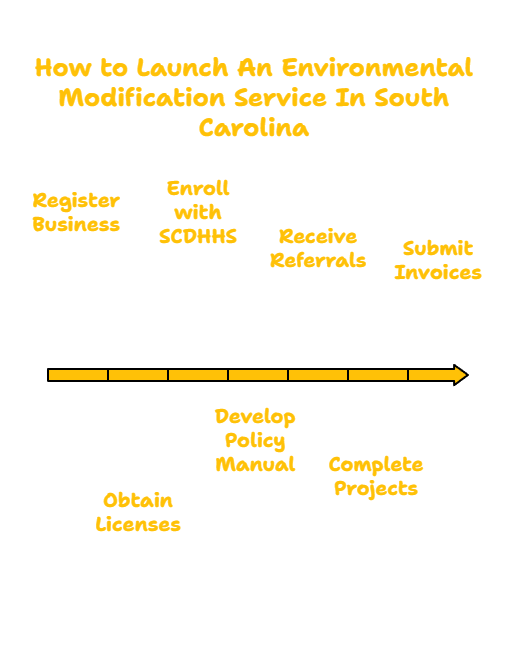
To become a Medicaid waiver service provider for environmental modifications, organizations must navigate a rigorous vetting process. Prospective providers must first register their business entity with the South Carolina Secretary of State and secure all necessary business tax identifiers, including an EIN and a Type 2 National Provider Identifier (NPI). These foundational steps are necessary to interact with the SCDHHS provider enrollment portal effectively.
Professional licensing is non-negotiable. Providers must hold a valid General Contractor License in South Carolina for any projects requiring structural changes or exceeding state-mandated dollar thresholds. Additionally, businesses must carry appropriate insurance—including general liability and workers’ compensation—and demonstrate financial stability through bonding. Finally, a comprehensive Policy & Procedure Manual is required, detailing internal processes for participant safety, project documentation, and conflict resolution.
- Business Foundation: Legal registration, EIN, NPI, and relevant LLR-issued contractor licenses.
- Risk Management: Proof of current liability insurance, bonding, and clear protocols for background checks on all staff and subcontractors.
- Operational Compliance: A written Policy & Procedure Manual that addresses ADA compliance, HIPAA confidentiality, and quality assurance metrics.
How Is the Medicaid Enrollment and Project Authorization Process Structured?
The enrollment process is a sequential journey that begins with verifying eligibility through the SCDHHS Medicaid Provider Enrollment Portal. Once a provider is enrolled in the HCBS waiver category, they become eligible to receive referrals generated by case managers. These case managers, representing programs such as the Community Long Term Care (CLTC), ID/RD, or HASCI waivers, act as the primary point of contact for identifying participants who require home modifications.
Project execution follows a strict documentation protocol. Before beginning any work, the provider must obtain an approved scope of work and a service authorization based on the participant’s Individualized Service Plan (ISP). Throughout the project, providers must maintain rigorous records, including detailed cost estimates, before-and-after photographic evidence, and itemized invoices that reflect only approved modifications. Non-reimbursable expenses, such as general home repairs or luxury cosmetic upgrades, must be strictly excluded from the billing process.
What Staffing and Training Protocols Must Providers Maintain?
Quality of service is directly tied to the competency of the staff and subcontractors involved. The Project Manager or Lead Contractor carries the primary responsibility for ensuring that all physical adaptations meet technical specifications and project timelines. This individual must possess significant experience in accessibility design to ensure that the modifications genuinely serve the participant’s functional needs.
Staff and subcontractors must be well-versed in both the technical aspects of construction and the sensitive nature of working within a home-based care environment. Training requirements are extensive and include mandated sessions on HIPAA compliance, participant rights, and infection control or safety protocols like OSHA standards. Maintaining a record of this training for all personnel is a requirement for audits conducted by state agencies.
- Accessibility Design: Ongoing training on ADA compliance and specific adaptations for various physical limitations.
- Professionalism & Ethics: Mandatory HIPAA and participant rights training to ensure privacy and respectful engagement.
- Safety & Documentation: Rigorous adherence to construction safety protocols and standardized Medicaid invoicing and documentation practices.
Frequently Asked Questions
Which Medicaid waiver programs cover environmental modifications?
Modifications are covered under the Community Long Term Care (CLTC) program, the ID/RD Waiver, the HASCI Waiver, and the Community Supports Waiver. Additionally, children may receive adaptations through State Plan EPSDT services when supported by a physician’s referral.
What types of home modifications are generally approved for reimbursement?
Approved projects focus on safety and accessibility, such as installing wheelchair ramps, grab bars, roll-in showers, stair lifts, widened doorways, and ceiling lifts. Minor plumbing or electrical work required to support these specific accessibility aids may also be covered.
Can a provider bill for general home maintenance or remodeling?
No. Medicaid funding for environmental modifications is strictly limited to adaptations that directly improve accessibility and independence for the participant. General home repairs, maintenance, or aesthetic improvements unrelated to the individual's disability are ineligible for reimbursement.
Key Takeaway
Successfully operating as a South Carolina Environmental Modification provider requires a meticulous balance between construction expertise and strict adherence to Medicaid administrative requirements. By prioritizing comprehensive documentation, professional licensing, and a thorough understanding of SCDHHS protocols, providers can effectively support the independence of South Carolina’s most vulnerable populations while maintaining a sustainable, compliant business model.
Last verified: October 2023. Disclaimer: This article is intended for informational purposes only and does not constitute legal or professional advice. Always verify current state statutes, SCDHHS policies, and CMS waiver requirements directly with the appropriate governing agencies before launching or modifying your business operations.