ENVIRONMENTAL ACCESSIBILITY SERVICES PROVIDER IN ALABAMA
By Fatumata Kaba · 2025-06-30 · 5 min read
Environmental Accessibility Services in Alabama serve as a critical component of the state’s Home and Community-Based Services (HCBS) Medicaid Waivers, providing essential physical home adaptations for individuals with intellectual and developmental disabilities (IDD). By facilitating modifications that enhance safety and promote independent living, these services enable participants to remain in their own homes rather than transitioning to institutional care settings.
Providers interested in entering this space must navigate a rigorous regulatory landscape overseen by the Alabama Department of Mental Health (ADMH) and the Alabama Medicaid Agency. Success requires a combination of construction project management expertise, a robust understanding of ADA accessibility standards, and strict adherence to Medicaid billing and documentation protocols.
What is the Scope of Environmental Accessibility Services in Alabama?
Environmental Accessibility Services focus on the physical modification of a participant’s primary residence to eliminate barriers to daily living and ensure health and safety. These modifications are specifically intended to increase the participant's independence within their home environment. Because these services are funded through Medicaid HCBS waivers, every project must be deemed medically necessary and aligned with the participant’s person-centered plan.
The scope of work generally involves one-time or occasional physical alterations rather than ongoing maintenance. These projects require careful coordination with licensed professionals to ensure that all work is completed according to local building codes, permit requirements, and federal accessibility standards. Common examples of authorized modifications include:
- Installation of wheelchair ramps, specialized handrails, and threshold bridges.
- Widening of doorways and hallways to accommodate mobility aids.
- Bathroom adaptations, such as the installation of roll-in showers, walk-in tubs, or grab bars.
- Structural kitchen modifications to lower counters or adjust cabinetry for wheelchair accessibility.
- Integration of specialized lighting or environmental alert systems to support sensory or physical needs.
How Do Governing Agencies Regulate Service Delivery?
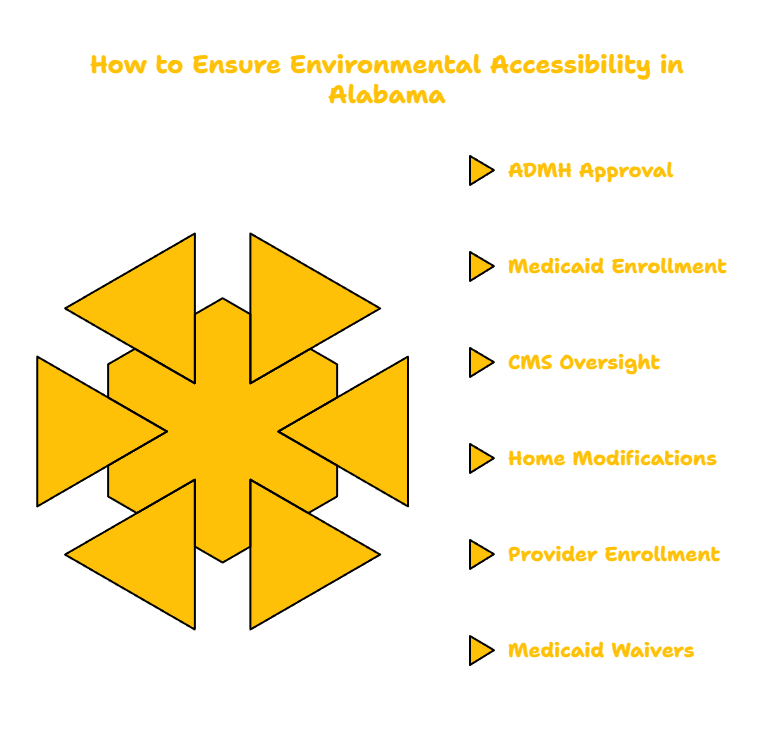
The delivery of environmental modifications is subject to multi-layered oversight to protect the health, welfare, and safety of waiver participants. The Alabama Department of Mental Health (ADMH) serves as the primary regulatory body for the Intellectual and Developmental Disabilities (IDD) community. ADMH is responsible for approving service providers and monitoring ongoing compliance with state-specific waiver requirements and quality standards.
Beyond state-level oversight, the Alabama Medicaid Agency manages the fiscal aspects of the program, including provider enrollment and the reimbursement process for authorized services. At the federal level, the Centers for Medicare & Medicaid Services (CMS) provides the overarching regulatory framework for all HCBS waiver programs. CMS oversight ensures that Alabama’s environmental modification services meet the federal standards required to maintain the integrity of Medicaid-funded community supports.
What Prerequisites Must an Organization Meet Before Applying?
Prospective providers must establish a solid business and operational foundation before engaging with the ADMH application process. Administrative readiness begins with formal business registration via the Alabama Secretary of State, followed by the acquisition of a federal Employer Identification Number (EIN) and a Type 2 National Provider Identifier (NPI). Organizations must maintain a physical office within Alabama or utilize a documented mobile-based operational model capable of serving the intended region.
A critical component of operational readiness involves demonstrating technical competence in accessibility design and project management. Providers must establish formal partnerships with licensed, bonded, and insured construction professionals. Internal controls are equally vital; agencies must be prepared to demonstrate their capability for budget tracking, cost estimation, and the inspection of finished work to ensure it aligns with ADA guidelines and safety regulations.
How Does the ADMH Provider Enrollment Process Function?
The transition from applicant to authorized provider is a multi-phase process designed to ensure that the agency is fully prepared to manage home modification projects safely and efficiently. The process begins by requesting the Environmental Accessibility Services Provider Application Packet from ADMH. During the initial phase, the applicant must submit a detailed service delivery model that explains how they intend to vet contractors, control project budgets, and manage the quality of modifications.
Following the application submission, the organization undergoes a Program Readiness Review. This evaluation tests the agency’s internal systems, including documentation templates, client consent forms, and inspection checklists. ADMH evaluates how the agency handles emergency repair requests, dispute resolution, and project timelines. Once ADMH determines the provider is compliant with all program standards, the agency proceeds to final enrollment with Alabama Medicaid to activate their specific service billing codes.
What Are the Key Requirements for Staffing and Documentation?
The success of an Environmental Accessibility agency relies on the expertise of its staff and the thoroughness of its documentation. A Program Coordinator should possess a background in construction management or disability services to bridge the gap between architectural needs and consumer requirements. All contractors must hold valid, current state construction licenses and maintain sufficient liability insurance to protect both the participant and the provider agency.
Standardized documentation is required to maintain Medicaid eligibility. Each project file must include:
- Formal proof of business formation and active licensing.
- ADMH-compliant policies regarding contractor selection, bidding, and safety protocols.
- Documentation of consumer informed consent for all structural changes.
- Pre- and post-modification photos to verify project completion.
- Final inspection reports confirming adherence to safety and ADA compliance standards.
Frequently Asked Questions
Which Medicaid Waivers authorize Environmental Accessibility Services?
In Alabama, these services are authorized under the Intellectual Disabilities (ID) Waiver, the Living at Home (LAH) Waiver, and the State of Alabama Community Waiver Program.
What is the typical timeline to launch an agency?
While timelines vary based on individual agency preparation, the process generally spans several months, including 60–90 days for ADMH review, 30–60 days for operational setup, and another 60–90 days for Medicaid enrollment.
Do staff members require specific training to deliver these services?
Yes. All staff and contractors must complete ADMH orientation, HCBS waiver training, and annual education regarding disability rights, safety protocols, and proper documentation procedures.
Key Takeaway
Launching an Environmental Accessibility Services agency in Alabama requires a disciplined approach to regulatory compliance, construction oversight, and Medicaid billing. By ensuring that all business practices are aligned with ADMH expectations and that every project strictly adheres to accessibility standards, providers can successfully support the independence and safety of individuals with intellectual and developmental disabilities.
Last verified: [Insert Date]. This information is intended for educational purposes and does not constitute legal or professional advice. Readers should consult the Alabama Department of Mental Health and the Alabama Medicaid Agency for the most current regulatory requirements and guidance.