ENVIRONMENTAL ACCESSIBILITY ADAPTATIONS (EAA) SERVICES PROVIDER IN DELAWARE
By Fatumata Kaba · 2025-07-07 · 5 min read
ENHANCING HOME SAFETY AND ACCESSIBILITY THROUGH STRUCTURAL MODIFICATIONS FOR INDIVIDUALS WITH DISABILITIES
Environmental Accessibility Adaptations (EAA) services in Delaware provide essential structural modifications to the homes of individuals with disabilities, fostering greater independence and safety within their primary residences. These services are authorized under the Delaware Lifespan Waiver, administered by the Division of Developmental Disabilities Services (DDDS), ensuring that participants can remain in their communities by eliminating physical barriers to mobility and daily living.
What Are Environmental Accessibility Adaptations and Who Governs Them?
Environmental Accessibility Adaptations are permanent or semi-permanent modifications designed to improve access and functionality for individuals enrolled in the Delaware Lifespan Waiver. These services go beyond standard home improvement by focusing specifically on clinical and safety-related needs, such as enabling a participant to maneuver a wheelchair, access bathroom facilities independently, or safely navigate entryways.
The regulatory framework for these services involves three primary entities, each playing a distinct role in ensuring quality and accountability:
- Delaware Division of Developmental Disabilities Services (DDDS): Responsible for the oversight of the Lifespan Waiver, DDDS manages participant eligibility and approves the specific modifications included in an Individual Service Plan (ISP).
- Delaware Division of Medicaid and Medical Assistance (DMMA): Oversees the fiscal side of the program, managing Medicaid billing, waiver reimbursement protocols, and overall program policy.
- Centers for Medicare & Medicaid Services (CMS): Provides federal oversight to ensure that Delaware’s HCBS waiver programs strictly adhere to federal safety standards and Medicaid compliance rules.
How Do Contractors Become Approved EAA Providers in Delaware?
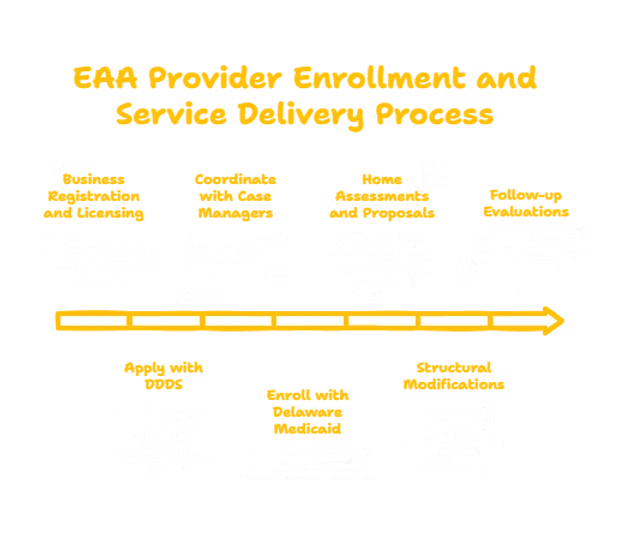
Transitioning into the Medicaid-funded accessibility space requires a systematic approach to business compliance. Before accepting referrals, a provider must establish their business entity with the Delaware Division of Corporations, secure an EIN from the IRS, and obtain a Type 2 NPI. Because EAA services involve structural changes, maintaining a valid Delaware contractor license is non-negotiable, as is carrying adequate general liability and workers’ compensation insurance.
The enrollment process moves from business formation to agency-specific authorization. Providers must enroll with the DDDS as an approved EAA provider by submitting comprehensive documentation, including proof of licensure and sample project portfolios. Following DDDS approval, providers must typically enroll through the Delaware Medicaid Provider Enrollment (DMAP) portal to ensure that they are properly credentialed to receive reimbursement for services delivered to waiver participants.
What Is the Required Documentation and Policy Infrastructure?
Successful EAA providers must maintain a robust administrative infrastructure. Medicaid auditors look for clear evidence that the provider is not only skilled in construction but also disciplined in clinical and administrative documentation. This includes maintaining HIPAA-compliant systems for storing participant data, as EAA work involves interacting with sensitive health information regarding a participant's mobility and care needs.
Every provider should maintain a detailed Policy & Procedure Manual that covers the following essential areas:
- Intake and Assessment: Standardized protocols for conducting initial home evaluations to determine the scope of need.
- Bid Submission: Templates for formal bids that provide clear cost justification, including detailed breakdowns of labor and materials to support project approval.
- Compliance Documentation: Checklists verifying ADA compliance and before-and-after photographic records of all installations.
- Safety and Quality Control: Incident reporting procedures, warranty tracking for installed hardware, and established protocols for obtaining informed consumer consent.
What Are the Essential Staffing and Training Standards?
The quality of EAA services depends heavily on the competency of the staff and subcontractors involved. At a minimum, the lead contractor or accessibility technician must possess extensive experience in ADA-compliant renovation. While a specialized license may not be required for every task, the lead technician must demonstrate an advanced understanding of the physical barriers faced by individuals with developmental disabilities.
Beyond technical skills, all staff members should be trained in the specific context of working within a Medicaid HCBS environment. Training programs should prioritize:
- ADA and Accessibility Standards: Maintaining a working knowledge of national and state accessibility codes.
- Professionalism and Ethics: Understanding cultural sensitivity, personal boundaries, and the importance of professional conduct when working in a participant’s private home.
- Privacy and Safety: Maintaining HIPAA basics and strict adherence to safety planning during active construction phases.
What Is the Typical Project Execution Process?
Project execution starts when a case manager or support coordinator refers a participant to an approved provider. The provider must then conduct a thorough home assessment to evaluate the structural feasibility of the requested modifications. This involves drafting a detailed project proposal that aligns with the participant’s ISP and demonstrates why the specific modification is medically necessary.
Once the bid is submitted and approved by DDDS, the provider manages the installation process from start to finish. This includes securing necessary local building permits, coordinating site access with the family, and performing the actual construction or installation. Following completion, the provider must perform a final evaluation to ensure the installation is functional and safe, and then submit the final verification documentation required for reimbursement.
Frequently Asked Questions
Can a general contractor perform EAA services without specialized accessibility training?
While general construction skills are required, EAA services demand a specific understanding of disability-related codes and Medicaid documentation requirements. Failure to adhere to these standards can result in denied claims or project disapproval by the DDDS.
How long does the provider enrollment process usually take?
The timeline varies based on the completeness of the application. Generally, business formation and licensing take 1–4 weeks, while the DDDS provider enrollment process can take anywhere from 30 to 60 days. Providers should plan for a multi-month period before the first referral is finalized.
What happens if a project requires a modification not explicitly listed in the standard guidelines?
Providers must coordinate closely with the participant’s case manager. If a modification is outside standard scope, it requires additional justification and documented medical necessity to ensure it aligns with the goals of the individual’s Service Plan.
Key Takeaway
Providing Environmental Accessibility Adaptations in Delaware is a specialized service that blends high-quality construction with rigorous Medicaid compliance. Success in this field requires a deep commitment to administrative accuracy, clear communication with DDDS case managers, and a focus on delivering durable, ADA-compliant modifications that fundamentally improve the daily lives of waiver participants.
Last verified: October 2023. Disclaimer: This document is for informational purposes only and does not constitute legal or professional advice. Always verify current state requirements with the Delaware Division of Developmental Disabilities Services (DDDS) and the Division of Medicaid and Medical Assistance (DMMA) before making business decisions.