EMPLOYMENT SERVICES PROVIDER IN CONNECTICUT
By Fatumata Kaba · 2025-07-08 · 5 min read
How to Become an Employment Services Provider in Connecticut
Becoming an approved Employment Services provider in Connecticut requires a structured commitment to delivering person-centered vocational support that aligns with state-mandated Competitive Integrated Employment (CIE) standards. Providers are essential partners in helping individuals with disabilities navigate the workforce, move toward self-sufficiency, and participate fully in their communities through HCBS waiver-funded initiatives.
Employment services in Connecticut are governed by the Department of Developmental Services (DDS) and managed in collaboration with the Department of Social Services (DSS) and the Bureau of Rehabilitation Services (BRS). For prospective agency owners, success depends on achieving qualification as a provider, maintaining rigorous documentation standards, and ensuring that all service delivery meets federal community integration requirements set forth by the Centers for Medicare & Medicaid Services (CMS).
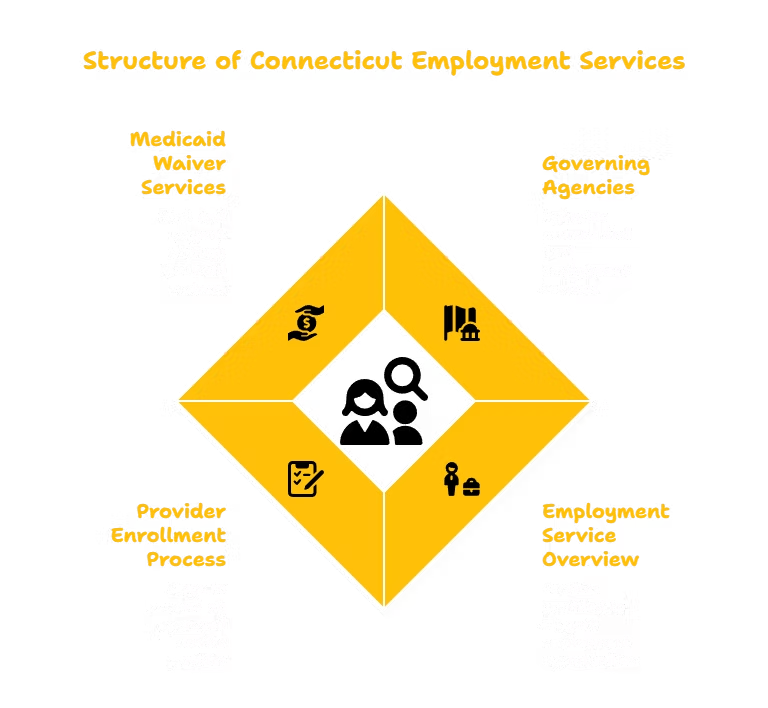
Understanding the Role of Governing Agencies in HCBS
The regulatory framework for employment services in Connecticut is multi-faceted, involving several state and federal bodies. The Department of Developmental Services (DDS) serves as the primary authorizing agency, responsible for monitoring employment services through the Individual Plan (IP) process. DDS ensures that services are person-centered and that providers are qualified to meet the diverse needs of waiver participants.
The Department of Social Services (DSS) acts as the state’s lead Medicaid agency, overseeing the financial integrity and compliance of the HCBS waivers. Meanwhile, the Bureau of Rehabilitation Services (BRS) often provides the bridge for individuals transitioning from short-term vocational rehabilitation to long-term waiver-funded supports. All providers must demonstrate that their operational models comply with CMS standards for community integration, which mandate that individuals with disabilities work in environments alongside individuals without disabilities.
- Department of Developmental Services (DDS): Authorizes and monitors employment services through DDS Waiver programs and Individual Plans (IPs).
- Department of Social Services (DSS): Manages Medicaid reimbursement and ensures compliance with federal HCBS requirements.
- Bureau of Rehabilitation Services (BRS): Offers initial vocational rehabilitation support and collaborates on long-term transitions.
- Centers for Medicare & Medicaid Services (CMS): Sets federal standards for community integration and Medicaid waiver program integrity.
Core Components of Employment Service Delivery
Employment services are intended to move beyond traditional day programs, focusing instead on meaningful work and professional growth. An effective service model must address the full trajectory of the employment lifecycle, from the initial discovery of career interests to the long-term maintenance of a job. Providers are expected to act as advocates, coaches, and mediators between the participant and the employer.
Service delivery typically includes vocational assessments to identify strengths, followed by targeted job development and placement assistance. Once a participant secures a position, the provider must furnish on-the-job training and ongoing coaching to ensure the individual succeeds. Additionally, providers are responsible for teaching soft skills, facilitating workplace accommodations, and providing travel training to ensure the participant can reach their work destination independently.
Navigating the Provider Qualification and Enrollment Process
The path to becoming a qualified provider begins with the formal application process through DDS. Before applying, organizations must ensure they are properly structured as business entities, including registration with the Connecticut Secretary of the State and the acquisition of an EIN and Type 2 NPI. The provider must then demonstrate that their internal service model is fully aligned with the principles of Competitive Integrated Employment.
Once the application is submitted, the approval process involves a review of staff qualifications, program policies, and the organization's capacity to deliver HCBS-compliant services. Following approval, providers coordinate with DDS case managers to receive referrals linked to specific participant Individual Plans. Sustained success in this role requires ongoing professional development and strict adherence to Medicaid billing codes and documentation protocols.
- Phase 1: Register the business, obtain a Type 2 NPI, and develop a comprehensive program design.
- Phase 2: Submit the formal qualified provider application to DDS, including policy manuals and staff credentialing documentation.
- Phase 3: Coordinate with DDS case managers for referral activation and integrate service delivery with participant IP goals.
Establishing Documentation and Compliance Protocols
Rigorous documentation is the cornerstone of maintaining Medicaid provider status in Connecticut. Because HCBS programs are publicly funded, every interaction, goal, and outcome must be meticulously recorded. This includes maintaining up-to-date vocational assessments, job development logs, and progress notes that clearly demonstrate how the provider’s efforts are contributing to the participant’s employment milestones.
A comprehensive policy and procedure manual is a prerequisite for approval. This manual must cover areas such as HIPAA-compliant record management, incident reporting, and the protection of participant rights. Additionally, providers must establish clear tracking systems for staff training, background checks, and certifications, as well as templates for employer engagement that show continuous outreach and support efforts.
Staffing, Credentialing, and Professional Development
The quality of employment services is directly tied to the competency of the staff. Job developers and employment specialists must possess strong backgrounds in vocational rehabilitation or workforce development to successfully negotiate with employers and match candidates to suitable roles. Meanwhile, job coaches serve as the direct support interface, requiring excellent interpersonal skills and a deep understanding of workplace accommodations.
Mandatory training for all staff members includes person-centered employment planning, ADA compliance, and HCBS-compliant documentation techniques. Because the workforce needs of participants can be complex, supervisors must ensure that staff receive ongoing continuing education units (CEUs). This commitment to professional growth not only ensures compliance but also significantly improves the employment outcomes for the individuals served.
Frequently Asked Questions
What is the typical timeline for becoming a DDS qualified provider?
The process generally spans 60–90 days for the formal provider application, following an initial 1–2 week business formation phase. Staff hiring and community outreach are conducted in parallel or immediately following qualification, usually taking an additional 2–4 weeks.
Which Medicaid waivers cover employment services?
Employment services are primarily funded through the DDS Individual and Family Support (IFS) Waiver and the DDS Comprehensive Waiver. Funding may also originate from BRS during the initial vocational phase before transitioning to long-term waiver support.
What are the essential administrative requirements for starting an agency?
You must register your business with the Connecticut Secretary of the State, obtain an IRS EIN, and secure a Type 2 NPI. Furthermore, you must develop a formal policy and procedure manual that satisfies DDS requirements for service delivery, HIPAA compliance, and participant rights.
Key Takeaways for Prospective Providers
Launching an Employment Services agency in Connecticut requires careful coordination with DDS, DSS, and BRS to ensure that all business operations align with state and federal regulations. Success is built upon a foundation of robust documentation, qualified staffing, and an unwavering commitment to Competitive Integrated Employment. By adhering to the established procedural, clinical, and administrative standards of the HCBS waiver system, agencies can effectively support individuals with disabilities in achieving long-term vocational success.
Waiver Consulting Group provides support for agencies, nonprofits, and professionals seeking to launch DDS-approved Employment Services. Our services include assistance with business formation, policy manual development, staff credentialing systems, and operational audit preparation. Our Client Portal offers a wealth of resources that you can explore related to various programs and state requirements.
Last verified: October 2023. This information is intended for educational purposes only and does not constitute legal or professional advice. Always consult directly with the Connecticut Department of Developmental Services (DDS) or your legal counsel regarding specific state regulations and requirements.