DAY HABILITATION SERVICES PROVIDER IN NEW MEXICO
By Fatumata Kaba · 2025-09-05 · 6 min read
Day Habilitation Services in New Mexico are structured Medicaid HCBS programs designed to foster independence, community integration, and skill acquisition for individuals with intellectual or developmental disabilities. By providing purposeful activities in both community and facility-based settings, these services enable participants to enhance their daily living abilities while receiving support tailored to their Individualized Service Plan (ISP). Providers of these services play a critical role in the state’s healthcare infrastructure by facilitating social, vocational, and personal growth for one of New Mexico's most vulnerable populations.
What Are the Governing Agencies and Regulatory Requirements for New Mexico Day Habilitation?
The delivery of Day Habilitation Services in New Mexico is governed by a framework of state and federal oversight designed to ensure participant safety and the quality of care. The New Mexico Human Services Department (HSD) serves as the primary authority, overseeing Medicaid waiver funding, provider enrollment, and reimbursement processes. Their role is to ensure that all administrative and financial aspects of the program remain compliant with state regulations.
The Developmental Disabilities Supports Division (DDSD) works in tandem with HSD to maintain high standards of service delivery. They conduct oversight to ensure that providers are meeting the quality of care expectations defined under the Home and Community-Based Services (HCBS) waivers. Finally, the federal Centers for Medicare & Medicaid Services (CMS) provides the overarching federal regulatory framework, ensuring that all New Mexico programs align with national standards for person-centered planning and participant protections.
What Scope of Services Should a Day Habilitation Provider Offer?
At its core, Day Habilitation is focused on helping participants acquire, maintain, and improve self-help, socialization, and adaptive skills. Providers are expected to move beyond simple supervision, instead offering structured, goal-oriented activities that directly map to the participant's ISP. These programs should be diverse enough to address the varying needs of the population, ranging from basic communication and personal care to complex community integration tasks.
Approved providers commonly facilitate the following core areas of service:
- Skill Development: Focused training in essential daily living skills, such as self-care, personal hygiene, and communication.
- Community Integration: Facilitated participation in social, educational, and recreational activities that connect the participant to their local community.
- Social and Cognitive Enrichment: Programs aimed at building interpersonal relationships and stimulating problem-solving, memory, and creative thinking.
- Health and Vocational Training: Nutrition and wellness education, combined with pre-employment or task-oriented training to boost vocational readiness.
- Safety and Mobility: Structured instruction on safe navigation within both the facility and the broader community environment.
How Do You Navigate the New Mexico Provider Enrollment Process?
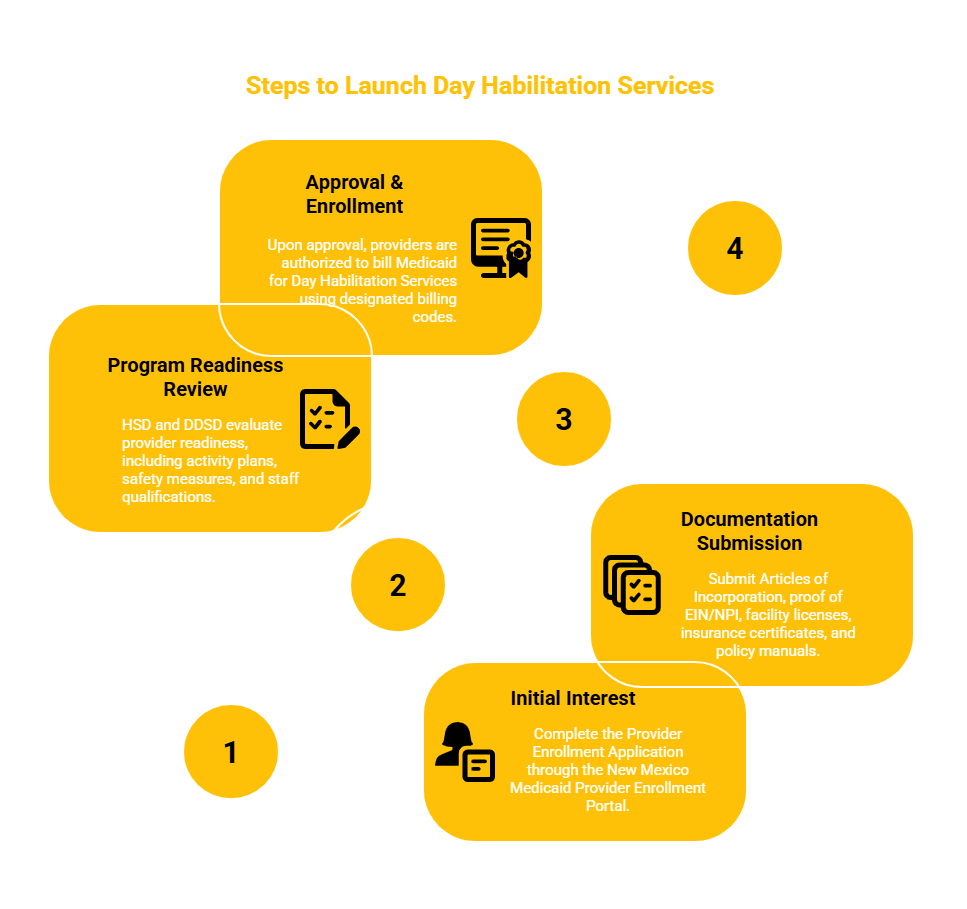
Becoming an approved provider is a multi-step journey that begins with establishing the legal business entity. Prospective providers must first register with the New Mexico Secretary of State, obtain an IRS Employer Identification Number (EIN), and secure a Type 2 National Provider Identifier (NPI). These credentials serve as the foundation for all subsequent Medicaid-related filings and billing activities.
Once the business entity is established, the provider must navigate the enrollment process through the New Mexico Medicaid Provider Enrollment Portal. This phase involves a rigorous submission of documentation, including proof of insurance, facility licenses, and comprehensive policy manuals. Following the initial submission, the HSD and DDSD will conduct a program readiness review. This review evaluates the provider's operational readiness, including the adequacy of activity plans, staff qualification documentation, and safety infrastructure. Only after a successful review will the provider be granted the authority to bill Medicaid for services rendered.
What Are the Essential Documentation and Policy Requirements?
Operational success in New Mexico requires a robust administrative backbone. Providers must maintain a comprehensive Policy and Procedure Manual that addresses every aspect of their operations, from the mundane to the critical. This manual is not merely for internal use; it is a vital document for auditors and state regulators who will verify that the agency has established proper controls before and during service delivery.
Essential documentation areas that must be thoroughly addressed include:
- Operational Protocols: Detailed procedures for daily activity planning, skill development tracking, and community engagement.
- Compliance and Rights: Formal policies regarding HIPAA compliance, participant rights, and the handling of grievances.
- Safety and Emergency Management: Rigorous protocols for emergency response, infection control, and daily facility safety monitoring.
- Human Resources: Clearly defined standards for staff credentialing, required background checks, and annual competency training.
- Fiscal Controls: Standardized documentation processes that support accurate Medicaid billing and ensure audit-readiness.
How Do You Manage Staffing and Training Compliance?
Staffing for a Day Habilitation program requires a balance of professional leadership and skilled direct support. The Program Director must typically possess a bachelor’s degree in human services or a related field, alongside practical experience in managing similar day programs. This ensures that the agency is led by someone capable of maintaining clinical and operational standards.
Supporting the Director are Habilitation Specialists and Direct Support Professionals (DSPs). Specialists focus on adaptive programming, while DSPs provide the hands-on assistance necessary for daily activities. All staff, regardless of role, must undergo mandatory training that covers the following areas:
- Foundational Education: HIPAA compliance, participant rights, and the ethics of providing care to individuals with disabilities.
- Skill-Specific Training: Ongoing instruction in adaptive skill development and community integration techniques.
- Safety Proficiency: Mandatory and current CPR/First Aid certification, emergency preparedness, and infection control protocols.
- Professional Growth: Annual competency evaluations to ensure that staff remain proficient in delivering high-quality, person-centered support.
What Are the Available Medicaid Waiver Programs?
Day Habilitation Services in New Mexico are specifically authorized under several Medicaid HCBS waiver programs. Each waiver serves a distinct population, and providers should understand the nuances of each to better serve their participants. The primary waivers include the Developmental Disabilities (DD) Waiver, the Mi Via Waiver, the Medically Fragile Waiver, and the Supports Waiver.
Because these services are funded under the broader HCBS framework, all interventions must be delivered in settings that allow for full access to the benefits of community living. Whether through the DD waiver or others, the overarching goal remains the same: to empower participants to increase their independence and improve their quality of life through meaningful daily engagement.
Frequently Asked Questions
What is the typical timeline for launching a Day Habilitation service?
The launch process typically spans several months. Business formation and initial compliance preparation generally take 1–2 months, followed by 2–3 months for staffing and internal program development. The Medicaid enrollment and readiness review phase requires 60–90 days, with final billing setup taking an additional 30–45 days.
Is facility licensure always required?
Facility licensure from the HSD or NMDOH is required if you are providing site-based day habilitation services. If your business model focuses exclusively on community-based outreach without a dedicated facility, the regulatory requirements may differ regarding physical plant inspections.
What does Waiver Consulting Group offer for new providers?
WCG provides comprehensive startup assistance, including aid with business registration, Medicaid enrollment, policy manual development, staff training templates, and the setup of billing systems designed to ensure audit-preparedness and long-term program effectiveness.
Key Takeaway: Successfully operating as a Day Habilitation provider in New Mexico requires a rigorous commitment to documentation, regulatory compliance, and person-centered service delivery. By aligning your operational practices with the standards set by HSD, DDSD, and CMS, your agency can provide essential support to individuals while maintaining a stable and sustainable business model.
Last verified: May 2024. This information is for educational purposes only and does not constitute legal or financial advice. Regulations regarding Medicaid waivers in New Mexico are subject to change, and providers should consult with the official New Mexico Medicaid Provider Enrollment Portal and governing departments for the most current requirements.