DAY HABILITATION SERVICES PROVIDER IN NEW HAMPSHIRE
By Fatumata Kaba · 2025-08-12 · 5 min read
Supporting Independence and Community Integration Through Structured Day Programs
Day Habilitation services in New Hampshire are specialized programs designed to assist individuals with intellectual or developmental disabilities in mastering essential daily living skills, fostering meaningful social interactions, and increasing overall community engagement. Authorized under New Hampshire Medicaid Home and Community-Based Services (HCBS) waiver programs, these services are essential for promoting long-term independence through structured, person-centered support environments.
What Are the Governing Agencies and Regulatory Frameworks?
The delivery of Day Habilitation services in New Hampshire is overseen by a collaborative regulatory framework involving both state and federal entities. The primary state agency is the New Hampshire Department of Health and Human Services (DHHS), which holds the overarching responsibility for administering Medicaid waiver funding, managing provider enrollment, overseeing service authorization, and ensuring appropriate reimbursement for services rendered.
Within the DHHS structure, the Bureau of Elderly and Adult Services (BEAS) plays a critical role in maintaining quality standards and ensuring compliance with HCBS waiver mandates. At the federal level, the Centers for Medicare & Medicaid Services (CMS) provides the necessary oversight to ensure that all Medicaid-funded Day Habilitation programs adhere to rigorous standards regarding person-centered planning, participant protections, and quality of care. Providers must align their operational protocols with the expectations set forth by these three governing bodies to maintain their eligibility to participate in state-funded programs.
What Scope of Services Defines a Day Habilitation Program?
The primary focus of Day Habilitation is to facilitate the development of skills that directly support a participant’s path toward independence, personal growth, and community inclusion. These services are not one-size-fits-all; they are tailored to the specific needs and desires of the individual as outlined in their Individualized Service Plan (ISP). By combining clinical support with social integration, providers offer a comprehensive approach to habilitation.
Approved providers generally deliver services that encompass several core areas of development:
- Skill Development: Practical training in activities of daily living, including personal hygiene, meal preparation, household chores, and financial literacy or budgeting.
- Social and Community Integration: Facilitating group activities and community outings to encourage meaningful social interactions and civic participation.
- Communication Enhancement: Developing verbal, non-verbal, and social communication skills to assist individuals in expressing their needs and preferences.
- Health and Wellness Activities: Integrating physical exercise routines, nutritional education, and consistent self-care practices.
- Vocational Readiness: Providing foundational support for basic job skills, volunteer placement opportunities, and pre-employment activities.
- Therapeutic Engagement: Utilizing specialized activities such as art, music, or physical therapy to promote cognitive and motor skill development.
- Personal Safety Education: Teaching essential safety protocols, situational awareness, and self-advocacy techniques.
What Are the Licensing and Provider Approval Requirements?
Launching a Day Habilitation program requires navigating a series of formal prerequisites to ensure the entity is legally structured and compliant with state Medicaid standards. Before beginning the enrollment process, a provider must register their business entity with the New Hampshire Secretary of State and secure a Federal Employer Identification Number (EIN) from the IRS, along with a Type 2 National Provider Identifier (NPI).
Beyond basic business registration, prospective providers must obtain the necessary licensure as a Day Habilitation Program from the DHHS. This process includes securing comprehensive general liability and professional liability insurance. Furthermore, the agency must develop robust internal policies covering program safety, skill development methodologies, and participant support mechanisms. It is also mandatory to establish rigorous internal systems for staff vetting, including comprehensive background checks, health screenings, and proof of habilitation-specific training, ensuring that the agency is prepared to meet the high standards of care required by the state.
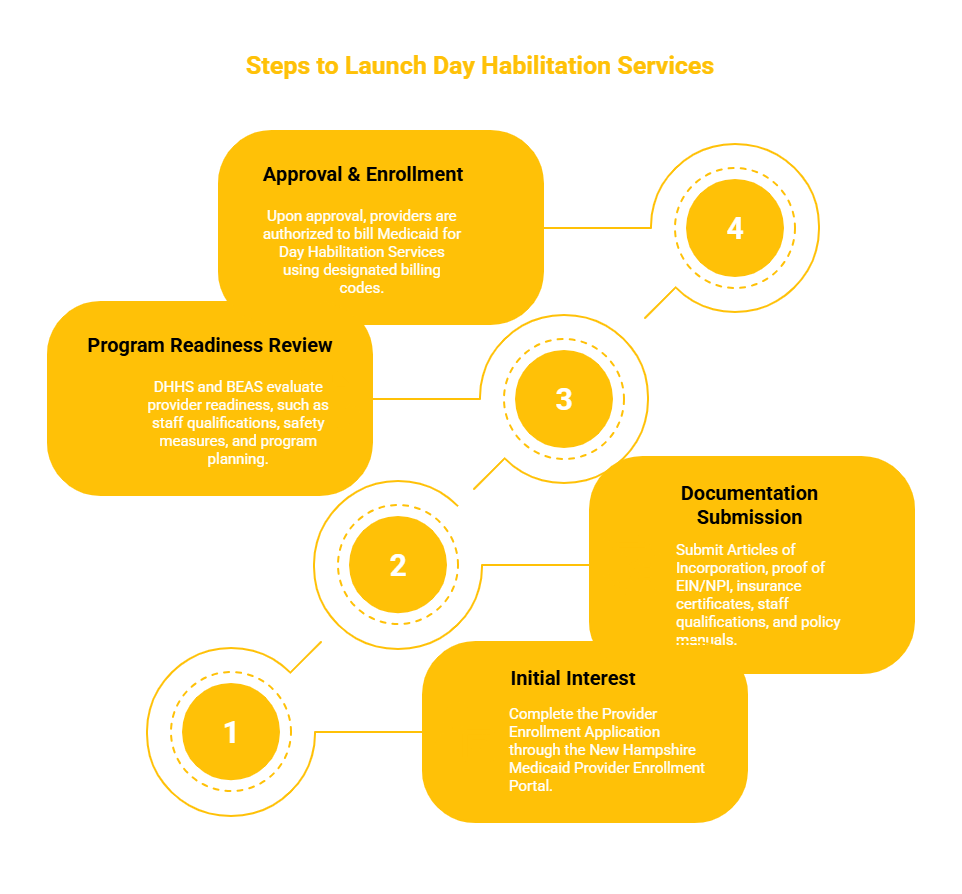
How Does the New Hampshire Provider Enrollment Process Function?
The transition from a business entity to an authorized Medicaid provider involves a structured sequence of applications and program reviews. Initially, the applicant must complete the Provider Enrollment Application through the New Hampshire Medicaid Provider Enrollment Portal specifically for Day Habilitation services under HCBS waivers. This stage requires the submission of extensive documentation, including the business’s Articles of Incorporation, proof of EIN/NPI, active insurance certificates, staff qualifications, and comprehensive policy manuals.
Following the submission, the DHHS and BEAS conduct a program readiness review. This evaluation is critical, as it confirms that the provider is prepared to deliver quality care, maintains proper safety measures, and possesses an effective program plan. Once the agency passes this review, it is formally authorized to bill Medicaid using designated billing codes. The timeline for this process generally requires several months of preparation, beginning with business formation and ending with the final activation of billing capabilities.
What Are the Essential Staffing and Documentation Standards?
Operational success in Day Habilitation depends on the expertise and training of the staff. A Program Director is typically required to hold a bachelor’s degree in a human services or special education field and possess proven experience managing habilitation programs. Direct Support Professionals (DSPs) are the frontline caregivers and are required to hold a high school diploma or GED, alongside certifications in CPR, First Aid, and specific training in habilitation and community integration.
Documentation is the backbone of Medicaid compliance. Every agency must maintain a comprehensive Policy & Procedure Manual that addresses HIPAA compliance, participant rights, and grievance handling. Other critical documentation includes:
- Detailed activity planning, social engagement logs, and skill-building protocols.
- Protocols for personal care assistance, supervision, and ongoing participant safety.
- Staff credentialing files, including background check results and records of ongoing training.
- Standardized procedures for service tracking and accurate Medicaid billing.
- Emergency response plans and infection control measures to ensure a safe environment.
Frequently Asked Questions
Which Medicaid waiver programs allow for Day Habilitation services in New Hampshire?
Day Habilitation services are available under several New Hampshire Medicaid waivers, including the Choices for Independence (CFI) Waiver, the Developmental Disabilities (DD) Waiver, the Acquired Brain Disorder (ABD) Waiver, the In-Home Support (IHS) Waiver for Children, and the broader Home and Community-Based Services (HCBS) Waiver.
How long does the entire startup and enrollment process typically take?
The timeline varies based on organizational readiness, but generally follows this path: 1–2 months for business formation, 2–3 months for staff hiring and program development, 60–90 days for Medicaid provider enrollment and readiness reviews, and 30–45 days for final billing setup.
What must be included in the provider’s staff training curriculum?
All staff must complete training in person-centered care and habilitation practices, HIPAA compliance, participant rights, and ongoing education regarding social skills support and community engagement. Furthermore, annual competency evaluations are required to ensure staff remain current with best practices.
Key Takeaway
Establishing a Day Habilitation program in New Hampshire requires a disciplined commitment to regulatory compliance, rigorous staff credentialing, and meticulous documentation. By aligning business operations with the standards set by the DHHS, BEAS, and CMS, providers can ensure they are well-positioned to deliver high-quality, person-centered care that significantly improves the independence and quality of life for individuals with intellectual or developmental disabilities. Success is achieved through careful attention to the enrollment portal requirements and the consistent application of established program policies.
Last verified: October 2023. Disclaimer: This information is for educational purposes and does not constitute legal or professional medical advice. Always consult with the New Hampshire Department of Health and Human Services (DHHS) and current state regulations for the most recent updates and requirements regarding Medicaid provider enrollment.