CRISIS STABILIZATION SERVICES PROVIDER IN GEORGIA
By Fatumata Kaba · 2025-07-14 · 5 min read
How to Become a Crisis Stabilization Services Provider in Georgia
Becoming a Crisis Stabilization Services provider in Georgia involves meeting rigorous clinical, operational, and regulatory standards set forth by the Department of Behavioral Health and Developmental Disabilities (DBHDD) and the Department of Community Health (DCH). These providers play a vital role in the state's healthcare safety net by offering immediate, intensive supports that de-escalate psychiatric and behavioral emergencies, thereby preventing unnecessary hospitalizations and ensuring participant safety within the community.
The path to authorization requires a multifaceted approach, encompassing business entity formation, facility licensure (for unit-based models), comprehensive clinical policy development, and successful enrollment as a Medicaid provider. Organizations aiming to deliver these services must demonstrate readiness to manage high-acuity behavioral needs while maintaining strict compliance with state and federal oversight requirements.
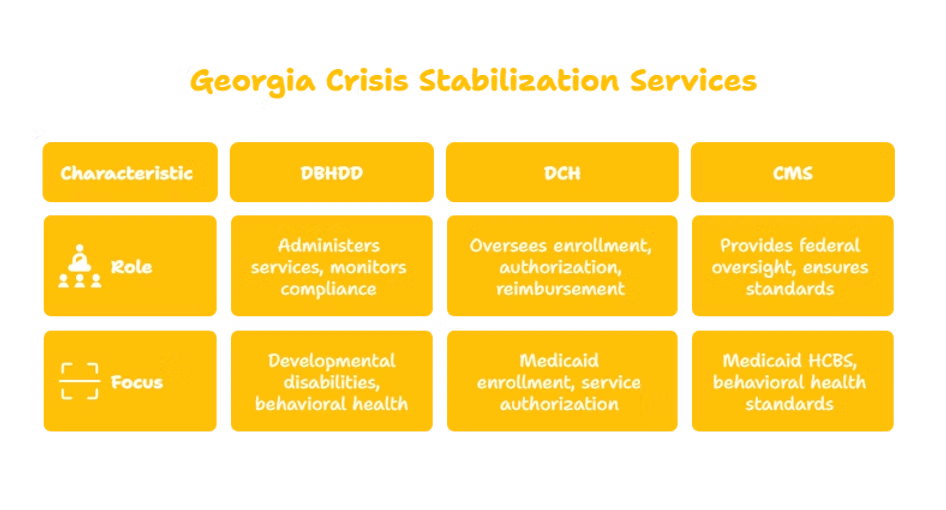
Understanding the Governing Agencies and Regulatory Landscape
The regulatory structure for Crisis Stabilization Services in Georgia is designed to ensure participant safety and the delivery of evidence-based interventions. The Georgia Department of Behavioral Health and Developmental Disabilities (DBHDD) serves as the primary body responsible for administering these services, monitoring provider compliance, and overseeing the quality of care for individuals with developmental disabilities and behavioral health challenges.
Parallel to DBHDD's role, the Georgia Department of Community Health (DCH) manages the administrative and fiscal aspects of the program. DCH is responsible for Medicaid enrollment, defining service authorization criteria, and managing reimbursement workflows. Furthermore, all programs must operate under the federal guidelines established by the Centers for Medicare & Medicaid Services (CMS), which ensure that HCBS and behavioral health standards are upheld consistently across the state.
Establishing Essential Operational and Licensing Requirements
Launching a service as sensitive as crisis stabilization requires a foundation built on robust administrative infrastructure. Before applying for program participation, an organization must be properly registered with the Georgia Secretary of State and possess a valid Federal Employer Identification Number (EIN) and a Type 2 National Provider Identifier (NPI). These are the prerequisites for all subsequent interactions with state health authorities.
If the provider model includes a physical facility—such as a Crisis Stabilization Unit (CSU)—the organization must secure a Behavioral Health Facility License through the Healthcare Facility Regulation Division (HFRD) of the DCH. This process involves stringent facility inspections and the verification of life safety codes. Regardless of the service model, providers must maintain comprehensive insurance portfolios, including professional, general liability, and property coverage, to safeguard the organization and its participants.
- Register the business entity with the Georgia Secretary of State.
- Obtain a Type 2 NPI and an IRS-issued EIN.
- Secure a Behavioral Health Facility License from the DCH-HFRD if operating a unit-based service.
- Establish comprehensive insurance coverage, including professional and general liability.
- Draft a detailed Policy & Procedure manual covering crisis triage, clinical documentation, and participant rights.
Navigating the DBHDD and DCH Provider Enrollment Process
The enrollment journey begins with the submission of a Letter of Intent to the DBHDD, signaling an organization’s commitment to providing specific crisis stabilization supports. Once the initial interest is acknowledged, prospective providers must complete a pre-qualification checklist. This checklist confirms the entity’s readiness regarding staffing models, facility specifications, and operational capacity to handle acute psychiatric symptoms.
Following the pre-qualification phase, the organization must submit a comprehensive packet including Articles of Incorporation, clinical credentials, and detailed operational policies. A program readiness review follows, which is perhaps the most critical step. During this phase, DBHDD representatives perform facility inspections or rigorous programmatic audits. Only after official DBHDD approval is the provider permitted to finalize their enrollment through the Georgia Medicaid Management Information System (GAMMIS) to configure billing codes and commence service delivery.
Defining Staffing and Clinical Competency Standards
The effectiveness of crisis stabilization is predicated on the qualifications and training of the staff. Programs must be led by a Crisis Stabilization Program Manager or Clinical Supervisor, typically a licensed mental health professional such as an LPC, LCSW, or psychologist, who oversees the clinical integrity of the program. Depending on the model, the team may also require a psychiatrist or nurse practitioner to provide medication management and psychiatric evaluations.
Direct support staff and behavioral health aides are the backbone of daily operations. While these roles have lower entry-level education requirements—typically a high school diploma or GED—they must possess specialized training in crisis intervention and de-escalation. All personnel, regardless of their role, are required to undergo comprehensive background screenings and mandatory training modules, including HIPAA compliance, participant rights, and emergency preparedness.
- Crisis Prevention Intervention (CPI) or equivalent de-escalation training.
- HIPAA confidentiality, patient privacy, and participant rights education.
- Abuse prevention and incident reporting protocols.
- Annual continuing education refreshers in behavioral health crisis management.
Frequently Asked Questions
What is the difference between facility-based and mobile crisis services?
Facility-based stabilization involves short-term, 24-hour stays in a licensed unit for intensive medical and psychiatric monitoring. Mobile crisis response teams provide in-home or community-based de-escalation and support services without requiring the participant to be admitted to a facility.
Which Medicaid programs authorize these services?
Crisis Stabilization Services are authorized under the Comprehensive Supports Waiver Program (COMP), the New Options Waiver Program (NOW), and various Medicaid Behavioral Health State Plan services designed for both children and adults.
How long should a provider expect the launch process to take?
The timeline typically spans several months. Business formation and licensing generally take 2–3 months, the DBHDD application and readiness review take 90–120 days, and subsequent Medicaid enrollment and staff onboarding phases add approximately 2–3 additional months to the total development time.
Key Takeaway
The delivery of Crisis Stabilization Services in Georgia requires a high degree of administrative rigor, clinical expertise, and strict adherence to the regulatory mandates enforced by DBHDD and DCH. By meticulously following the established pathways for licensing, enrollment, and staff training, providers can build sustainable, high-impact programs that successfully prevent institutionalization and support the recovery of participants in crisis.
Last verified: October 2023. Disclaimer: This document is for informational purposes only and does not constitute legal or professional advice. Always refer to official Georgia DBHDD and DCH documentation for the most current regulatory requirements and enrollment guidelines.