COUNSELING AND MENTAL HEALTH SERVICES PROVIDER IN MICHIGAN
By Fatumata Kaba · 2025-07-27 · 5 min read
PROMOTING WELL-BEING THROUGH MENTAL HEALTH SUPPORT AND COUNSELING
Counseling and Mental Health Services in Michigan are essential components of the state's Home and Community-Based Services (HCBS) Medicaid Waivers, providing critical support for individuals with mental health needs. These services, which must adhere to strict regulatory protocols established by the Michigan Department of Health and Human Services (MDHHS), aim to improve emotional well-being, foster effective coping strategies, and promote community integration for waiver participants.
How Do Governing Agencies Oversee Mental Health Services in Michigan?
The delivery of mental health services within Michigan’s Medicaid waiver landscape is governed by a multi-tiered regulatory framework. The Michigan Department of Health and Human Services (MDHHS) serves as the primary authority, overseeing provider enrollment, service authorization, and ongoing Medicaid compliance. By establishing rigorous standards, the MDHHS ensures that all providers operate within the scope of state-mandated care requirements.
Complementing state oversight, the Michigan Medicaid Agency handles the administrative tasks associated with provider enrollment and the processing of reimbursements for services rendered. Furthermore, the Centers for Medicare & Medicaid Services (CMS) provide federal oversight, ensuring that Michigan’s waiver programs remain in alignment with national HCBS rules. This hierarchical structure ensures that providers are held accountable to both state and federal quality benchmarks.
- Michigan Department of Health and Human Services (MDHHS): Oversees provider enrollment, service authorization, and Medicaid compliance.
- Michigan Medicaid Agency: Handles Medicaid provider enrollment and reimbursement for Counseling and Mental Health Services.
- Centers for Medicare & Medicaid Services (CMS): Provides federal oversight and ensures compliance with HCBS waiver rules.
What Is the Scope of Counseling and Mental Health Services?
Counseling and Mental Health Services are designed to be individualized, ensuring that every participant receives support tailored to their unique needs as outlined in their person-centered plan. These services move beyond basic care, offering a comprehensive suite of therapeutic interventions that prioritize the emotional and mental stability of the waiver participant.
Approved providers are expected to deliver a diverse range of therapeutic services, including clinical assessments, crisis management, and family support. The objective is to equip the participant with the necessary tools to manage their mental health conditions while fostering independence. Rigorous documentation of these interventions and their measured outcomes is a non-negotiable requirement for all providers to maintain ongoing compliance.
- Individual and group counseling sessions.
- Family therapy and support.
- Crisis intervention and management.
- Psychoeducation and skill-building workshops.
- Mental health assessments and progress evaluations.
- Documentation of therapeutic interventions and outcomes.
What Are the Licensing and Provider Approval Prerequisites?
Launching a mental health service provider agency requires careful adherence to administrative and clinical prerequisites. Before engaging with potential participants, an entity must establish its legal foundation by registering with the Michigan Department of Licensing and Regulatory Affairs (LARA) and securing necessary federal identifiers, including an Employer Identification Number (EIN) and a Type 2 National Provider Identifier (NPI).
Beyond administrative setup, the agency must ensure it has the physical or digital infrastructure to deliver high-quality care. This includes maintaining a professional office environment or a compliant telehealth platform. Furthermore, the agency must develop robust internal protocols for intake, assessment, and crisis intervention, while also ensuring that all client safety and data confidentiality standards are met in accordance with privacy laws.
- Register your business with the Michigan Department of Licensing and Regulatory Affairs (LARA).
- Obtain EIN from the IRS and NPI (Type 2).
- Maintain a physical counseling office or telehealth setup in Michigan.
- Hire licensed mental health professionals (e.g., counselors, psychologists, social workers).
- Develop protocols for client intake, mental health assessment, and crisis management.
- Establish client safety and confidentiality measures.
How Should Agencies Navigate the Enrollment and Credentialing Process?
The provider enrollment process is a structured sequence that begins with the submission of an application packet to the MDHHS. Applicants are required to present a comprehensive business plan that details their proposed therapeutic approaches and how they intend to engage with the participant population. This plan must also explicitly detail how the agency will manage crisis situations and maintain clinical records.
Following the initial application, the agency must undergo a thorough credentialing phase. This includes conducting background checks on all staff members who will be providing direct mental health services and verifying the professional licenses of all clinical personnel. The final step involves a program readiness review, where the agency must demonstrate its capability to deliver services tailored specifically to individuals with mental health conditions.
- Request the Counseling and Mental Health Provider Application Packet from MDHHS.
- Submit a business plan outlining therapeutic approaches and client engagement strategies.
- Conduct background checks for all staff providing direct mental health services.
- Verify state licenses and professional certifications.
- Establish protocols for therapeutic record-keeping and client feedback.
What Are the Essential Staffing and Training Requirements?
The quality of mental health services is inherently tied to the competence of the professional staff. Agencies must employ a qualified Clinical Director who serves as a licensed mental health professional with experience in program management to oversee clinical integrity. Additionally, the agency must staff Licensed Mental Health Counselors and Crisis Intervention Specialists who possess the required certifications in trauma-informed care.
Continuous professional development is a mandatory aspect of program operations. All staff must complete MDHHS orientation and specific training related to the HCBS Waiver programs. Annual training requirements emphasize the importance of mental health best practices, client rights, and ethical conduct, ensuring that the agency remains compliant with evolving standards of care and participant safety.
- Clinical Director: Licensed mental health professional with experience in program management.
- Licensed Mental Health Counselor: State licensure and experience in providing individual and group therapy.
- Crisis Intervention Specialist: Certification in crisis management and trauma-informed care.
- Ongoing requirements: MDHHS orientation, HCBS Waiver training, and annual ethical/confidentiality training.
Frequently Asked Questions
Which Michigan Medicaid Waivers authorize Counseling and Mental Health Services?
Counseling and Mental Health Services are authorized under the MI Choice Waiver, the Habilitation Supports Waiver, and the Children’s Waiver Program. Providers must ensure their service offerings align with the specific requirements of the waiver program under which the participant is enrolled.
What is the typical timeline for launching a mental health agency in Michigan?
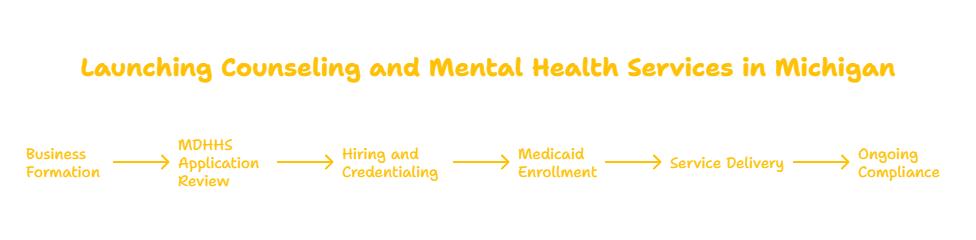
The timeline involves several phases: business formation (0–1 week), MDHHS application review (60–90 days), hiring and credentialing (30–60 days), and final Medicaid enrollment (60–90 days). These timelines are estimates and can vary based on application completeness and agency readiness.
What documentation is required for the MDHHS Policy & Procedure Manual?
Your manual must include clearly defined protocols for client intake and assessment, standards for record-keeping and confidentiality, detailed crisis management and intervention procedures, and methods for tracking financial data and client progress logs.
Key Takeaways for Prospective Providers
Success as a Counseling and Mental Health Services provider in Michigan depends on meticulous adherence to MDHHS regulations and a commitment to high-quality, person-centered care. By establishing a robust operational foundation, securing properly licensed staff, and maintaining rigorous documentation practices, agencies can effectively support the needs of waiver participants while remaining fully compliant with state and federal oversight requirements.
Last verified: October 2023. Disclaimer: This information is for educational purposes only and does not constitute legal or professional advice. Always consult with the Michigan Department of Health and Human Services (MDHHS) and qualified legal counsel to ensure compliance with the most current state and federal regulations.