CONSUMER-DIRECTED OPTION (CDO) SERVICES PROVIDER IN KENTUCKY
By Fatumata Kaba · 2025-07-25 · 6 min read
The Consumer Directed Option (CDO) in Kentucky serves as a vital framework within the state's Home and Community-Based Services (HCBS) waivers, empowering participants to move away from traditional agency-based care models toward a self-directed approach. By assuming the role of the employer of record, participants gain the authority to hire, train, and supervise their own caregivers, ensuring that support is tailored precisely to their personal preferences, lifestyle, and individual needs.
This program is facilitated through a collaboration between the Kentucky Cabinet for Health and Family Services (CHFS), the Department for Medicaid Services (DMS), and the Department for Aging and Independent Living (DAIL). For providers, successfully operating within the CDO space requires a rigorous adherence to federal CMS standards for person-centered planning, as well as operational excellence in payroll, tax compliance, and clinical oversight. This guide outlines the essential requirements for agencies and brokers aiming to support this transition.
How Does the Consumer Directed Option Empower Kentucky Waiver Participants?
The CDO model fundamentally shifts the power dynamic in long-term care by placing the participant in the driver's seat. Instead of relying on a rotating staff from a large agency, participants can recruit family members, friends, or trusted neighbors to provide essential services. This increases continuity of care, improves trust, and allows for flexible scheduling that respects the participant's daily routine rather than the constraints of an institutional schedule.
Support Brokers and Fiscal Management Agencies (FMAs) are the two pillars supporting this autonomy. A Support Broker guides the participant through the nuances of self-direction, such as identifying care needs and understanding their responsibilities, while an FMA manages the complex financial and administrative tasks like payroll withholding, tax filings, and unemployment insurance. Together, these entities ensure that the participant can focus on their well-being while remaining compliant with Medicaid regulations.
- Participants gain control over hiring, firing, and training their caregivers.
- Personal care, meal preparation, homemaker tasks, and community integration are managed according to the participant's own service plan.
- The model reduces the administrative burden on the participant by delegating complex financial duties to a professional FMA.
- Supports are provided in the home or community, maintaining the participant's inclusion in their natural environment.
What Are the Governing Regulatory Roles in the Kentucky CDO Program?
Operating a CDO-related entity requires navigating a multi-layered regulatory environment. The Kentucky Department for Medicaid Services (DMS) serves as the primary authority, setting the reimbursement rates and establishing the overarching policy guidelines for Medicaid waiver compliance. Simultaneously, the Department for Aging and Independent Living (DAIL) oversees quality assurance, ensuring that the services rendered meet the specific rights and needs of the participants served under the HCBS waivers.
At the federal level, the Centers for Medicare & Medicaid Services (CMS) dictates the requirements for person-centered service planning, ensuring that all CDO programs across the state uphold participant rights and promote independent living. Managed Care Organizations (MCOs) act as the final gatekeepers for service delivery, reviewing and approving the Individualized Care Plans that incorporate CDO services. Coordination with these entities is essential for any provider seeking to maintain steady operations.
What Are the Eligibility Requirements for Entities Supporting CDO?
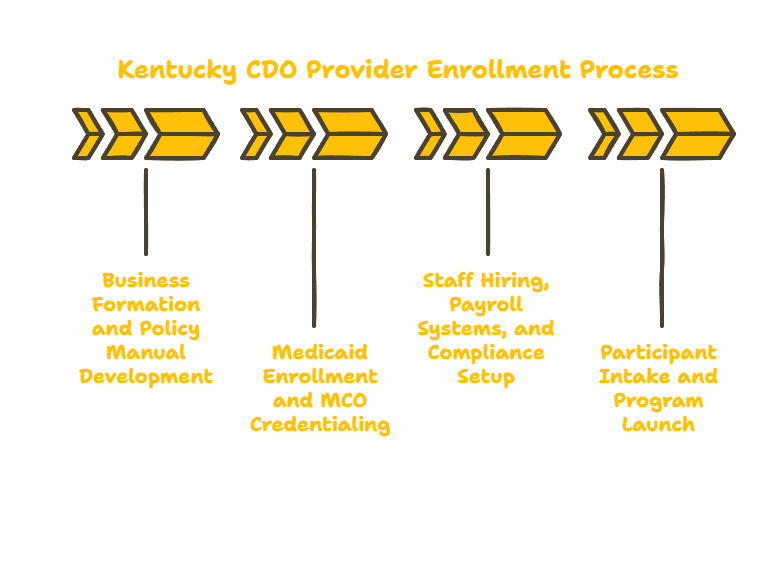
Entities intending to function as Support Brokers or FMAs must establish a robust business foundation. This includes formal registration with the Kentucky Secretary of State and the acquisition of necessary federal identifiers, including an Employer Identification Number (EIN) and, where applicable, a Type 2 National Provider Identifier (NPI). The infrastructure for these businesses must be designed to handle sensitive data, requiring advanced HIPAA-compliant systems and comprehensive liability insurance, including cyber and data protection policies.
Beyond technical setup, the success of a CDO provider hinges on the development of a comprehensive Policies & Procedures Manual. This document must detail how the entity will handle participant onboarding, caregiver training logs, and strict adherence to Medicaid billing protocols. Because the FMA or broker essentially facilitates a state-funded program, the ability to generate audit-ready financial reports and maintain transparent documentation is a prerequisite for continued enrollment in the Kentucky Medicaid program.
- Business registration and active status with the Kentucky Secretary of State.
- Proof of general liability and cyber insurance coverage to mitigate operational risks.
- Detailed internal protocols for HIPAA, grievance filing, and critical incident reporting.
- Demonstrated competence in payroll systems, tax compliance, and Medicaid reimbursement models.
How Do Providers Navigate the Enrollment Process via MPPA?
The enrollment process for CDO providers is conducted primarily through the Medicaid Provider Participation Application (MPPA) system. Prospective brokers and FMAs must apply under the appropriate provider types designated for CDO services. This process requires not only the submission of administrative data but also the specific credentialing required by each individual Managed Care Organization (MCO) operating in Kentucky. Failure to align with MCO requirements can lead to delays in payment processing.
Once initial enrollment is underway, the provider must present a suite of documentation that demonstrates readiness to serve. This includes, but is not limited to, detailed staffing plans, evidence of operational capacity, and data protection protocols. Following the approval of these materials, the provider enters the program setup phase, which involves configuring payroll systems, establishing timesheet tracking, and creating workflows that integrate with the participant’s case management team to ensure consistent service delivery.
What Are the Essential Staffing and Training Mandates?
The human element of CDO services is critical to ensuring participant safety. Support Brokers are typically required to have a professional background in social work, case management, or a related human services field. They must be adept at facilitating person-centered planning sessions while maintaining strict confidentiality. Conversely, FMA staff must possess high-level skills in tax compliance and Medicaid billing, as even minor errors in payroll or claims can result in significant program disruptions.
All staff involved in the delivery of CDO services must undergo rigorous training. This includes education on Medicaid rules, participant rights, crisis intervention, and abuse prevention. Given that the CDO program is governed by evolving state and federal standards, providers are expected to conduct annual updates and provide ongoing training to ensure that their staff remains current on documentation standards and legal obligations, thereby minimizing the risk of non-compliance during state audits.
Frequently Asked Questions
Can a family member be a paid caregiver under the CDO?
Yes, the CDO model is designed specifically to allow participants to hire individuals they trust, which often includes family members, friends, or neighbors, provided they meet the program’s caregiver qualifications and are hired through the approved FMA process.
What is the role of a Support Broker versus an FMA?
A Support Broker assists the participant with non-financial aspects of the program, such as the development of the service plan, hiring, and training. An FMA handles the financial aspects, including payroll processing, tax withholding, and processing payments to workers on behalf of the participant.
Which Kentucky Medicaid waivers support CDO?
CDO services are currently available under the Home and Community-Based (HCB) Waiver, the Michelle P. Waiver (MPW), the Supports for Community Living (SCL) Waiver, and both the Acquired Brain Injury (ABI) and ABI-LTC Waivers.
Key Takeaway
Becoming an effective CDO provider or broker in Kentucky requires a disciplined approach to administrative compliance, robust data security, and an unwavering commitment to the person-centered mission of the Medicaid waiver program. By mastering the MPPA enrollment process, maintaining audit-ready documentation, and fostering strong relationships with MCOs and case managers, agencies can provide a stable and transformative service model that empowers Kentucky’s most vulnerable residents to live with greater independence and dignity.
Last verified: October 2023. Disclaimer: This article is for informational purposes only and does not constitute legal or professional medical advice. Requirements for Medicaid programs are subject to change by the Kentucky Cabinet for Health and Family Services (CHFS) and the Centers for Medicare & Medicaid Services (CMS). Providers should verify current regulations through official state portals before initiating business activities.