CONSUMER-DIRECTED COMMUNITY SUPPORT (CDCS) SERVICES PROVIDER IN MINNESOTA
By Fatumata Kaba · 2025-07-27 · 5 min read
Understanding Consumer-Directed Community Support (CDCS) in Minnesota
Consumer-Directed Community Support (CDCS) is a service option within Minnesota’s Home and Community-Based Services (HCBS) waivers that grants individuals and their families the autonomy to design and manage their own care plans. By shifting the control from traditional agency-directed models to a self-directed framework, CDCS empowers participants to hire their own support staff and manage a flexible budget tailored to their specific needs and goals.
For provider agencies, entering this space requires a deep understanding of both the federal oversight provided by the Centers for Medicare & Medicaid Services (CMS) and the state-level administration managed by the Minnesota Department of Human Services (DHS). Successfully operating as a CDCS provider necessitates strict adherence to waiver guidelines, ensuring that services remain person-centered, compliant, and effectively managed through authorized Financial Management Services (FMS).
Establishing the Foundation: Licensing and Regulatory Requirements
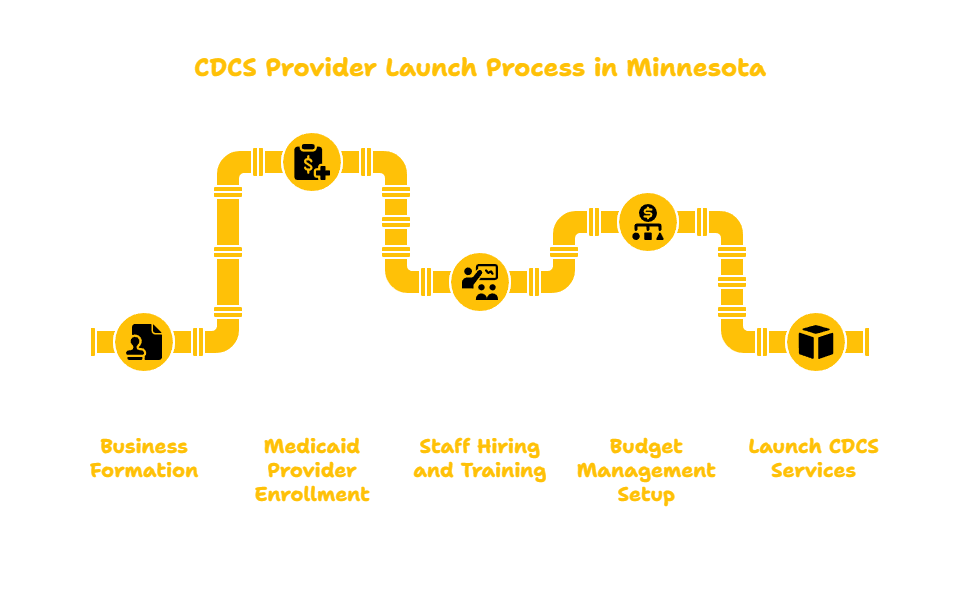
Before an agency can begin delivering CDCS services, it must establish a formal business structure that meets state and federal requirements. The process begins with registering the business entity with the Minnesota Secretary of State. Following legal formation, the agency must secure a federal Employer Identification Number (EIN) from the IRS and a National Provider Identifier (NPI) Type 2, which is required for all organizational healthcare providers.
Once the business is legally recognized, the agency must complete the Medicaid provider enrollment process with the Minnesota Department of Human Services. A critical component of this phase is securing Financial Management Services (FMS) provider approval, as this function is essential for managing the budgets that support participant-directed care. Maintaining comprehensive liability insurance is a non-negotiable requirement to protect the agency, its staff, and the individuals receiving support.
- Register business with the Minnesota Secretary of State
- Obtain EIN from the IRS and NPI (Type 2)
- Enroll as a Medicaid provider with the Minnesota Department of Human Services
- Obtain Financial Management Services (FMS) provider approval
- Maintain valid liability insurance
Navigating the Medicaid Provider Enrollment Process
The enrollment timeline is a significant commitment, generally spanning 60 to 90 days from the initial application to final approval. Providers must initiate the process by contacting the Minnesota Department of Human Services to obtain the most current guidance on CDCS provider requirements. This pre-application contact is vital for avoiding delays caused by missing documentation or misaligned operational procedures.
The application submission itself must be thorough, including the business registration, proof of FMS approval, and detailed service descriptions. During the license verification stage, the state will assess the agency’s capacity to uphold the principles of consumer-directed care. Upon successful review, the agency will be assigned a Medicaid provider number, signaling the authorization to begin delivering services under the specific HCBS waivers for which the provider is qualified.
Developing Comprehensive Operational Documentation
A high-functioning CDCS provider must maintain a robust policy and procedure manual that serves as the blueprint for daily operations. This documentation must clearly outline how the agency facilitates client-directed care planning and budget management. Because CDCS relies on the active participation of the individual, policies must also define clear protocols for staff hiring, training, and the ongoing oversight of safety and risk management.
In addition to internal manuals, agencies are required to maintain strict financial tracking and reporting methods to ensure that state funds are used in accordance with the participant’s approved care plan. Documentation regarding client rights, grievance procedures, and standardized service agreements must be readily available and communicated to every individual served. These materials ensure that the agency remains compliant during state audits and quality assurance reviews.
Staffing, Training, and Capacity Building
The effectiveness of a CDCS program hinges on the quality of its personnel, particularly the CDCS Program Coordinator. This role requires individuals with demonstrated experience in self-directed care or disability services, as they serve as the bridge between the participant's goals and the agency's operational capabilities. Direct support workers must also meet specific standards, including the completion of background checks and TB clearance.
Training programs must be rigorous, focusing not only on technical personal care skills but also on the philosophy of self-direction. Staff must be trained in client autonomy, budget management, and effective communication strategies. Cultural competence training is also essential to ensure that support services are delivered in a manner that respects the unique background and preferences of each participant.
- Self-direction principles and client autonomy
- Budget management and service planning
- Safety and emergency response protocols
- Cultural competence and communication skills
Alignment with Minnesota HCBS Waiver Models
CDCS services are authorized through specific Minnesota HCBS waivers, each designed to meet the needs of distinct populations. These include the 1915(c) HCBS Waiver for the Elderly and Disabled, the Community Access for Disability Inclusion (CADI) Waiver, and the Brain Injury (BI) Waiver. Providers must ensure that their service delivery model aligns with the specific parameters of these waivers to ensure billing eligibility.
Approved services under these waivers may include personal assistance with activities of daily living (ADLs), respite care for primary caregivers, and specialized health-related supports. By integrating assistive technology and adaptive equipment into the Person-Centered Plan (PCP), providers help participants maintain their independence. The focus remains on community participation, ensuring that individuals receiving services are integrated into their local social and civic environments.
Frequently Asked Questions
What is the primary role of an FMS provider in the CDCS model?
The Financial Management Services (FMS) provider acts as an intermediary that handles the fiscal aspects of the individual's budget, including processing payroll for support staff, withholding taxes, and ensuring expenditures remain within the approved budget limits defined in the Person-Centered Plan.
How does a provider ensure compliance with the Person-Centered Plan?
Compliance is maintained by ensuring that all services delivered are explicitly authorized within the client's care plan. The provider must document all services provided and regularly review the plan with the participant to ensure that support remains aligned with their evolving needs and regulatory requirements.
What happens if a provider needs to update their service descriptions?
If an agency needs to modify its service offerings, it must contact the Minnesota Department of Human Services to ensure the changes are compatible with current waiver requirements. Any significant changes to the scope of service may necessitate an update to the provider's formal registration or Medicaid enrollment information.
Key Takeaway
Launching a CDCS provider agency in Minnesota is a complex, multi-phased endeavor that requires meticulous attention to state regulations, administrative documentation, and the foundational principles of self-directed care. By focusing on compliant financial management, rigorous staff training, and a participant-centered approach to care, new providers can successfully bridge the gap between individual autonomy and professional support within the state's HCBS waiver system.
Last verified: 2024. The information provided in this article is for educational purposes and does not constitute legal or professional consulting advice. For specific guidance regarding Minnesota Department of Human Services (DHS) policies and regulations, always refer directly to official state resources and authorized personnel.