COMPANION CARE SERVICES PROVIDER IN UTAH
By Fatumata Kaba · 2026-03-31 · 5 min read
OFFERING SOCIAL ENGAGEMENT AND BASIC NON-MEDICAL SUPPORT TO PROMOTE INDEPENDENCE AND WELL-BEING FOR INDIVIDUALS WITH DISABILITIES
Companion Care Services in Utah provide essential non-medical supervision and social support to individuals with intellectual and developmental disabilities (ID/DD) or physical limitations. By facilitating community engagement and providing consistent, compassionate oversight, these services help participants maintain their independence, reduce social isolation, and ensure safety within their preferred home or community-based settings.
What Is the Regulatory Framework for Companion Care in Utah?
The delivery of Companion Care services in Utah is governed by a collaboration between federal and state entities. The Utah Department of Health and Human Services (DHHS), specifically through the Division of Services for People with Disabilities (DSPD), is the primary authority responsible for managing Home and Community-Based Services (HCBS) waivers. This division authorizes service delivery, establishes quality standards, and conducts monitoring to ensure that all providers remain in full compliance with state and federal mandates.
At the federal level, the Centers for Medicare & Medicaid Services (CMS) oversees the Medicaid program. CMS ensures that Utah’s waiver programs strictly adhere to federal HCBS requirements, which prioritize the participant's right to live in the community and receive services in the least restrictive environment. Providers must maintain a deep understanding of these regulations to ensure that their operations meet the rigorous oversight standards set by both agencies.
What Are the Core Components of Companion Care Services?
Companion Care is defined by its focus on non-medical, person-centered support. The primary objective is to assist individuals in achieving their goals as outlined in their service plans while promoting social inclusion. Unlike personal care services, which involve hands-on assistance with activities of daily living (ADLs) like bathing or toileting, Companion Care focuses on psychological, social, and environmental safety.
Providers are responsible for facilitating meaningful engagement and monitoring the general well-being of the participant. The core components of the service model include:
- Providing supervision and companionship during home-based activities or community outings.
- Assisting with cognitive and social activities such as reading, playing games, or facilitating conversation.
- Accompanying participants to local events, social gatherings, or on walks to encourage community integration.
- Maintaining consistent monitoring of the participant’s safety and general status.
- Supporting the individual's established routines without crossing into medical or hands-on clinical care tasks.
What Are the Prerequisites for Provider Approval and Enrollment?
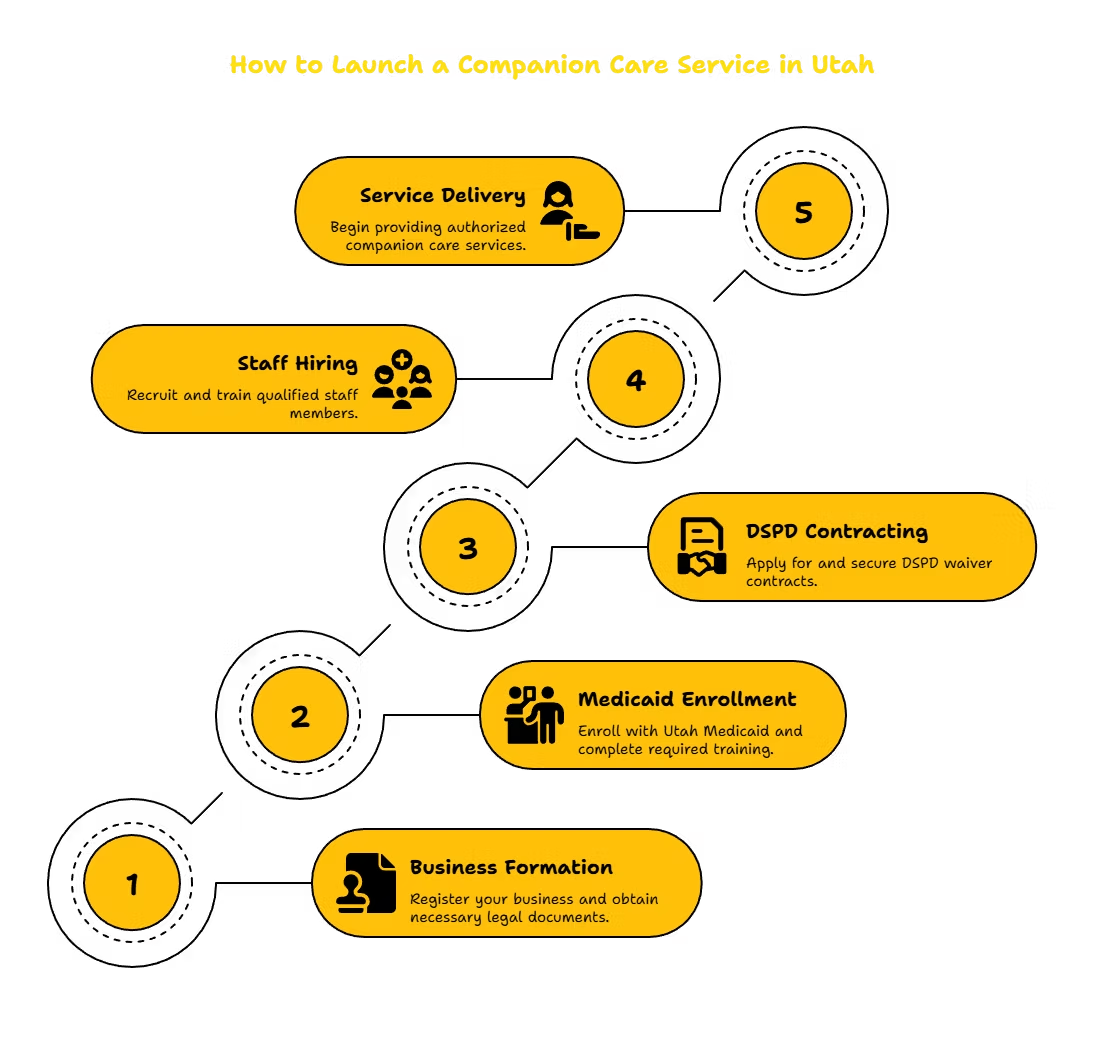
Establishing a Companion Care agency in Utah requires a structured approach to administrative and legal readiness. Before a provider can be authorized to deliver services under a DSPD waiver, the business must establish a formal legal identity and fulfill specific enrollment criteria required by state health authorities.
The initial phase involves business registration with the Utah Division of Corporations, obtaining an Employer Identification Number (EIN), and securing a Type 2 National Provider Identifier (NPI). Once these legal foundations are set, the entity must undergo the formal Medicaid provider enrollment process. Additionally, the prospective provider must secure appropriate liability and worker’s compensation insurance to protect the business, the staff, and the program participants.
A significant portion of the approval process involves demonstrating administrative readiness. This requires the development of a comprehensive Companion Care Services Policy & Procedure Manual. This document must clearly articulate how the agency will manage participant intake, align services with individual support plans, and ensure that all staff adhere to strict confidentiality and abuse-prevention protocols.
What Is the Required Documentation for DSPD Waiver Compliance?
Maintaining rigorous documentation is a cornerstone of success in the Utah HCBS system. Beyond standard business documents such as articles of incorporation and tax identifiers, providers must house a robust internal compliance library. This library ensures that if an audit occurs, the agency can demonstrate that all services were provided in accordance with the participant’s individualized needs and state regulations.
Required documentation includes, but is not limited to:
- Valid Medicaid and DSPD provider contracts.
- Current certificates of liability and worker's compensation insurance.
- Comprehensive internal policies covering:
- Participant intake and person-centered service plan alignment.
- Standardized daily activity logs and detailed shift notes.
- Emergency response and safety monitoring procedures.
- Strict confidentiality protocols and the protection of participant rights.
- Mandatory policies regarding the prevention of abuse, neglect, and exploitation.
- Formal staff training curricula and verification tools.
How Should Providers Manage Staffing and Training Requirements?
The quality of Companion Care is directly linked to the competency and character of the staff. Providers must ensure that all direct support personnel are at least 18 years of age and have successfully passed the required background checks. Furthermore, all staff must demonstrate the ability to communicate effectively with participants and support their non-medical needs with dignity.
Beyond individual staff members, it is highly recommended to appoint a supervisor or scheduler who possesses previous experience with DSPD services or in-home care coordination. Every staff member must complete a mandatory training regimen to ensure full alignment with state expectations. This curriculum typically includes:
- HIPAA compliance and strict confidentiality training.
- DSPD-specific Abuse, Neglect, and Exploitation Prevention (ANEP).
- Education on participant rights and the preservation of personal dignity.
- Official DSPD MySupport provider orientation.
- Comprehensive basic safety and emergency response protocols.
Frequently Asked Questions
Which Medicaid waivers in Utah cover Companion Care?
Companion Care is generally covered under several key programs, including the Community Supports Waiver (CSW) for individuals with ID/DD, the Acquired Brain Injury (ABI) Waiver, and the Physical Disabilities Waiver (PDW). It may also be considered under the Medically Complex Children’s Waiver (MCCW) on a case-by-case basis following approval from the participant's medical team.
How long does the provider enrollment process typically take?
The timeline varies, but generally, the process takes several months. Business formation and manual creation typically require 1–2 months. The Medicaid enrollment and DSPD contracting phase usually spans 2–3 months, followed by 30–45 days for staff hiring and mandatory readiness training. Service delivery can only commence once the Individual Support Plan (ISP) and official service authorizations are in place.
Is Companion Care considered the same as Personal Care?
No, they are distinct service categories. Companion Care is strictly non-medical and focuses on supervision and social interaction. It does not include hands-on assistance with activities of daily living, such as bathing, grooming, toileting, or physical mobility assistance.
WAIVER CONSULTING GROUP’S START-UP ASSISTANCE SERVICE — UTAH COMPANION CARE PROVIDER
WCG assists new providers in launching high-quality, person-centered Companion Care services tailored to Utah’s DSPD requirements, offering support in Medicaid and DSPD enrollment, policy manual development, staff training guide creation, and the design of essential participant monitoring templates.
Key Takeaway: Successfully becoming a Companion Care provider in Utah requires meticulous adherence to DSPD and Medicaid regulatory frameworks, a strong focus on person-centered service documentation, and a commitment to rigorous, ongoing staff training to ensure participant safety and compliance.
Last verified: October 2023. The information provided herein is for educational purposes only and does not constitute legal or professional advice. Always refer to the latest Utah Department of Health and Human Services (DHHS) and Division of Services for People with Disabilities (DSPD) policy manuals for the most current regulatory requirements.