COMPANION CARE SERVICES PROVIDER IN KANSAS
By Fatumata Kaba · 2025-07-24 · 5 min read
Understanding Companion Care Services in Kansas
Companion Care Services in Kansas serve as a vital non-medical social support pillar, designed to foster independence and emotional well-being for individuals who face social isolation or require supervision to remain in their homes. These services focus on providing companionship, emotional support, and gentle guidance, serving as an essential alternative to institutionalization for those who do not require hands-on medical care.
By operating under Kansas Medicaid (KanCare) and specific Home and Community-Based Services (HCBS) waivers, these services ensure that participants maintain strong ties to their communities. For provider agencies, entering this space requires a deep understanding of state regulations, participant-centered service plans, and the administrative framework that governs the delivery of non-skilled support across the state.
Who Governs Companion Care in the Kansas Medicaid System?
The regulatory landscape for companion care in Kansas is a collaborative effort between state and federal oversight bodies. The Centers for Medicare & Medicaid Services (CMS) sets the overarching federal requirements to ensure that all community-based services effectively prevent institutionalization and promote participant autonomy. Within Kansas, the Department for Aging and Disability Services (KDADS) acts as the primary authority, defining service parameters, setting provider standards, and ensuring compliance with HCBS waiver mandates.
Operational oversight is further managed by the Kansas Department of Health and Environment (KDHE), specifically the Division of Health Care Finance, which oversees the Medicaid enrollment process and reimbursement systems. Additionally, the Managed Care Organizations (MCOs)—Sunflower Health Plan, UnitedHealthcare Community Plan, and Aetna Better Health of Kansas—serve as the front line for day-to-day administration. They are responsible for authorizing individual service plans, credentialing agencies, and monitoring the quality of care provided to participants.
What Does the Scope of Companion Care Entail?
Companion Care is defined by its non-medical nature, focusing on social interaction and assistance with daily routines rather than clinical nursing tasks. Authorized providers are tasked with improving the quality of life for individuals who may be housebound or socially isolated. Services are always tailored to the participant’s Individualized Service Plan (ISP), ensuring that the support provided meets specific emotional and cognitive needs.
The scope of service typically includes, but is not limited to, the following activities:
- Providing conversation, emotional support, and active recreational engagement.
- Accompaniment to medical appointments, local errands, and essential community events.
- Assistance with meal support, including setting up food for consumption (non-preparation).
- Offering general supervision to ensure the safety and well-being of the participant.
- Facilitating cognitive activities, such as reading, letter writing, or guided hobbies.
- Providing gentle prompts or reminders for medication schedules and daily routines.
- Offering support during life transitions, such as providing follow-up assistance after a hospital discharge.
How to Establish a Compliant Provider Agency
Becoming an approved Kansas Medicaid provider for companion care requires a structured approach to business formation and regulatory compliance. Before engaging with the state, an organization must be properly registered with the Kansas Secretary of State, obtain an IRS EIN, and secure a Type 2 NPI. Because these services involve the safety of vulnerable populations, providers must also establish a robust Companion Care Policies & Procedures Manual that covers every aspect of service delivery, from intake to emergency response.
Risk management is a foundational element of a successful agency. This includes securing comprehensive general liability insurance, as well as auto insurance if the agency intends to provide transportation for participants. Furthermore, maintaining HIPAA compliance is mandatory, as is the development of clear protocols for documentation and grievance handling. All staff must be screened through thorough background checks to ensure the safety and trust of the individuals being served.
The Provider Enrollment and Credentialing Roadmap
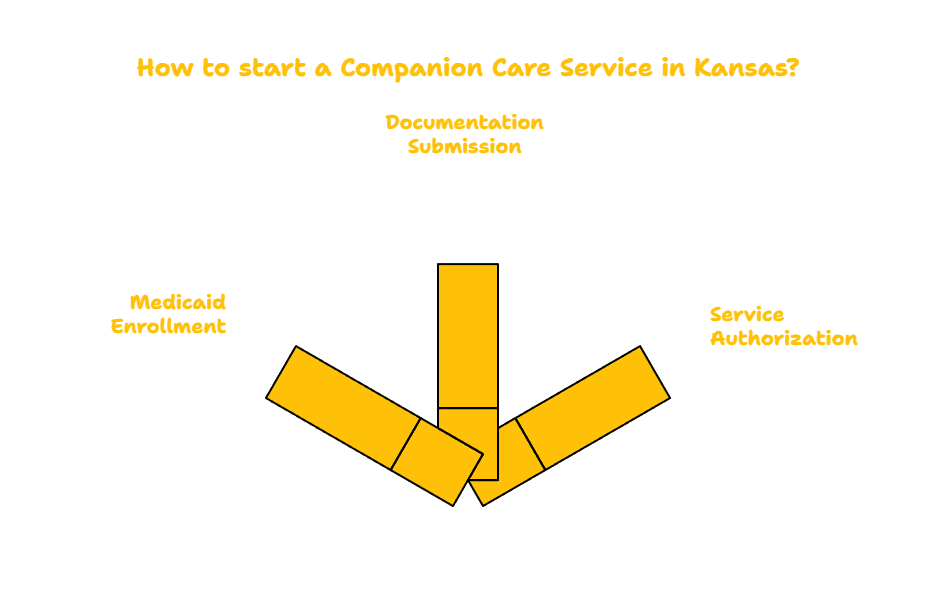
The path to becoming an active Medicaid provider in Kansas follows a sequential process involving state enrollment and MCO-level credentialing. Initially, the agency must enroll through the Kansas Medical Assistance Program (KMAP) as a provider of Companion or Non-Medical Support Services. During this stage, the agency will submit all business documentation, proof of insurance, and evidence of established service protocols for review.
Following KMAP enrollment, the agency must complete the credentialing process with each KanCare MCO. This step involves submitting specific staff qualifications, risk management documentation, and demonstrating an operational capacity to meet the needs of the HCBS waiver populations. Once credentialed, the agency coordinates closely with case managers to accept referrals, ensure that service delivery aligns with the participant's ISP, and submit claims accurately using the appropriate HCPCS codes assigned to companion services.
Staffing, Training, and Operational Oversight
The success of a companion care program depends heavily on the quality and dedication of the support workers. While a high school diploma or equivalent is generally required, the most critical attributes for a companion care aide are strong interpersonal skills, patience, and a genuine commitment to supporting the dignity of those in care. All staff must be onboarded with a comprehensive orientation that emphasizes the goals of the HCBS programs.
Mandatory training modules for all staff members must include:
- In-depth orientation on HCBS philosophy and ISP-based service delivery.
- Strict adherence to participant confidentiality and HIPAA compliance.
- Comprehensive emergency preparedness and safety response procedures.
- Annual continuing education focused on the evolving needs of aging and disabled populations.
- Protocols for documenting daily goals and reporting critical incidents.
Frequently Asked Questions
Which Kansas HCBS waivers allow for companion care services?
Companion care is authorized under several HCBS waivers based on the participant’s assessed needs, including the Frail Elderly (FE) Waiver, Physical Disability (PD) Waiver, Brain Injury (BI) Waiver, Intellectual/Developmental Disability (IDD) Waiver, and the Technology Assisted (TA) Waiver.
Can companion care aides provide hands-on medical assistance?
No. Companion care is strictly non-medical. Aides are prohibited from performing clinical tasks, such as administering medication, changing dressings, or providing physical therapy. Their role is restricted to social support, supervision, and non-skilled daily assistance.
What is the typical timeline for launching a new agency?
The launch process generally takes 4–6 months. This includes 1–2 months for business formation and manual development, 1–2 months for staff hiring and KMAP enrollment, 30–60 days for MCO credentialing, and 30–45 days for final service coordination and initial service delivery.
Key Takeaways for Prospective Providers
Operating a Companion Care agency in Kansas requires a steadfast commitment to the regulatory standards set by KDADS and the operational requirements of the KanCare MCOs. By focusing on compliant administrative structures, thorough staff training, and deep integration with the state’s HCBS waiver infrastructure, providers can ensure they are delivering high-quality, audit-ready support that significantly improves the lives of Kansas residents in need of social connection and safety.
Last verified: October 2023. Disclaimer: This article is for informational purposes only and does not constitute legal or professional medical advice. Always verify current Kansas Medicaid regulations and waiver requirements directly with the Kansas Department for Aging and Disability Services (KDADS) or the relevant Managed Care Organizations (MCOs) before initiating any service programs.