COMMUNITY TRANSITION SERVICES PROVIDER IN WASHINGTON
By Fatumata Kaba · 2026-04-06 · 5 min read
Community Transition Services in Washington provide critical, one-time financial and logistical support to help individuals move from institutional settings, such as nursing facilities or intermediate care facilities, into independent, community-based living. These services facilitate the setup of a safe and stable household, ensuring that participants have the essential resources required to live with dignity and autonomy in their own homes.
As a Medicaid-funded initiative, this program is administered by the Department of Social and Health Services (DSHS) through the Aging and Long-Term Support Administration (ALTSA) and the Developmental Disabilities Administration (DDA). By bridging the gap between clinical settings and community residency, transition providers play an essential role in the state's broader commitment to person-centered care and the successful integration of Medicaid participants into local communities.
What Are the Governing Structures and Regulatory Requirements for Providers?
Providers must navigate a dual-agency environment, as the regulatory framework is split based on the population served. ALTSA manages transition services for aging adults and individuals with physical disabilities, while the DDA handles transitions for individuals with intellectual and developmental disabilities. Medicaid funding is provided by the Health Care Authority (HCA), which oversees program compliance and billing through the ProviderOne portal.
To operate as a certified transition provider, an organization must maintain stringent standards regarding business formation and administrative accountability. This includes maintaining valid liability insurance and ensuring all staff undergo rigorous background checks. The service is not a blanket allowance; all transition-related purchases must be strictly pre-approved and explicitly documented within the participant’s Person-Centered Service Plan (PCSP) to ensure federal and state audit compliance.
How Do Community Transition Services Facilitate Household Setup?
The primary function of a Community Transition Services provider is to manage the essential non-recurring expenses associated with establishing a new home. This program is designed to mitigate the financial barriers that often prevent individuals from leaving institutional care. By covering initial setup costs, the state enables a seamless transition into community living environments, including supported living or private family homes.
Allowable expenses are specific to the functional needs of the individual and must be documented as essential for health and safety. Common allowable costs include:
- Security deposits and initial rent payments
- Utility deposits for electric, gas, water, and phone services
- Essential furnishings, including basic furniture and household goods
- Moving service fees and initial food supply provisions
- Setup of basic home appliances if not already provided
- Health and safety modifications, such as locks, fire extinguishers, and shower chairs
What Are the Steps to Becoming an Approved Medicaid Provider?
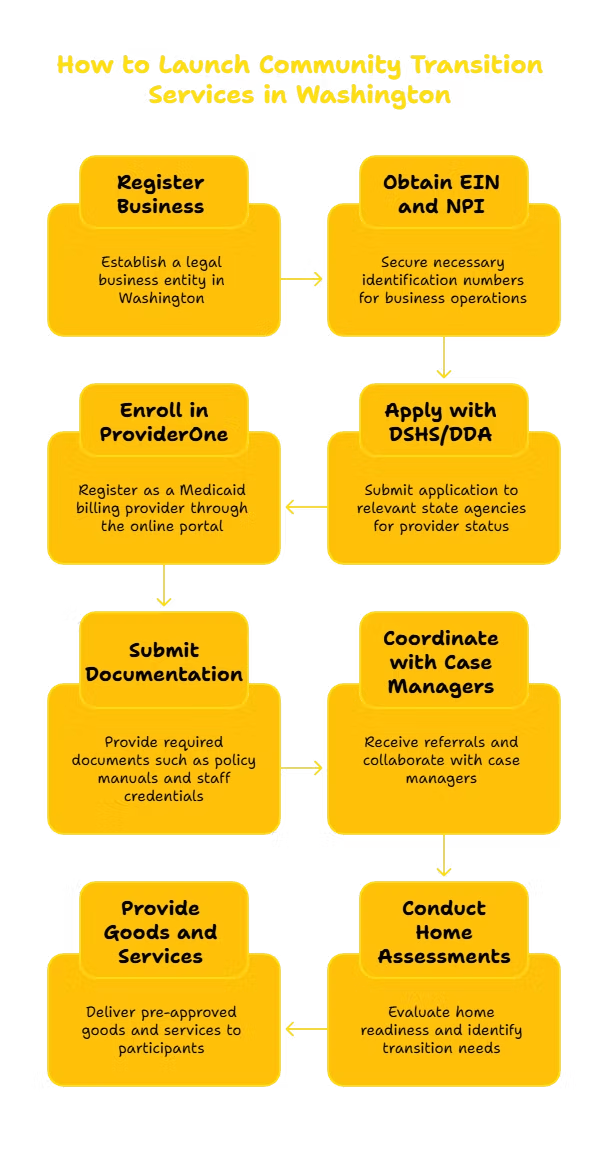
The enrollment process requires a systematic approach to business registration and agency certification. Organizations should first ensure their legal business entity is registered with the Washington Secretary of State, followed by obtaining an Employer Identification Number (EIN) and a Type 2 National Provider Identifier (NPI). These credentials serve as the foundation for both DSHS/DDA provider applications and Medicaid enrollment.
Once registered, the provider must undergo a vetting process by the relevant administration (ALTSA or DDA). This includes submitting a comprehensive Policy & Procedure Manual, which serves as the operational blueprint for the organization. After the provider is qualified and enrolled in the ProviderOne portal, they enter a coordination phase, working closely with case managers who initiate referrals for eligible participants ready for the transition process.
What Staffing and Operational Documentation Must Be Maintained?
Administrative integrity is paramount, as providers are expected to manage sensitive financial and personal data. Staffing requirements include a designated Transition Coordinator or Specialist who possesses a demonstrated background in housing, case management, or disability services. This individual must be well-versed in Medicaid compliance, housing laws, and the specific needs of the population being served.
Operational documentation must be robust enough to withstand state audits. Providers should maintain detailed records including:
- Intake and home readiness checklists
- Transition planning forms reflecting the person-centered service plan
- Strict protocols for purchase approval, receipt collection, and invoicing
- Staff training logs covering HIPAA, abuse prevention, and fraud detection
- Incident response documentation and participant rights acknowledgments
Which Medicaid Waivers Cover These Transition Services?
Transition support is integrated into several distinct Medicaid waiver programs, each tailored to specific participant demographics. These programs act as the funding mechanism for transition services, with predefined spending limits—typically ranging between $850 and $2,000—depending on the specific waiver rules and the participant's demonstrated needs. The programs include the Basic Plus Waiver, the Core Waiver, and the Community Options Program Entry System (COPES).
Additionally, specialized programs such as Roads to Community Living (RCL) serve as time-limited demonstration projects focused on complex transitions from nursing facilities. Providers may also interact with Foundational Community Supports (FCS), which can be paired with transition services to provide long-term housing stability. Maintaining deep knowledge of these specific waiver rules is essential for ensuring that service delivery remains within allowable funding caps.
Frequently Asked Questions
What is the typical timeline to launch a transition services agency?
The launch timeline generally spans three to four months. Initial business formation and NPI registration take approximately 1–2 weeks, followed by 1–2 months for DSHS/DDA provider qualification and Medicaid enrollment. Finalizing internal policies and onboarding staff usually requires an additional 2–3 weeks before the agency is ready to accept referrals.
Can a provider bill for services before the person-centered service plan is approved?
No. All expenditures and services must be explicitly listed and pre-approved within the participant’s Person-Centered Service Plan (PCSP). Engaging in service delivery or purchasing goods prior to authorization may result in claim denials and failure to meet audit requirements.
Where can providers find resources for billing and program compliance?
Providers should utilize the Health Care Authority’s ProviderOne portal for all billing and enrollment management. Policy updates and guidance for aging and physical disability transitions are managed through the ALTSA website, while developmental disability-specific information is accessible via the DDA website.
Key Takeaway: Successfully operating as a Community Transition Services provider in Washington requires a disciplined focus on administrative accuracy, strict adherence to person-centered planning, and proactive engagement with the DSHS/DDA enrollment frameworks. Organizations that prioritize documentation, staff training, and deep knowledge of waiver-specific billing limits will be best positioned to support participants as they successfully move into stable community settings.
Last verified: October 2023. This information is for educational purposes and is not a substitute for official DSHS, DDA, or HCA guidance. Providers should consult the Washington ProviderOne manual and relevant state statutes for the most current regulatory requirements.