COMMUNITY TRANSITION SERVICES PROVIDER IN ILLINOIS
By Fatumata Kaba · 2025-07-19 · 5 min read
Navigating the Illinois Community Transition Services Landscape
Community Transition Services in Illinois are vital programs designed to assist individuals in relocating from institutional settings—such as nursing facilities and intermediate care facilities—to independent, community-based living environments. Authorized under various Medicaid Home and Community-Based Services (HCBS) waiver programs, these services empower participants by promoting independence, autonomy, and a significantly improved quality of life outside of restrictive institutional settings.
For organizations looking to enter this field, the process requires strict adherence to regulatory standards set forth by the Illinois Department of Healthcare and Family Services (HFS) and the Illinois Department of Human Services (DHS). Successfully operating as a provider involves comprehensive transition planning, housing navigation, and a commitment to person-centered care that aligns with federal CMS HCBS Settings Rule requirements for community integration.
What Are the Roles of Governing Agencies?
The operational framework for Community Transition Services is established through a multi-agency hierarchy. The Illinois Department of Healthcare and Family Services (HFS) serves as the primary administrator for Medicaid transition funding. HFS is responsible for authorizing provider enrollment and ensuring that the reimbursement of transition services is processed accurately and in compliance with state Medicaid policies.
Working in tandem with HFS, the Illinois Department of Human Services (DHS)—specifically through the Division of Developmental Disabilities (DDD) and the Division of Rehabilitation Services (DRS)—oversees the practical application of these services. Their role includes coordinating case management, facilitating transition planning, and ensuring that providers strictly adhere to person-centered transition practices. Finally, the federal Centers for Medicare & Medicaid Services (CMS) provides the overarching regulatory oversight, ensuring all Illinois programs meet federal standards for choice, autonomy, and the successful integration of participants into the community.
What Services Do Community Transition Providers Deliver?
Community Transition Services provide a structured path for individuals to relocate safely and successfully into community-based residences. The scope of these services is broad, focusing on the removal of barriers to relocation and the establishment of a sustainable support network. Providers are tasked with facilitating the logistics of the move while simultaneously preparing the participant for the responsibilities of independent living.
Approved providers generally offer a core set of services, including:
- Comprehensive transition planning in active collaboration with case managers, discharge planners, and the participant's family.
- Assistance with securing housing, which may include support with housing applications and the management of security deposit funding.
- Procuring essential household items such as furniture, linens, and necessary kitchen supplies to ensure a functional home environment.
- Payment coordination for initial housing expenses, including utility setup fees and initial grocery purchases.
- Coordination of moving services and the management of relocation logistics.
- Linkage to community-based providers for ongoing, long-term supports such as personal care or home health services.
- Training in independent living skills, including personal budgeting, meal preparation, and safety awareness.
What Are the Licensing and Provider Approval Prerequisites?
Becoming an approved Medicaid waiver provider in Illinois is a structured process that requires significant preparation and administrative diligence. Before an agency can begin billing for services, it must establish a formal business structure and demonstrate that it possesses the systems required to manage sensitive transitions. This includes registering the business entity with the Illinois Secretary of State and obtaining both an EIN from the IRS and an NPI (Type 2) for billing purposes.
Providers must then navigate the Illinois Medicaid Provider Enrollment Portal, known as the IMPACT system, to enroll under the applicable waivers. Beyond basic registration, agencies must maintain comprehensive general liability insurance and develop specific internal policies. These policies must address key operational pillars such as housing coordination, financial assistance management, participant protection protocols, and rigorous documentation standards. Staff must be vetted through background screenings and trained to meet the specific HCBS requirements, ensuring that every member of the organization is prepared to uphold participant rights and safety standards.
How Does the Illinois Provider Enrollment Process Function?
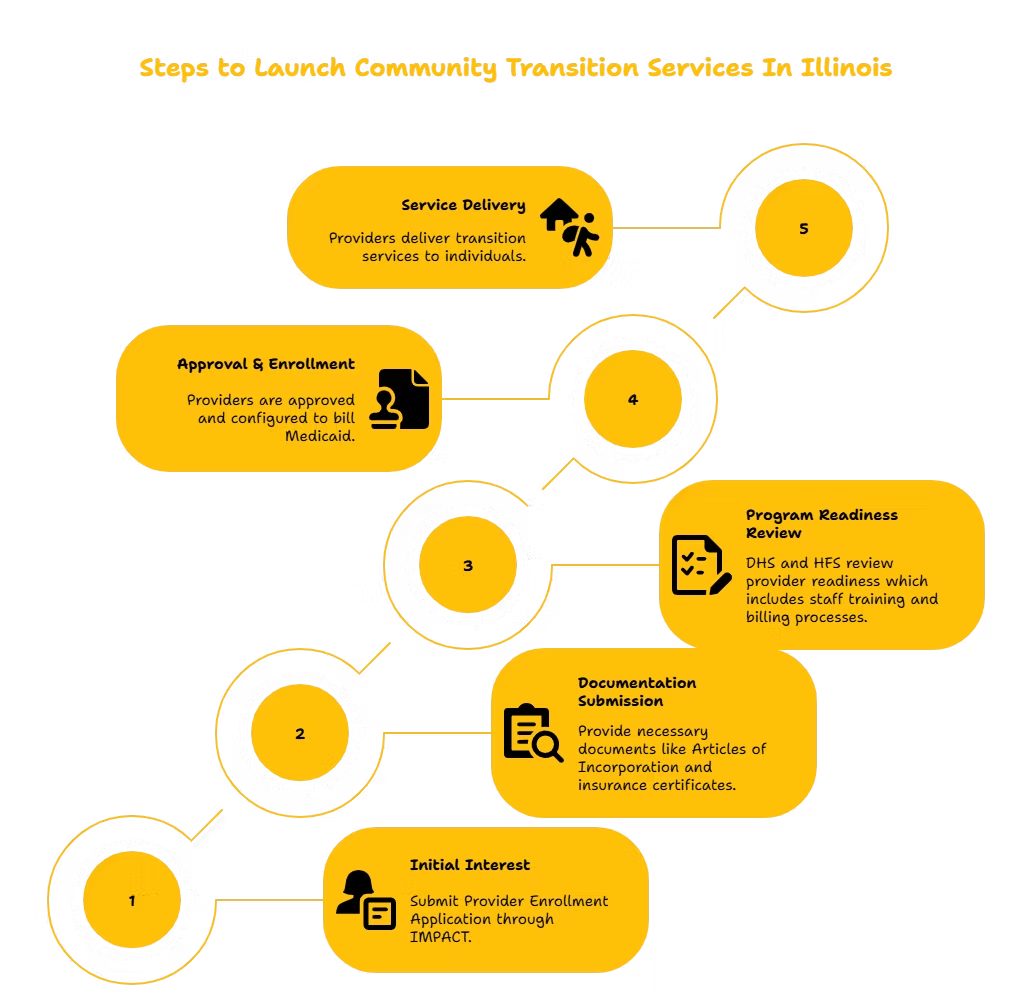
The enrollment timeline follows a sequential path. It begins with the initial interest and submission of an application through the IMPACT system. Once the application is submitted, the agency must provide a comprehensive documentation package. This package typically includes Articles of Incorporation, proof of EIN/NPI registration, certificates of insurance, operational policies, and staff credentials. Providing accurate, clean documentation during this stage is essential to preventing delays in the review process.
Following the submission, the program undergoes a readiness review. During this phase, DHS and/or HFS evaluate the provider's ability to execute transition services. This includes a review of internal training protocols, the efficacy of the agency’s transition planning tools, the stability of its billing processes, and the strength of its participant protection measures. Once these criteria are met and the application is approved, the provider is fully configured within the state's system to bill Medicaid for Community Transition Services using the appropriate service codes.
What Are the Essential Staffing and Documentation Requirements?
Quality of care in transition services is heavily dependent on the competence of the staff involved. A Community Transition Specialist or Coordinator is expected to hold a bachelor’s degree in human services, social work, or a related field, alongside professional experience in transition planning. Transition support staff, who often assist with the day-to-day logistics of a move, must hold a high school diploma or GED and receive specific training in independent living skills.
All staff members are required to undergo comprehensive training modules. These include:
- HCBS Settings Rule compliance and person-centered planning methodologies.
- Housing navigation techniques and effective transition planning.
- Protocols for financial management and the ethical handling of transition funds.
- Best practices for abuse prevention, maintaining participant confidentiality, and upholding participant rights.
- Ongoing professional development and periodic competency evaluations to ensure high-quality service delivery.
Frequently Asked Questions
Which Medicaid Waivers Cover Community Transition Services in Illinois?
Community Transition Services are available through several specific programs, including the Adults with Developmental Disabilities Waiver, the Children and Young Adults with Developmental Disabilities Waiver, the Persons with Brain Injury (BI) Waiver, the Persons with Disabilities (PD) Waiver, and the Money Follows the Person (MFP) Demonstration Project.
What Is the General Timeline to Launch a New Provider Agency?
The path to launch is divided into four main phases: Business Formation (1–2 months), Staff Hiring and Credentialing (1–2 months), IMPACT Enrollment and Readiness Review (60–90 days), and final Billing Configuration (30–45 days). Total development time typically spans several months depending on organizational readiness.
What Documentation Must Be Included in the Policy and Procedure Manual?
An effective manual must include detailed protocols for transition planning, assessment, and discharge coordination. It must also feature guidelines for housing searches, household setup assistance, participant-centered tracking, financial management of transition funds, incident reporting, and formal grievance procedures.
Key Takeaway
Establishing a successful Community Transition Services agency in Illinois is a rigorous process that demands a deep understanding of both state-level regulatory requirements and federal HCBS standards. By maintaining strict adherence to documentation, staff training, and person-centered planning protocols, providers play a crucial role in enabling individuals to transition from institutional care to independent, self-determined lives in their chosen communities.
Last verified: October 2023. Disclaimer: This article is for informational purposes only and does not constitute legal or professional advice. Requirements for Medicaid provider enrollment in Illinois are subject to change; always verify current regulations through official state portals and the Centers for Medicare & Medicaid Services.