COMMUNITY SUPPORTED LIVING SERVICES (CSLA) PROVIDER IN MARYLAND
By Fatumata Kaba · 2025-09-02 · 5 min read
Community Supported Living Arrangements (CSLA), frequently referred to as Community Supported Living Services (CSLS) in Maryland, are specialized support models that empower individuals with intellectual and developmental disabilities (IDD) to maintain independence within their own homes. These services, primarily funded through Maryland’s Developmental Disabilities Administration (DDA) waivers, provide tailored, person-centered assistance that allows participants to live alone or with housemates while receiving essential support in daily living and community integration.
For providers looking to enter this space, the model requires a rigorous commitment to health, safety, and regulatory compliance as defined by the Maryland Department of Health and federal Home and Community-Based Services (HCBS) standards. By aligning service delivery with the Individual Plan (IP) developed under the person’s Person-Centered Plan (PCP), providers play a critical role in fostering autonomy, dignity, and active social participation for Maryland residents with disabilities.
What Are the Governing Agencies and Regulatory Frameworks?
The provision of CSLA services in Maryland operates under a hierarchical regulatory structure that ensures the health and welfare of individuals receiving Medicaid-funded supports. The Maryland Department of Health (MDH) serves as the overarching entity, establishing the regulatory environment for all Medicaid services. Within this framework, the Developmental Disabilities Administration (DDA) acts as the primary authority for authorizing, monitoring, and overseeing CSLA providers to ensure adherence to state standards and waiver requirements.
Data management and billing operations are facilitated through the Office of Long-Term Services and Supports (LTSS Maryland), which provides the platform for tracking service delivery and ensuring that billing is tied to approved authorizations. Furthermore, all state operations must align with the regulations set forth by the Centers for Medicare & Medicaid Services (CMS). CMS provides federal oversight to ensure Maryland’s DDA waivers comply with established HCBS rules, focusing on community integration and the quality of supports provided to individuals.
- Maryland Department of Health (MDH): Regulates health and community-based service standards for Medicaid.
- Developmental Disabilities Administration (DDA): Authorizes and monitors provider operations and manages waiver-based models.
- Office of Long-Term Services and Supports (LTSS Maryland): Handles data tracking, billing, and system integration.
- Centers for Medicare & Medicaid Services (CMS): Ensures federal compliance with HCBS waiver rules.
What Constitutes Core Community Supported Living Services?
CSLA services are specifically designed to be flexible and highly individualized. Because every participant has unique requirements, providers must be prepared to deliver a diverse range of supports, including assistance with Activities of Daily Living (ADLs) like bathing and grooming, as well as Instrumental Activities of Daily Living (IADLs) such as budgeting, grocery shopping, and meal preparation. This approach ensures that the individual remains the primary decision-maker in their living situation.
Beyond physical support, the service model emphasizes community inclusion. Providers facilitate access to local resources, coordinate transportation, and support the individual's desire for social participation. This often requires close collaboration with health providers to ensure that medication administration and general health and wellness tracking are conducted accurately. All these efforts must be documented within the participant’s Individual Plan (IP) to ensure that the care delivered remains consistent with their evolving needs.
How Do Providers Navigate the Licensing and Enrollment Process?
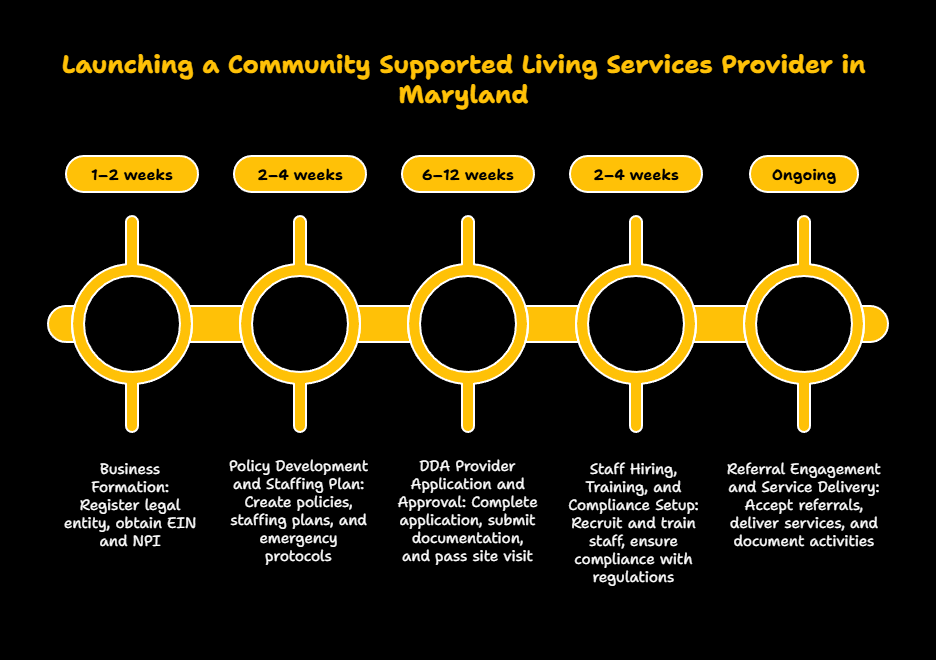
Before an agency can begin billing for CSLA, it must complete a multi-step enrollment process with the DDA. The initial phase involves formal business formation, which includes registering the entity with the Maryland Department of Assessments and Taxation (SDAT) and obtaining a federal Employer Identification Number (EIN) and a Type 2 National Provider Identifier (NPI). This foundational step is necessary to demonstrate legitimacy as a healthcare business in the state of Maryland.
Once the business is legally established, the provider must enroll via the DDA’s provider application portal. This process is comprehensive and requires the submission of organizational charts, detailed program descriptions, staff qualification summaries, and a full policy and procedure manual. If the provider intends to operate or supervise the actual housing, they must also prepare for a pre-approval site visit conducted by the DDA. Following a successful review and approval, the agency can begin accepting referrals coordinated through local Coordination of Community Services (CCS) offices.
- Register the legal entity with SDAT.
- Obtain a Tax ID (EIN) and Type 2 NPI.
- Complete the application via the Maryland Developmental Disabilities Provider Portal.
- Submit organizational policies and readiness documentation for review.
- Undergo site inspections where required by DDA policy.
What Are the Staffing and Training Requirements for CSLA Providers?
The quality of CSLA services is directly linked to the competency of the staff. At a minimum, Direct Support Professionals (DSPs) are expected to hold a high school diploma or GED, pass rigorous background checks, and demonstrate proficiency in First Aid and CPR. Beyond these basics, staff must undergo specific training in DDA orientation and the implementation of Person-Centered Plans. This ensures that every team member understands how to respect the individual's preferences while maintaining professional boundaries.
Supervisory roles, such as Program Managers, require prior experience in the disability services sector to oversee service integrity and ensure staff are held to organizational standards. If the provision of care includes medical support, staff may need to hold certification as Medication Technicians (CMT) and work under the delegation of a Registered Nurse. Continuous education is mandatory, with staff expected to refresh their knowledge annually on topics including abuse prevention, mandated reporting, and infection control.
Frequently Asked Questions
How are CSLA services funded in Maryland?
CSLA services are funded through the Maryland DDA waivers, specifically the Community Pathways Waiver and the Community Supports Waiver. These waivers allow for Medicaid funding to follow the individual, provided the service is authorized within their Person-Centered Plan.
What is the typical timeline for launching a new CSLA agency?
While timelines vary based on operational readiness, the total process typically spans 15 to 22 weeks. This includes 1–2 weeks for business formation, 2–4 weeks for policy development, 6–12 weeks for DDA provider approval, and 2–4 weeks for hiring and training staff.
Can self-directed participants use CSLA providers?
Yes, CSLA is a flexible model that can be provided by agencies or through the Self-Directed Services model, where the individual exercises budget authority to hire and manage their own staff, supported by their chosen financial management service.
Summary of Operational Documentation
Maintaining a compliant agency requires organized, accessible documentation. Providers must maintain a robust Policy & Procedure manual that covers Person-Centered Planning, health tracking protocols, and emergency preparedness. Furthermore, each participant file must contain current service logs, incident reports, and evidence of community participation. Because billing and record-keeping are often audited, keeping these documents in a HIPAA-compliant, digitized format is essential for long-term viability and maintaining good standing with the DDA.
The key takeaway for any prospective CSLA provider is the necessity of building a program that prioritizes the voice of the individual receiving services. Success in this sector is measured not only by technical compliance with state and federal regulations but by the ability to effectively translate a person’s life goals into actionable, daily supports that truly promote independence and community inclusion.
Last verified: May 2024. This information is provided for educational purposes and does not constitute legal or professional consulting advice. For specific regulatory questions or to begin your own provider journey, consult with the Maryland Developmental Disabilities Administration or legal counsel specializing in healthcare compliance.