COMMUNITY LIVING SUPPORT SERVICES PROVIDER IN KENTUCKY
By Fatumata Kaba · 2025-07-25 · 5 min read
What Are Community Living Support (CLS) Services in Kentucky?
Community Living Support (CLS) services in Kentucky are essential Medicaid-funded supports designed to foster independence, skill acquisition, and community integration for individuals with intellectual or developmental disabilities (ID/DD), brain injuries, or other complex needs. These services operate under the Home and Community-Based Services (HCBS) waiver framework, prioritizing person-centered care delivered in the participant’s own home or local community rather than in institutional settings.
For provider agencies, delivering CLS involves more than just providing supervision; it requires active coaching and hands-on assistance to help participants achieve the goals outlined in their Person-Centered Service Plan (PCSP). By focusing on daily living skills and social inclusion, CLS providers play a critical role in Kentucky's long-term care infrastructure, ensuring that participants remain safe, healthy, and engaged within their natural environments.
Who Regulates and Oversees Kentucky CLS Providers?
Navigating the regulatory landscape is a fundamental requirement for any agency operating in the Kentucky Medicaid HCBS space. The delivery of CLS is governed by a hierarchical structure of agencies that ensure fiscal integrity, quality of care, and compliance with federal standards. Understanding these roles is essential for maintaining good standing and ensuring consistent reimbursement.
The Kentucky Cabinet for Health and Family Services (CHFS) and its Department for Medicaid Services (DMS) serve as the primary administrative bodies for Medicaid funding, enrollment, and reimbursement. Meanwhile, the Kentucky Department for Behavioral Health, Developmental and Intellectual Disabilities (DBHDID) establishes the specific service standards and provides ongoing programmatic oversight for waiver participants. At the federal level, the Centers for Medicare & Medicaid Services (CMS) dictates the requirements for community integration and ensures that state waivers remain compliant with federal HCBS regulations.
- Department for Medicaid Services (DMS): Manages enrollment, billing, and the Medicaid Partner Portal Application (MPPA).
- Department for Behavioral Health, Developmental and Intellectual Disabilities (DBHDID): Sets standards for service delivery and clinical oversight.
- Managed Care Organizations (MCOs): Act as the frontline for provider credentialing, service authorization, and monitoring care outcomes.
- Centers for Medicare & Medicaid Services (CMS): Defines federal compliance standards and promotes person-centered care models.
How Do Providers Obtain Approval and Launch Services?
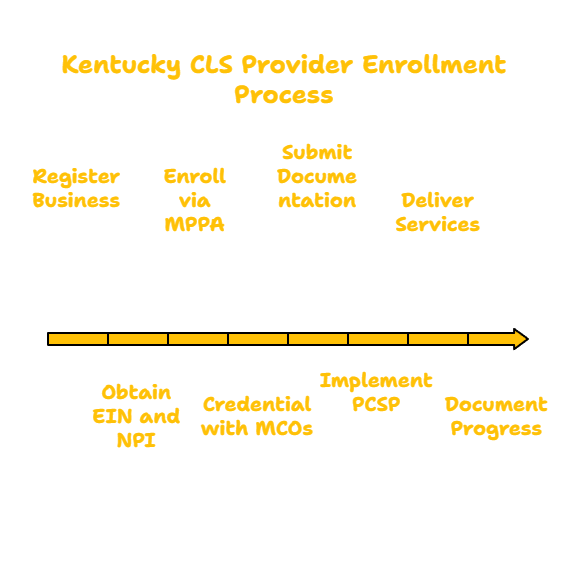
Launching a CLS agency requires a systematic approach to business registration and Medicaid enrollment. The process begins with the formalization of the entity, including registration with the Kentucky Secretary of State and obtaining an IRS EIN and Type 2 NPI. Once the legal structure is established, the agency must navigate the Medicaid Partner Portal Application (MPPA) to enroll as a legitimate provider under the appropriate HCBS waivers.
Following registration, providers must engage in credentialing with all Managed Care Organizations (MCOs) operating in their intended service regions. This step is critical, as MCOs are responsible for authorizing the specific services that providers will eventually bill for. During this phase, agencies must also prepare to demonstrate operational readiness by submitting comprehensive policy and procedure manuals, incident reporting protocols, and evidence of professional liability and workers’ compensation insurance.
What Are the Core Responsibilities and Staffing Standards for CLS?
The success of a CLS program hinges on the quality of its staff, specifically the Direct Support Professionals (DSPs) who engage daily with participants. Providers are responsible for ensuring that all staff meet stringent background check requirements and hold current certifications in CPR and First Aid. Beyond these baseline requirements, staff must undergo specialized training in person-centered delivery, abuse and neglect prevention, and emergency response protocols.
The daily activities performed by CLS staff are diverse and must be explicitly tied to the participant's goals. Whether assisting with Activities of Daily Living (ADLs) like personal hygiene and mobility or supporting Instrumental ADLs (IADLs) such as budgeting and grocery shopping, the service must be intentional. Documentation is the backbone of this service; every hour of support must be recorded in detail, demonstrating that the service provided directly aligns with the objectives set forth in the participant’s PCSP.
What Documentation Is Required to Maintain Compliance?
Administrative compliance is a continuous process that requires a robust record-keeping system. Providers must maintain organized files for every participant, including current versions of their PCSP and detailed daily progress notes that substantiate every billing claim. Audit readiness is achieved only when an agency can produce documentation that links specific service hours to the achievement of identified goals, while simultaneously upholding the highest standards of HIPAA compliance.
- Administrative Records: Articles of Incorporation, NPI/EIN registrations, and current insurance policies.
- Operational Manuals: Comprehensive Community Living Support Policy & Procedure Manual covering intake, grievances, and safety.
- Participant Files: Signed PCSPs, incident reports, goal tracking checklists, and service initiation forms.
- Staffing Files: Training certifications, HIPAA confidentiality agreements, and ongoing supervision logs.
Frequently Asked Questions
Which Kentucky Medicaid waivers allow for Community Living Support services?
CLS services are authorized under the Supports for Community Living (SCL) waiver, the Michelle P. Waiver (MPW), and both the Acquired Brain Injury (ABI) and ABI-LTC waivers. Providers must ensure their enrollment covers the specific waiver program for which they intend to provide services.
What is the typical timeline for becoming a Kentucky CLS provider?
The launch process generally takes between four to six months. This includes 1–2 months for business setup, 60–90 days for Medicaid and MCO enrollment, and 1–2 months for staff hiring and training. Timelines may vary depending on the speed of credentialing responses from the MCOs.
Can CLS services be provided in group homes or institutional settings?
No. CLS services are intended for non-institutional settings, such as a participant's home or community-based locations like parks and libraries. They are not authorized for use in settings where 24/7 institutional supervision is already provided to the participant.
Key Takeaway for New Providers
Establishing a successful Community Living Support agency in Kentucky requires a rigorous focus on regulatory compliance, meticulous documentation, and a deep understanding of the person-centered mission inherent in the state’s HCBS waivers. By aligning operational processes with the requirements set by the DMS, DBHDID, and regional MCOs, providers can build a sustainable organization that successfully supports the independence and well-being of the disability community.
Last verified: October 2023. This content is for informational purposes only and does not constitute legal or professional advice. Always consult the official Kentucky Medicaid Provider Manual and relevant state regulations for the most current guidance on program participation and compliance requirements.