COMMUNITY LIVING SUPPORT (CLS) SERVICES PROVIDER IN MICHIGAN
By Fatumata Kaba · 2025-07-27 · 5 min read
Understanding Community Living Support (CLS) Services in Michigan
Community Living Support (CLS) services in Michigan serve as a vital lifeline for individuals with disabilities and chronic conditions, facilitating independence and meaningful community integration. These services are primarily funded through Michigan Medicaid via various Home and Community-Based Services (HCBS) waivers and the MI Choice Waiver Program, ensuring that participants receive personalized assistance tailored to their unique needs and goals.
For service providers and agency founders, understanding the regulatory landscape is the first step toward delivering high-quality care. By aligning business operations with the guidelines established by the Michigan Department of Health and Human Services (MDHHS) and federal mandates from the Centers for Medicare & Medicaid Services (CMS), providers can build sustainable, compliant, and impactful programs that empower participants to live, work, and thrive in their own homes and local environments.
What Regulatory Agencies Govern CLS Services?
The Michigan CLS ecosystem is governed by a multi-layered regulatory framework designed to ensure participant safety and the integrity of Medicaid funding. The Michigan Department of Health and Human Services (MDHHS) acts as the primary state authority, overseeing the administration of Medicaid-funded services and ensuring that all programs remain in strict compliance with federal HCBS waiver requirements. At the federal level, the Centers for Medicare & Medicaid Services (CMS) provides the foundational funding and regulatory oversight through 1915(c) waivers, which permit states to provide services to individuals in their homes rather than in institutional settings.
On a local and operational level, Community Mental Health (CMH) Authorities play a critical role in the coordination and authorization of services. They act as the primary point of contact for individuals seeking support, managing the referral process and ensuring that service delivery aligns with the participant's Individual Service Plan (ISP). Simultaneously, the Michigan Department of Licensing and Regulatory Affairs (LARA) maintains oversight of the providers themselves, issuing necessary licenses for community-based operations and enforcing essential safety and quality standards across the state.
How Are CLS Services Structured and Delivered?
Community Living Supports are fundamentally person-centered, meaning they are built entirely around the specific goals and preferences identified in an individual’s Person-Centered Plan (PCP). These services go beyond basic care, focusing on skill acquisition and community engagement. Whether assisting with a simple daily task or coaching an individual on how to navigate public transportation, the objective is to promote self-sufficiency and foster a higher quality of life.
Core service components typically include:
- Personal Assistance with Activities of Daily Living (ADLs): Support with bathing, grooming, dressing, hygiene, mobility, transfer support, and medication reminders.
- Instrumental Activities of Daily Living (IADLs): Assistance with meal planning and preparation, household chores, laundry, financial management, and transportation to appointments.
- Community Integration: Facilitating participation in community events, social skills development, and navigating public spaces.
- Skill Development: Coaching on personal safety, self-advocacy, healthy lifestyle routines, and foundational employment readiness.
What Steps Are Required for Provider Enrollment?
Launching a CLS agency requires a systematic approach to business registration and credentialing. Before seeking Medicaid authorization, founders must first establish their business entity and register with the Michigan Department of Licensing and Regulatory Affairs (LARA). Following business formation, the agency must secure a Federal Employer Identification Number (EIN) and a Type 2 National Provider Identifier (NPI), which are essential for all Medicaid billing activities.
Once the business is legally established, the provider must navigate the formal enrollment process. This involves applying through the Community Health Automated Medicaid Processing System (CHAMPS). Successful enrollment in CHAMPS is followed by the critical step of contracting with local Community Mental Health (CMH) authorities. Since CMH agencies oversee the distribution of authorizations and referrals, establishing strong professional relationships with these authorities is necessary to begin service delivery and ensure the agency is positioned to receive clients.
What Documentation and Staffing Standards Must Providers Meet?
Maintaining high-quality, audit-ready documentation is a non-negotiable aspect of operating a CLS program. Providers must develop a comprehensive Policy & Procedure Manual that encompasses every facet of agency operations. This manual must contain standardized client intake and assessment templates, daily activity logs, shift documentation forms, clear protocols for medication administration, and robust emergency and incident response procedures. Furthermore, agencies must document participant rights, consent forms, and thorough training logs for all staff members.
Staffing requirements are equally rigorous, as Direct Support Professionals (DSPs) are the primary face of the agency. Every DSP must hold a high school diploma or equivalent, possess relevant experience in disability support, maintain current CPR/First Aid certifications, and pass all required background checks. Program supervisors and care coordinators must demonstrate advanced competency in service coordination and care quality monitoring. Regardless of the role, all staff must complete mandatory training on topics including person-centered planning, HIPAA compliance, abuse and neglect prevention, and cultural competence.
Frequently Asked Questions
How long does the provider enrollment process take?
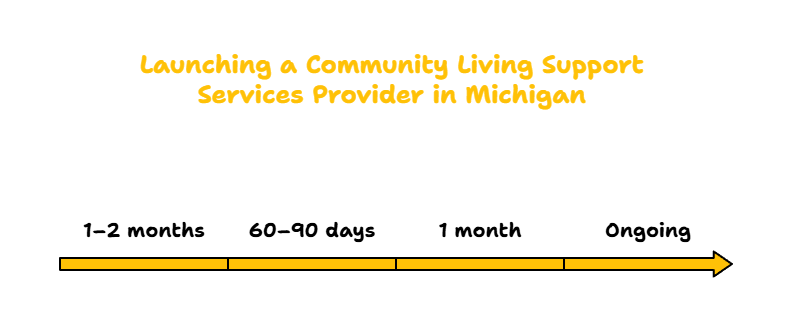
The timeline varies based on operational readiness, but generally, business registration and staffing take 1–2 months, followed by 60–90 days for Medicaid enrollment and manual development. Credentialing and licensing can add approximately another month before service delivery commences.
Which Medicaid programs utilize CLS services?
CLS services are utilized across several programs, including the MI Choice Waiver, Habilitation Supports Waiver (HSW), Children’s Waiver Program (CWP), Serious Emotional Disturbance (SED) Waiver, and various programs administered directly through local Community Mental Health (CMH) offices.
Is a facility license required to provide CLS services?
Licensing requirements depend on the nature of the program. While many CLS services are delivered in the individual's home, if the provider operates a facility-based program, specific licensure through LARA is required to ensure compliance with state safety standards.
Key Takeaway
Establishing a successful Community Living Support provider agency in Michigan requires a disciplined commitment to regulatory compliance, robust administrative documentation, and the recruitment of skilled staff. By mastering the integration between LARA licensing, CHAMPS enrollment, and local CMH coordination, agencies can build a reliable foundation for delivering essential, person-centered support to individuals with disabilities throughout the state.
Waiver Consulting Group’s Start-Up Assistance Service provides end-to-end support for agencies navigating this process, including business registration, policy manual development, staff training systems, and Medicaid billing guidance. Last verified: 2024-05-20. Disclaimer: This document is for informational purposes and does not constitute legal or financial advice; please consult with the Michigan Department of Health and Human Services (MDHHS) for the most current regulatory requirements.