COMMUNITY INTEGRATION SERVICES PROVIDER IN WYOMING
By Fatumata Kaba · 2026-04-14 · 5 min read
Community Integration Services in Wyoming are specialized Medicaid Home and Community-Based Services (HCBS) designed to empower individuals with disabilities to build meaningful relationships, increase their independence, and engage fully in public life. These services serve as a bridge between the home environment and the broader community, facilitating participation in educational, recreational, and cultural activities while ensuring that each participant’s unique needs are met through person-centered care.
As a provider, operating within this space requires strict adherence to the standards set forth by the Wyoming Department of Health’s Developmental Disabilities Division (DDD). By aligning service delivery with the Individualized Plan of Care (IPC), providers play a vital role in supporting the inclusion of individuals with intellectual and developmental disabilities (I/DD) across the state.
How Do Governing Agencies Oversee Community Integration in Wyoming?
The regulatory landscape for HCBS in Wyoming is structured to ensure participant safety and the quality of services. Three primary entities interact to maintain the integrity of the system. The Wyoming Department of Health – Developmental Disabilities Division (DDD) acts as the primary oversight body, responsible for setting program standards, certifying providers, and monitoring ongoing compliance with waiver requirements.
Parallel to the DDD, the Division of Healthcare Financing, which manages Medicaid Provider Services, focuses on the fiscal and administrative aspects of the program. This agency oversees the technical side of provider enrollment, electronic billing systems, and the reimbursement processes that sustain service delivery. Additionally, Case Management Agencies serve as the direct link for participants, tasked with coordinating specific goals, drafting the IPC, and authorizing the community integration supports that a provider will eventually deliver.
What Are the Core Components of Community Integration Programming?
Community integration is defined by its focus on active participation rather than mere presence. Providers must ensure that activities are goal-directed and align with the participant’s abilities and personal interests. The goal is to move beyond repetitive or isolating routines and instead offer exposure to the typical activities enjoyed by others in the local community.
When developing programming, providers should focus on activities that facilitate social skill development and functional independence. Common examples of approved community integration activities include:
- Attending community events, art shows, or festivals
- Volunteering at local nonprofits or places of worship
- Visiting museums, libraries, or cultural centers
- Participating in fitness or wellness classes
- Attending continuing education or community college courses
- Developing social skills in public settings, such as ordering food or navigating public transit
- Building routines to access community resources independently
What Are the Legal and Operational Prerequisites for Providers?
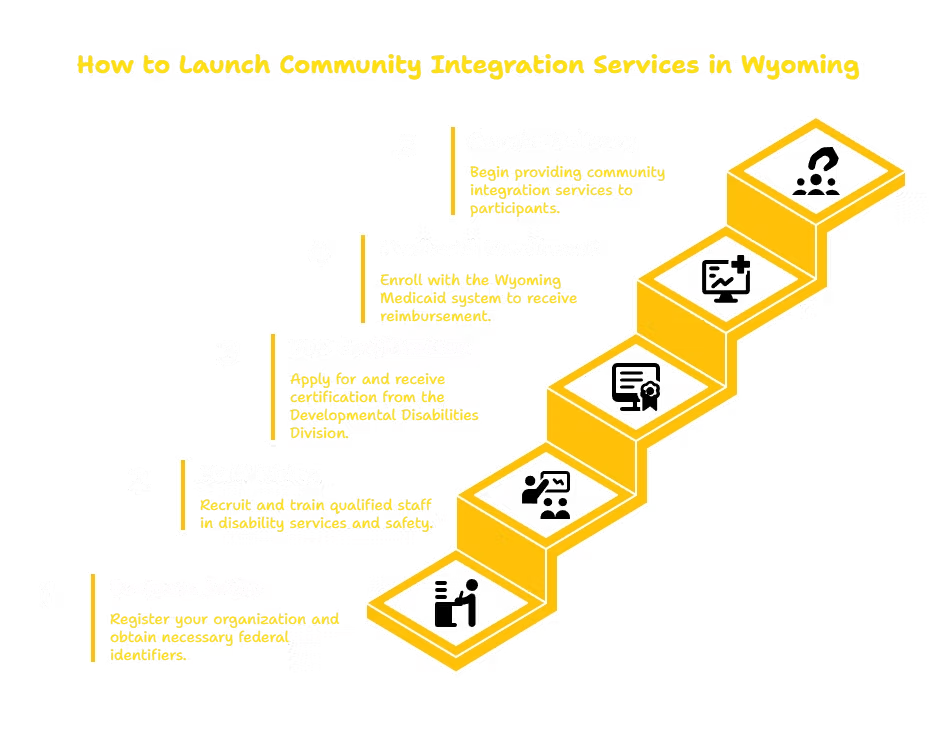
Launching a service provider organization in Wyoming requires a structured approach to business formation and regulatory alignment. Organizations must first establish their legal footing by registering with the Wyoming Secretary of State. Following business formation, the provider must secure a Federal EIN and a Type 2 NPI to interact with federal and state healthcare systems.
Before service delivery can commence, the provider must obtain certification from the DDD specifically for community integration services. This process involves the creation of a comprehensive Policy & Procedure (P&P) Manual. While licensure as a health facility is not required for this specific service category, providers must maintain rigorous documentation, including liability insurance coverage and clear evidence that all staff have undergone state-mandated background checks.
What Is the Required Enrollment Process for New Providers?
The path to becoming an active Medicaid provider in Wyoming follows a logical, sequential workflow. First, the provider must ensure all business credentials are finalized. Second, the provider must submit the official DDD provider application for community services. During this period, the development of the P&P manual is critical, as it must detail safety, supervision, and activity protocols that satisfy state oversight requirements.
Once the DDD has reviewed and accepted the organizational protocols, the provider must enroll with Wyoming Medicaid through the designated Provider Portal. After successful enrollment and completion of any necessary state orientation or training sessions, the provider may begin offering services once a participant's IPC has been formally authorized. Adhering to this timeline is essential, as services cannot be billed until all regulatory checkpoints are satisfied.
What Documentation and Staffing Standards Must Be Maintained?
Maintaining compliance requires a robust documentation system. Providers are expected to produce and maintain accurate records including Medicaid enrollment documentation, DDD certification files, and a thorough P&P manual. This manual must explicitly cover risk management, incident response, HIPAA compliance, and participant rights. Furthermore, providers must maintain detailed monthly progress reports and IPC goal-tracking forms to justify the necessity and impact of the services provided.
Staffing requirements emphasize the necessity of hiring capable Direct Support Professionals (DSPs). All personnel must meet minimum requirements, including being at least 18 years old and holding a high school diploma or GED. Additional requirements include:
- Valid driver’s license for those performing transportation duties
- Successful completion of background checks and abuse registry clearance
- Mandatory certification in CPR/First Aid
- Required training in HIPAA, confidentiality, person-centered support, and emergency preparedness
Frequently Asked Questions
Does the Medicaid waiver cover transportation to community activities?
Yes, community integration services often include assistance with navigating transportation systems to foster independence. However, providers must have specific transportation protocols and permission documentation in place to ensure participant safety during transit.
Can community integration services be provided alongside day habilitation?
Activities provided under community integration must not be duplicative of other services. Each activity must have a unique, goal-directed purpose linked to the participant's IPC that is distinct from the scope of day habilitation or other waiver services.
How does the Comprehensive Waiver differ from the Supports Waiver regarding these services?
Both waivers include community integration supports, but the scope and scale of services are tailored to the individual. The Comprehensive Waiver is typically utilized for individuals with high support needs, while the Supports Waiver offers community integration services within specific budget limits based on individual goals.
Successful entry into the Wyoming HCBS market requires a disciplined focus on regulatory compliance and person-centered service design. Providers must balance the administrative requirements of DDD certification and Medicaid enrollment with the practical necessity of providing high-quality, inclusive community experiences. By maintaining rigorous documentation and adhering to defined safety and supervision standards, providers ensure they can effectively meet the needs of individuals while remaining fully compliant with state waiver requirements.
Last verified: 2024. The information provided in this article is for educational purposes only and does not constitute legal or professional advice. Always consult with the Wyoming Department of Health – Developmental Disabilities Division or official state documentation for the most current regulatory guidance and requirements.