COMMUNITY INTEGRATION SERVICES PROVIDER IN WEST VIRGINIA
By Fatumata Kaba · 2026-04-14 · 5 min read
EMPOWERING INDIVIDUALS TO ACCESS, PARTICIPATE IN, AND CONTRIBUTE TO COMMUNITY LIFE THROUGH PERSONALIZED SUPPORTS AND SOCIAL ENGAGEMENT
Community Integration Services in West Virginia are specialized, non-clinical supports designed to assist individuals with disabilities, mental health challenges, or functional impairments in becoming active participants in their local communities. By focusing on skill-building, social inclusion, and the reduction of isolation, these services ensure that participants can access public resources, engage in personal interests, and build meaningful relationships, all while operating under the guidance of a Person-Centered Service Plan (PCSP) or Individualized Service Plan (ISP).
What Are the Roles of Governing Agencies and Oversight Bodies?
The regulatory framework for West Virginia Medicaid HCBS programs is multifaceted, ensuring that service delivery remains compliant with both federal and state mandates. The West Virginia Department of Health and Human Resources (WVDHHR) maintains primary responsibility for oversight regarding service implementation and the ongoing determination of participant eligibility. This administrative structure ensures that the safety and well-being of participants are prioritized across all community-based settings.
The Bureau for Medical Services (BMS) serves as the state’s Medicaid authority, managing the fiscal administration of programs, defining the scope of service delivery, and overseeing the provider enrollment process. Furthermore, Acentra Health (formerly Kepro) acts as the utilization management partner, responsible for reviewing and approving Community Integration services to ensure they align with the assessed needs and specific goals identified in the participant’s ISP. Together, these entities provide the framework for a structured and accountable delivery system.
What Activities Define Community Integration Services?
Community Integration Services are intended to bridge the gap between institutional or residential care and active life in the community. These services are distinctly non-clinical and must be performed in settings that promote inclusion with individuals without disabilities. The primary goal is to foster independence through real-world experience, ensuring that participants can navigate their surroundings safely and with confidence.
Authorized service activities often involve, but are not limited to, the following supports:
- Navigating public transportation systems, libraries, and public recreational spaces.
- Facilitating attendance at educational classes, support groups, or religious services.
- Assisting with volunteering or exploring pre-vocational discovery activities.
- Engaging in community-based health, wellness, and arts programs.
- Providing peer socialization opportunities and interpersonal skill-building exercises.
- Promoting safety awareness and decision-making skills in public settings.
- Supporting cultural participation, civic engagement, and community event attendance.
How Do Agencies Establish Eligibility as a Medicaid Provider?
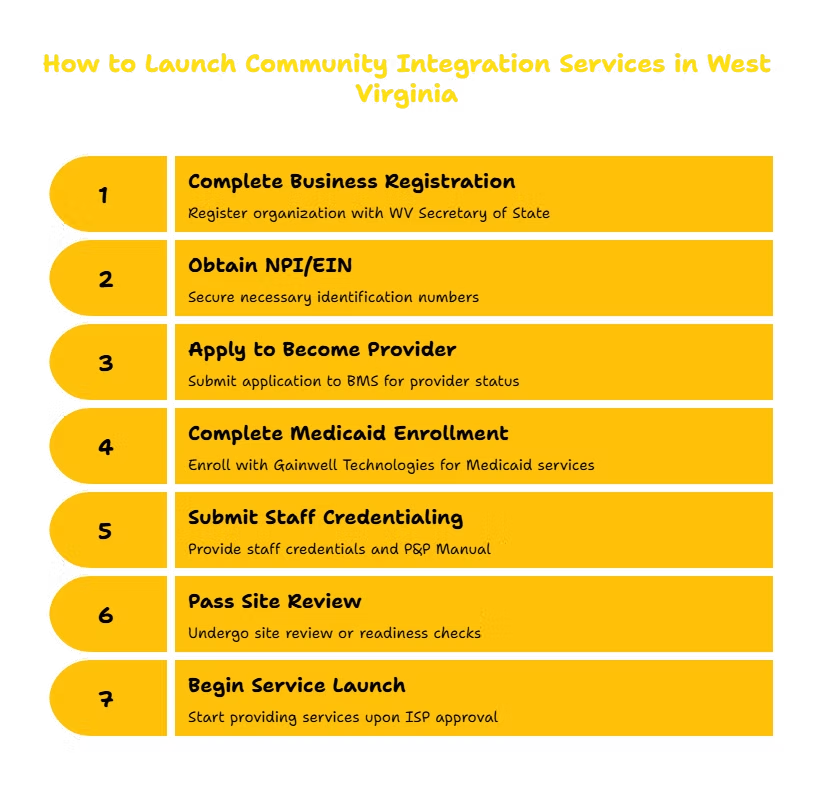
Becoming an approved Medicaid provider in West Virginia requires a methodical approach to business registration and regulatory compliance. Organizations must first establish their legal identity by registering with the West Virginia Secretary of State, followed by securing a federal Employer Identification Number (EIN) and a Type 2 National Provider Identifier (NPI). These credentials serve as the foundation for all subsequent applications and contractual agreements with the state.
Once initial business credentials are established, the organization must formally apply to the Bureau for Medical Services (BMS) to provide Community Integration services. Following this, the provider must complete the enrollment process through Gainwell Technologies, the state's Medicaid management information system. Finally, providers must develop comprehensive Policy & Procedure (P&P) manuals and hire qualified staff before passing any required site reviews or readiness checks conducted by state authorities.
What Are the Essential Documentation and Operational Requirements?
Operational success relies heavily on the quality and comprehensiveness of the agency’s internal documentation. A robust Policy & Procedure Manual is not merely a requirement for approval; it is a vital tool for ensuring consistency in service delivery. This manual must detail service goals, supervision structures, and strict progress-tracking protocols to ensure that every interaction is documented in alignment with the participant’s ISP goals.
Key documentation components must include:
- Daily activity logs that verify service delivery and location of care.
- Community safety protocols and risk management strategies for off-site activities.
- Signed consent forms for all community-based outings and transportation arrangements.
- Formalized incident reporting systems that meet state-mandated timelines.
- Staff training and credentialing records, including verification of certifications.
- HIPAA compliance policies and formal participant rights declarations.
- Billing documentation procedures that link service delivery to specific ISP goals.
What Are the Staffing and Training Expectations?
The quality of Community Integration services is directly tied to the competency of Direct Support Professionals (DSPs). All personnel must undergo rigorous background checks through the WV CARES system to ensure the safety of the participants they support. Furthermore, mandatory certifications, such as CPR and First Aid, are required to ensure that staff can respond effectively to emergencies in community settings.
Staff members, including those in optional Community Integration Coordinator roles, must be trained in the following areas:
- Waiver-specific service documentation and accurate billing practices.
- Cultural competence and the principles of disability inclusion.
- Transportation safety and community risk management techniques.
- Abuse and neglect prevention, HIPAA regulations, and person-centered planning.
Frequently Asked Questions
Which Medicaid waivers currently authorize Community Integration Services?
Community Integration services are authorized under several key programs, including the Intellectual/Developmental Disabilities (I/DD) Waiver, the Traumatic Brain Injury Waiver (TBIW), and the Children with Serious Emotional Disorder Waiver (CSEDW). In limited circumstances, the Aged and Disabled Waiver (ADW) may also cover specific forms of community engagement.
What is the typical timeline for launching a new provider agency?
The process is divided into phases, starting with a 2–3 week period for business registration and initial planning. Medicaid enrollment and waiver applications typically span 4–6 weeks, while manual development and readiness reviews require 30–45 days. Service launch occurs only after the final authorization of participant ISP matching.
Can services be delivered within the participant’s home?
No, Community Integration services must occur outside of the home or residential facility. The primary intent is to facilitate community-based interaction and access, which requires the service to take place in inclusive, non-residential settings.
WAIVER CONSULTING GROUP’S START-UP ASSISTANCE SERVICE — WEST VIRGINIA COMMUNITY INTEGRATION PROVIDER
Waiver Consulting Group provides structured support for new and existing agencies aiming to launch compliant Community Integration programs. Our support includes assistance with Medicaid and waiver enrollment, development of P&P Manuals, creation of ISP-aligned documentation templates, staff onboarding resources, and audit preparation to ensure long-term operational success.
Key Takeaway: Establishing a successful Community Integration provider agency in West Virginia requires a strict adherence to the regulatory requirements set by the WVDHHR and BMS. By focusing on rigorous staff training, meticulous documentation of ISP-aligned goals, and a deep commitment to community inclusion, agencies can effectively support the independence and personal development of waiver participants.
Last verified: October 2023. Disclaimer: This article is for informational purposes only and does not constitute legal or professional medical advice. Always refer to the most recent West Virginia Bureau for Medical Services policy manuals and state regulations for current program requirements.