COMMUNITY INTEGRATION SERVICES PROVIDER IN VIRGINIA
By Fatumata Kaba · 2026-04-07 · 5 min read
What Does a Community Integration Services Provider Do in Virginia?
A Community Integration Services provider in Virginia acts as a vital bridge between individuals with intellectual or developmental disabilities (ID/DD) and the broader society. These organizations facilitate meaningful community participation, helping participants move beyond traditional day support models toward active, inclusive roles in volunteerism, recreation, and lifelong learning, ultimately fostering self-determination and social connection.
These services are grounded in the principles of person-centered planning, ensuring that every activity, outing, or skill-building session is directly tied to the individual’s goals as outlined in their Individual Support Plan (ISP). By facilitating authentic community presence—such as joining local clubs, utilizing public libraries, or engaging in civic activities—providers help participants build lasting relationships with non-paid members of the community, moving away from institutional or segregated settings.
How Are Community Integration Services Governed and Regulated?
The delivery of these services involves a multi-layered regulatory framework designed to ensure participant safety, quality of care, and compliance with Medicaid reimbursement standards. Oversight is primarily divided among three key state entities, each playing a distinct role in the operational lifecycle of a service provider.
The Virginia Department of Medical Assistance Services (DMAS) serves as the primary body for Medicaid administration, overseeing program eligibility and the financial integrity of reimbursements. Simultaneously, the Virginia Department of Behavioral Health and Developmental Services (DBHDS) manages the licensing of providers, ensuring that all agencies meet rigorous standards for community engagement and coaching. Finally, Community Services Boards (CSBs) act as the local point of contact, authorizing specific services through the ISP, monitoring ongoing progress, and ensuring that providers remain aligned with the specific needs of the individuals they serve.
- DMAS: Manages Medicaid reimbursement policies and provider enrollment eligibility.
- DBHDS: Licenses and regulates the delivery of community engagement and coaching services.
- CSBs: Authorizes individual service plans and monitors local service delivery progress.
What Are the Essential Requirements for Launching a Provider Agency?
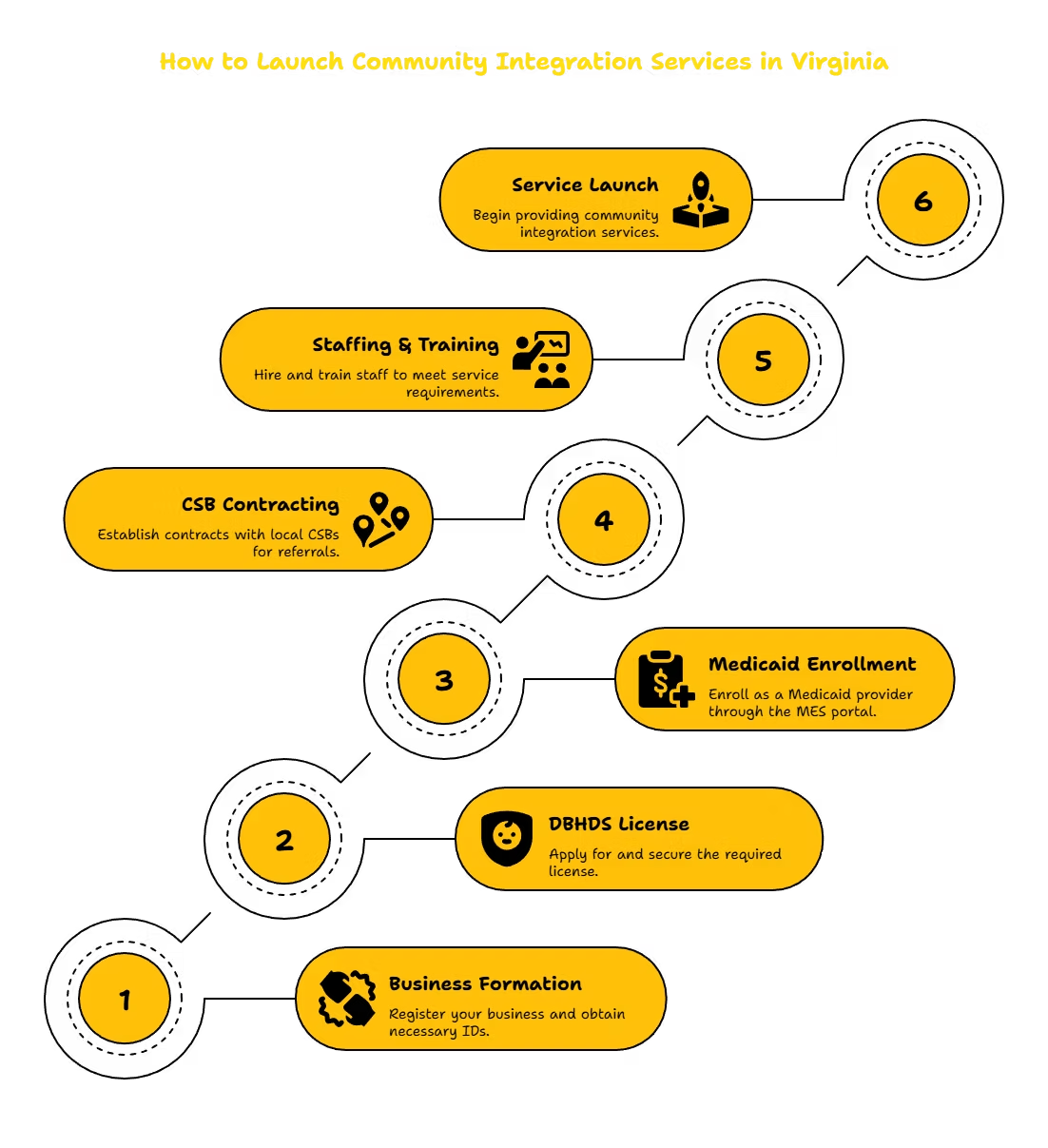
Becoming an approved provider requires a methodical approach to business formation, licensure, and Medicaid credentialing. Agency founders must first formalize their business structure through the Virginia State Corporation Commission (SCC) and establish the necessary federal identification, including an Employer Identification Number (EIN) and a Type 2 National Provider Identifier (NPI). These are the foundational building blocks required before applying for specialized state licensure.
Once the business is legally established, the agency must secure a DBHDS license for Community Engagement or Community Coaching. This process involves the development of a comprehensive Community Integration Services Policy & Procedure Manual, which must be submitted alongside proof of affiliation with the DBHDS Human Rights office. Maintaining compliance with human rights, HIPAA, and client protection regulations is a non-negotiable prerequisite for obtaining and retaining licensure.
How Do Providers Enroll in the Virginia Medicaid System?
After achieving licensure, the transition to becoming an active Medicaid provider occurs through the Medicaid Enterprise System (MES) portal. This process integrates the provider’s business profile with Virginia’s reimbursement infrastructure. Providers must demonstrate that they have developed the necessary operational tools, including staffing plans, documentation templates, and incident reporting procedures, to meet state oversight standards.
Following successful enrollment in the MES, the final step involves contracting with local Community Services Boards. Referrals for services are directed through the CSB, and providers cannot begin billing for services until the individual’s ISP has been officially authorized. This alignment ensures that every billable hour is directly linked to an authorized, person-centered goal, keeping the agency compliant with both state and federal audit requirements.
- Register business via SCC and obtain EIN/NPI.
- Apply for DBHDS licensure (Community Engagement or Community Coaching).
- Complete Human Rights affiliation and finalize operational policies.
- Enroll as a Medicaid provider through the MES portal.
- Contract with CSBs to receive service authorizations.
What Are the Staffing and Documentation Standards?
The quality of community integration is inherently tied to the competence of the direct support staff. A Community Engagement Specialist or Direct Support Professional (DSP) must hold a high school diploma or GED, pass background checks, and demonstrate proficiency in person-centered planning. Staff are also required to maintain certifications in CPR, First Aid, and behavior support, while completing mandatory DBHDS onboarding and annual training modules focused on human rights and emergency safety protocols.
Documentation is a critical component of service delivery. Providers must implement rigorous tracking systems that capture daily progress, community partnership development, and inclusion outcomes. These records must account for supervision, transportation safety, and incident reporting. By documenting how activities support the participant's ISP goals, agencies provide the evidence needed to justify continued Medicaid funding and ensure the safety and growth of the individuals in their care.
Frequently Asked Questions
What waivers cover Community Integration Services in Virginia?
Community Integration services are primarily covered under the Community Living (CL) Waiver and the Family and Individual Supports (FIS) Waiver. The Building Independence (BI) Waiver may also cover limited community-based activities depending on the specific needs identified in the individual’s plan.
What is the typical timeline to launch an agency?
The process generally takes 4–8 months total. Business formation and licensing preparation typically take 2–3 months, Medicaid enrollment and CSB contracting take 1–2 months, and hiring/training takes approximately 3–5 weeks. Actual service delivery begins only after receiving CSB authorization.
Can community integration occur in a group home?
Services must be person-centered and non-facility-based. While individuals living in group homes or supported apartments can access these services, the actual activities must occur in the community to promote true social inclusion and autonomy rather than institutional engagement.
Key Takeaway
Successfully operating a Community Integration Services agency in Virginia requires a dual focus on rigorous regulatory compliance—specifically regarding DBHDS licensing and DMAS Medicaid billing—and a deep commitment to person-centered outcomes. By aligning agency policies with state requirements and ensuring staff are well-trained in inclusive practices, providers can build sustainable, impactful organizations that effectively empower individuals with disabilities to thrive in their own communities.
Last verified: October 2023. Disclaimer: This article is for informational purposes only and does not constitute legal or professional consulting advice. Requirements for Medicaid providers may change; always refer to the official Virginia Department of Medical Assistance Services (DMAS) and Department of Behavioral Health and Developmental Services (DBHDS) websites for the most current regulations and policy manuals.