COMMUNITY INTEGRATION SERVICES PROVIDER IN VERMONT
By Fatumata Kaba · 2026-04-09 · 5 min read
Community Integration Services in Vermont are specialized Medicaid-funded supports designed to foster independence, inclusion, and meaningful social participation for individuals with disabilities or acquired conditions. By helping participants engage in their local neighborhoods based on personal interests and goals, these services effectively reduce isolation and build lasting natural support networks. Providers interested in delivering these services must navigate a regulatory landscape managed by the Department of Disabilities, Aging and Independent Living (DAIL) and coordinate through regional Designated Agencies (DAs) or Specialized Services Agencies (SSAs).
How Do Community Integration Services Function Within the Vermont HCBS Framework?
Community Integration Services operate on the core principle of person-centered care, moving away from facility-based settings toward authentic community involvement. The primary objective is to assist individuals in building confidence and skills while actively participating in the life of their community. Whether an individual aims to join a local civic group, volunteer, or access recreational facilities, the service is tailored to their specific needs and desires as outlined in their Individual Support Plan (ISP).
These services are strictly defined to ensure they promote true integration rather than segregation. By providing supported access to libraries, faith-based communities, and wellness activities, providers act as facilitators for relationship building. This structured support is essential for participants to navigate public transportation, engage in peer-to-peer social interaction, and develop the informal support networks necessary for a higher quality of life.
What Are the Governing Agencies and Regulatory Roles in Vermont?
The regulatory structure for Community Integration Services is a multi-tiered system designed to ensure safety, quality, and financial accountability. The Department of Disabilities, Aging and Independent Living (DAIL) serves as the primary authority, overseeing the authorization and regulation of these services under the state’s Home and Community-Based Services (HCBS) Waivers. Their role ensures that service delivery aligns with state standards for community-based care.
In addition to DAIL, the Department of Vermont Health Access (DVHA) is responsible for the financial and administrative aspects of the program, specifically managing Medicaid provider enrollment and reimbursement. Implementation is carried out at the local level by Designated Agencies (DAs) and Specialized Services Agencies (SSAs). These entities are the primary point of contact for providers, as they coordinate the development of ISPs, authorize individual service delivery, and conduct ongoing oversight regarding quality and compliance.
What Are the Essential Requirements for Provider Approval?
Prospective providers must complete a rigorous preparation process to ensure they can meet the operational demands of the HCBS waiver system. The foundational steps involve formal business registration with the Vermont Secretary of State, obtaining an Employer Identification Number (EIN), and securing a Type 2 National Provider Identifier (NPI). These are standard prerequisites for any organization intending to operate within the state’s medical and social service billing frameworks.
Beyond administrative setup, the provider must establish a robust organizational structure. This includes obtaining comprehensive general liability insurance and implementing standardized background screening protocols for all prospective employees. A critical component of the approval process is the creation of a formal Community Integration Services Policy & Procedure Manual. This document serves as the operational blueprint for how the organization will maintain safety, handle incidents, and provide person-centered training to staff.
What Does the Provider Enrollment Process Entail?
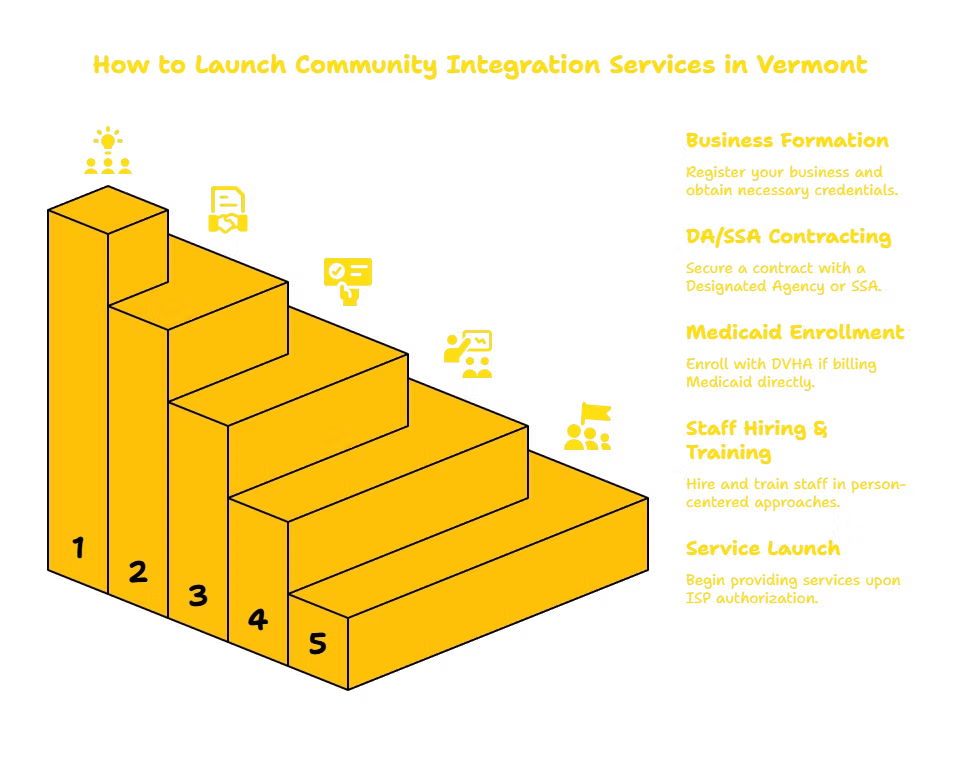
The path to becoming an approved provider involves a systematic progression from business formation to the delivery of authorized services. After establishing the legal entity and obtaining the necessary tax and identification numbers, the provider must seek a contract with a local Designated Agency (DA) or Specialized Service Agency (SSA). This partnership is vital, as these agencies act as the primary gatekeepers for service referrals in their respective regions.
- Register the business entity and obtain an EIN and NPI.
- Submit an application to serve as a contracted provider through the appropriate local DA or SSA.
- Complete the DVHA Medicaid enrollment process for direct billing capabilities.
- Submit required documentation, including staff credentials, training curricula, and the Policy & Procedure Manual.
- Satisfy all background check and orientation requirements for organizational staff.
- Begin service delivery only after formal participant referral and ISP authorization.
How Are Staffing and Documentation Standards Maintained?
Staffing requirements are centered on the quality of interaction between the Community Support Worker and the participant. A high school diploma or equivalent is the baseline, though previous experience supporting individuals with disabilities is highly preferred. To ensure participant safety and effective service delivery, all staff must undergo mandatory training in HIPAA compliance, client rights, incident reporting, and emergency response procedures. Annual skills refreshers are required to maintain consistency in care.
Documentation is equally critical for reimbursement and regulatory compliance. Providers must maintain meticulous records that align service delivery with the participant's ISP goals. This includes documenting activity risk assessments, supervision notes, and clear evidence of skill development. Because services must occur in inclusive, non-segregated settings, documentation must demonstrate that the activities were meaningful and truly representative of community integration, rather than mere supervision in a controlled environment.
Frequently Asked Questions
Which Medicaid waiver programs cover Community Integration Services?
Community Integration is a covered service under the Developmental Disabilities Services Waiver (DDSW) for core habilitative support, the Brain Injury Program for post-injury social rehabilitation, the Choices for Care (CFC) Waiver for older adults, and various Children’s High-Tech/Transition programs designed to foster independence.
What is the typical timeline for launching a provider agency?
The timeline varies based on organizational readiness, but generally, business formation and policy creation take 2–3 weeks, contracting with DAs/SSAs takes 1–2 months, staff hiring and training require 2–4 weeks, and service launch occurs upon the first participant referral and ISP authorization.
Are providers required to work directly with Designated Agencies?
Yes, Designated Agencies (DAs) and Specialized Services Agencies (SSAs) play a critical role in the Vermont system. They coordinate ISP development and provide the necessary authorization for service delivery, making them essential partners for any agency providing community-based services.
WAIVER CONSULTING GROUP’S START-UP ASSISTANCE SERVICE — VERMONT COMMUNITY INTEGRATION PROVIDER
WCG supports providers in creating person-driven Community Integration Services that meet waiver standards and promote lasting connections between individuals and their communities. Our scope of work includes DA/SSA and DVHA enrollment guidance, comprehensive Policy & Procedure Manual development, ISP-aligned goal tracking tools, and robust staff onboarding programs.
Key Takeaway: Successfully launching a Community Integration program in Vermont requires a strategic focus on aligning internal policies with DAIL and DVHA requirements while prioritizing the person-centered outcomes defined in the participant's Individual Support Plan. By mastering the regulatory documentation and focusing on high-quality staff training, providers can effectively bridge the gap between individuals and their local communities.
Last verified August 2024. The information provided is intended for educational purposes and does not constitute legal or financial advice. Regulations governing Vermont Medicaid programs are subject to change; providers should consult directly with the Department of Disabilities, Aging and Independent Living (DAIL) and the Department of Vermont Health Access (DVHA) for the most current policy updates.