COMMUNITY INTEGRATION SERVICES PROVIDER IN TEXAS
By Fatumata Kaba · 2026-03-30 · 5 min read
Supporting individuals with disabilities in building social connections, engaging in meaningful activities, and participating fully in their communities is the primary objective of Community Integration services in Texas. These person-centered supports, funded under Texas Medicaid 1915(c) Home and Community-Based Services (HCBS) waiver programs, are designed to increase independence, foster relationships, and facilitate access to authentic community life experiences for individuals with intellectual, developmental, or physical disabilities.
What Are the Governing Agencies and Regulatory Frameworks?
The delivery of community-based supports in Texas is governed by a dual regulatory structure involving both state and federal oversight. The Texas Health and Human Services Commission (HHSC) serves as the primary state agency responsible for managing waiver programs, authorizing service providers, and monitoring the quality and compliance of service delivery. They ensure that all programs remain consistent with the state’s long-term care objectives and fiscal responsibilities.
At the federal level, the Centers for Medicare & Medicaid Services (CMS) provides the overarching regulatory framework. CMS mandates that HCBS waiver services must prioritize inclusion, integration, and person-centered outcomes. Providers must align their operational policies with these federal expectations to ensure that participants receive services in the most integrated settings possible, effectively preventing isolation and promoting active participation in society.
How Do Community Integration Services Function in Practice?
Community Integration services provide participants with the opportunity to learn, practice, and apply vital life skills within real-world environments. By shifting the focus from facility-based settings to community settings, individuals can engage in activities ranging from volunteering and leisure pursuits to navigating public transportation or attending local cultural and spiritual events. The goal is to promote active citizenship and ensure the individual feels a sense of belonging in their local community.
To ensure effectiveness, these services must be explicitly tied to the individualized goals documented in the participant's Person-Directed Plan (PDP) or Individual Plan of Care (IPC). These services are designed to be distinct from other habilitation or day services and should not duplicate support already provided through other waiver components. Core activities often include the following:
- Social skill-building in both group and one-on-one settings.
- Facilitating attendance at public events, clubs, or spiritual gatherings.
- Encouraging participation in volunteerism, hobby groups, or recreational programs.
- Instruction on safety, etiquette, and social norms in public spaces like libraries, parks, and retail centers.
- Practical training on navigating transportation, ordering food, and managing personal finances.
- Fostering peer-to-peer interactions and developing natural community supports.
What Are the Licensing and Provider Approval Requirements?
Becoming an approved provider is a multi-step process that requires formal business registration and enrollment with the state’s healthcare administration partners. Before a provider can be authorized to deliver services, they must demonstrate legal standing as a business entity within Texas, typically through registration with the Texas Secretary of State. This includes obtaining an Employer Identification Number (EIN) and a Type 2 National Provider Identifier (NPI).
Once the business foundation is established, prospective providers must enroll as a Medicaid provider through the Texas Medicaid & Healthcare Partnership (TMHP). Beyond general business registration, providers must secure specific waiver contracts under HHSC for programs such as HCS, CLASS, TxHmL, or DBMD. Maintenance of professional insurance—including general liability and specific auto insurance for those providing transportation—is a strict requirement to protect both the agency and the individuals served.
What Steps Are Involved in the Texas Provider Enrollment Process?
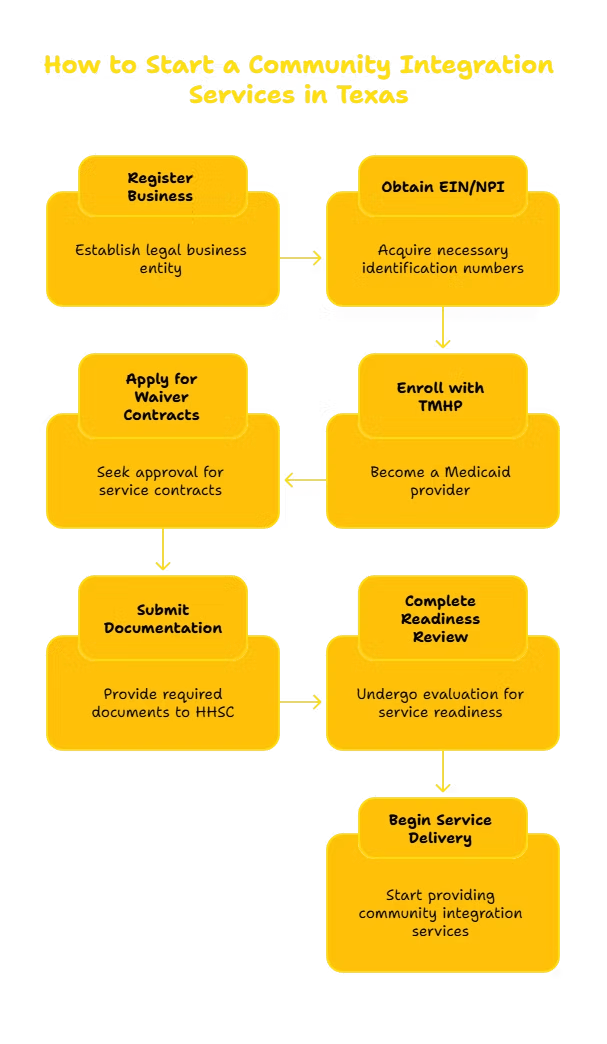
The path to becoming a qualified provider involves a sequential commitment to regulatory compliance and administrative preparation. Providers should approach this as a structured journey, starting with the formal creation of the business entity and ending with the successful receipt of service authorizations. Proper documentation at each stage is critical to avoiding delays in approval.
The enrollment process generally follows these essential steps:
- Establish the legal business entity and obtain all necessary tax and identification numbers (EIN/NPI).
- Complete the enrollment application with TMHP to become an authorized Medicaid waiver provider.
- Submit specific applications for waiver service contracts to the HHSC.
- Develop comprehensive service descriptions, staff training curricula, and rigorous documentation tools that reflect the provider's operational capacity.
- Complete the mandatory readiness review, during which HHSC verifies that the provider is fully prepared to deliver services in accordance with the participant's authorized plans.
How Do Staffing Requirements Impact Quality of Care?
The quality of Community Integration services is heavily dependent on the competence and training of the Direct Support Professionals (DSPs) and supervisors involved. Organizations are required to hire personnel who possess at least a high school diploma or its equivalent, along with demonstrated experience in supporting individuals with disabilities. Beyond baseline experience, staff must hold current certifications in CPR and First Aid and undergo thorough background checks prior to hire.
Once hired, staff members must undergo an intensive onboarding process that focuses on the specific requirements of the HHSC waiver programs. This training is essential for maintaining a high standard of care and ensuring that every interaction is conducted safely and ethically. Required training topics include:
- HHSC waiver-specific program requirements and compliance protocols.
- Accurate documentation procedures and the use of service notes for billing.
- Abuse and neglect prevention strategies combined with person-centered engagement techniques.
- Emergency preparedness, community safety, and incident reporting procedures.
- HIPAA compliance and the protection of participant rights.
Frequently Asked Questions
What documentation is required to maintain a compliant program?
Providers must maintain comprehensive records, including articles of incorporation, TMHP/HHSC contract approvals, and insurance certificates. A robust Policy and Procedure Manual is required, covering person-centered planning, activity mapping, safety and transportation protocols, and detailed participant support documentation.
Which Medicaid waiver programs include Community Integration?
Community Integration is a reimbursable service under several major Texas waiver programs, including Home and Community-Based Services (HCS), Community Living Assistance & Support Services (CLASS), Texas Home Living (TxHmL), and Deaf Blind with Multiple Disabilities (DBMD). It is also utilized within the YES Waiver for children with serious emotional disturbances.
What is the typical timeline for launching a provider agency?
The startup process is typically divided into three phases: Business Formation (1–2 months), TMHP/HHSC Enrollment (2–3 months), and Staff Onboarding (30–60 days). Services may commence immediately upon HHSC approval and the receipt of individual participant authorizations.
Key Takeaway
Success as a Community Integration service provider in Texas requires a rigorous commitment to person-centered planning, stringent regulatory adherence, and the development of highly trained staff. By carefully navigating the TMHP and HHSC enrollment pathways and maintaining comprehensive documentation, providers can effectively support individuals in achieving meaningful community participation and long-term independence. For those seeking professional guidance, consulting support is available to assist with the complex task of waiver program enrollment and the development of essential policy documentation.
Last verified: 2024. The information provided in this article is for educational purposes only and does not constitute legal or professional advice. Always consult with the Texas Health and Human Services Commission (HHSC) or qualified legal counsel to ensure your agency meets current state and federal regulations.